Type "browser racing game" into a search bar and you can still smell the Flash era: three looping tracks, a car that steers like a shopping cart, and a BUY FULL VERSION button where the handbrake should be. That reputation is a decade stale. In 2026, the browser runs full 3D engines at speed on a mid-range phone, keeps a physics simulation stable enough to settle leaderboard disputes, and syncs eight players across the planet with nobody installing anything. The floor has risen. The standards should rise with it.
So here they are — five criteria we think any racing game in a browser has to meet now, followed by a scoring of our own game against them. We built Mars Rally Championship, so we don't get to grade on a curve.
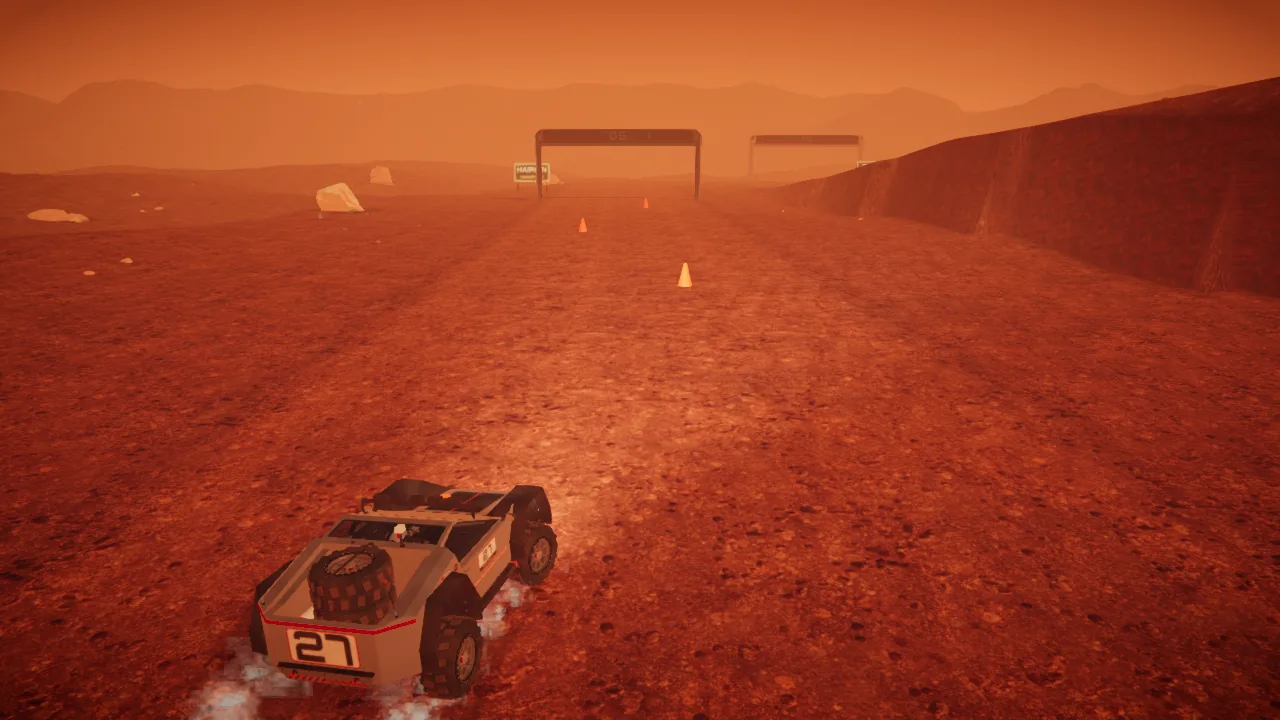
In-game screenshot: the Proving Ground slalom, where the rover’s weight rolls from side to side on loose ground between the pylons.
Standard one: it loads before you stop caring
The whole argument for the browser is immediacy. If a game demands a launcher, an account, or a two-gigabyte download, it's a PC game wearing a URL. The bar: click to first corner in under a minute, on hardware you already own, with the inputs you already have — keyboard, gamepad, or thumbs on glass. Installability is a bonus (a good PWA earns its home-screen icon). A signup wall is disqualifying. No one in history has wanted to verify an email address in order to drive.
Standard two: physics you can study
Browser games no longer get a pass on simulation quality. What separates a racing game from a car-shaped cursor is whether your hundredth run is faster because you got better: weight transfer you can provoke, surfaces that push back, braking points that reward memory. Underneath that sits a quieter requirement — determinism. If the simulation isn't reproducible (fixed timesteps, seeded terrain, no frame-rate-dependent math), ghost replays are approximations and leaderboard times are vibes. Honest ghost racing requires that the same inputs produce the same run every time, down to the bit.
Standard three: a reason to come back tomorrow
Any game can hold you for one session; day thirty is the test. Good progression hands you a fresh, fair problem daily — same seed for everyone, so times are actually comparable — plus quests that nudge you to drive differently and unlocks that mark time served. The line between progression and a slot machine is simple: does the loop make you a faster driver, or merely a more frequent visitor?
Standard four: other humans, minimum friction
Racing a clock is meditation; racing a human is a sport. The 2026 bar for browser multiplayer: a friend clicks one link and is on the start line. No accounts, no friend codes, no lobby archaeology. Extra credit for formats that keep the racing clean — rally, usefully, has never needed door handles.
Standard five: free has to mean free
"Free" with an energy meter, or a paywall at track four, is a demo with extra steps. The standard: every stage, every mode, every competitive feature at cost zero, with monetization — if any — never touching the stopwatch. Cosmetics earned by driving are fine. Milliseconds sold for money are not.
The scorecard
Here's how Mars Rally Championship measures up against its own rubric.
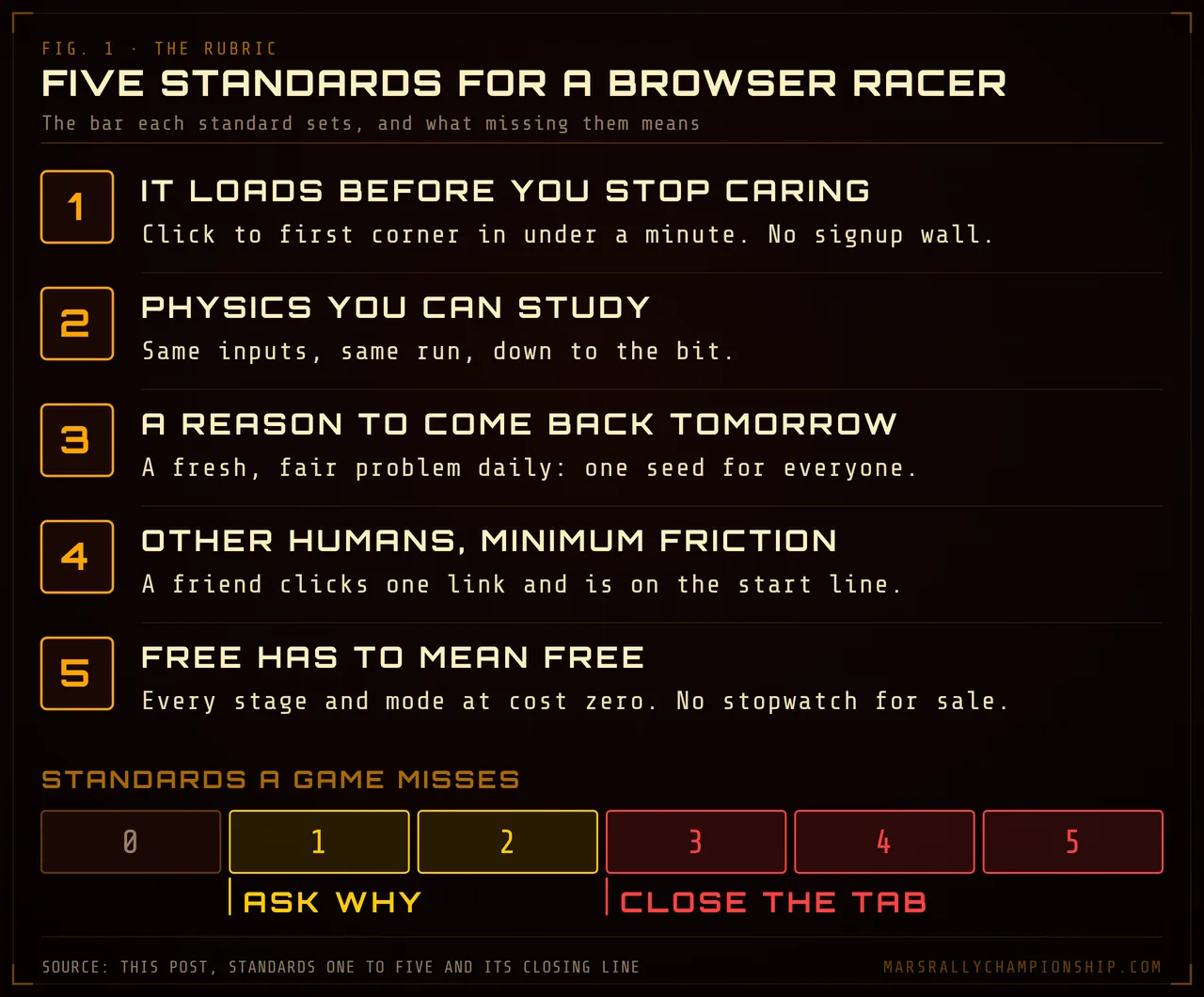
Diagram: the rubric this post applies to every browser racer, ours included: one miss is worth asking about, three are a reason to close the tab.
| Standard | How Mars Rally Championship delivers |
|---|---|
| Instant load | Free, no download, no signup. Runs in any modern WebGL browser with keyboard, gamepad, and mobile touch support; installable as a PWA. |
| Real physics | Per-wheel tire model on fixed substeps at Mars gravity (0.38 g) with seeded terrain — deterministic, so replays are bit-exact and split-delta timing is trustworthy. Battery, regen, and H/D/L gears give the electric rover real energy management; the storm variant runs a whole stage inside a full dust storm and drains the battery 50% faster. |
| Progression | Seeded daily challenge that resets at your local midnight, streaks, three daily quests, pilot XP, medals against par, 30 achievements, and a garage of 13 paints (Ion Trail glows), 5 rims, and 3 calipers funded by 500-credit supply crates with a pity timer. |
| Multiplayer | Up to 8 pilots per online room, ghost-style with no collisions. Private rooms share one invite link, a public lobby lists open races, and everyone launches off a synced countdown. |
| Free means free | No paywall, no account, ever. The global leaderboard takes a call sign, not an email. Crates are bought with credits earned by driving. |
Where we mark ourselves down
Honesty is a criterion too. The championship is the stages that are open, with more being charted, plus the Proving Ground tutorial and free roam — a proper rally calendar, not an encyclopedia. Every championship stage runs at sunset, which we maintain is the only correct time of day on Mars; variety purists get sunrise, midday and night skies (and both moons) from the daily challenge, which rolls a fresh sky every day. There is exactly one car: an electric rover whose chassis, motor, and battery all take damage, and which will punish you for casing a crest at 0.38 g. And multiplayer is ghost-style on purpose — no car-to-car contact, and a disconnect means DNF. If your idea of racing is trading paint into turn one, this isn't that. If it's eight clean runs and a finish order nobody can dispute, welcome.
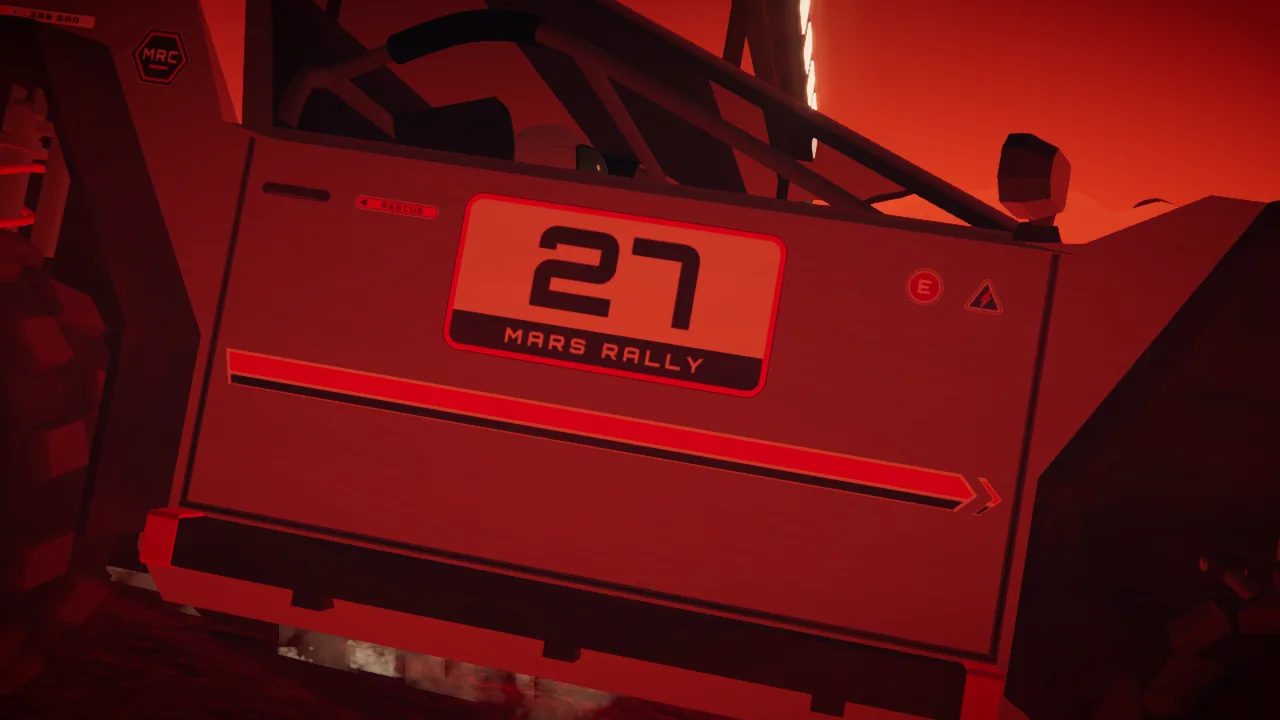
In-game screenshot: exactly one car, race number 27 on its doors, and no sponsor or agency marks anywhere on the livery.
A few things that didn't fit the rubric but matter anyway: a voice co-driver calling pace notes through the Web Speech API, and a results screen that pays out XP, credits and medals against derived par times.
Hold every game to this list
Including ours. The point of a standards piece isn't self-congratulation — it's that "browser racing game" should stop meaning "compromise." Instant load, physics worth studying, a daily reason to return, humans one link away, and free that means free. If a game misses one, ask why. If it misses three, close the tab. And if you want to see how the red planet handles the checklist, pick a call sign and bring your braking points.