Every new pilot's first run on the red planet ends the same way: a confident charge at a dune crest, a braking input timed for Earth, and then a long, silent, unsteerable flight while the racing line carries on somewhere below. Mars Rally Championship simulates a per-wheel tire model at Mars gravity — 0.38 g — and the physics does not care what your reflexes learned at 1 g. This is the recalibration guide.
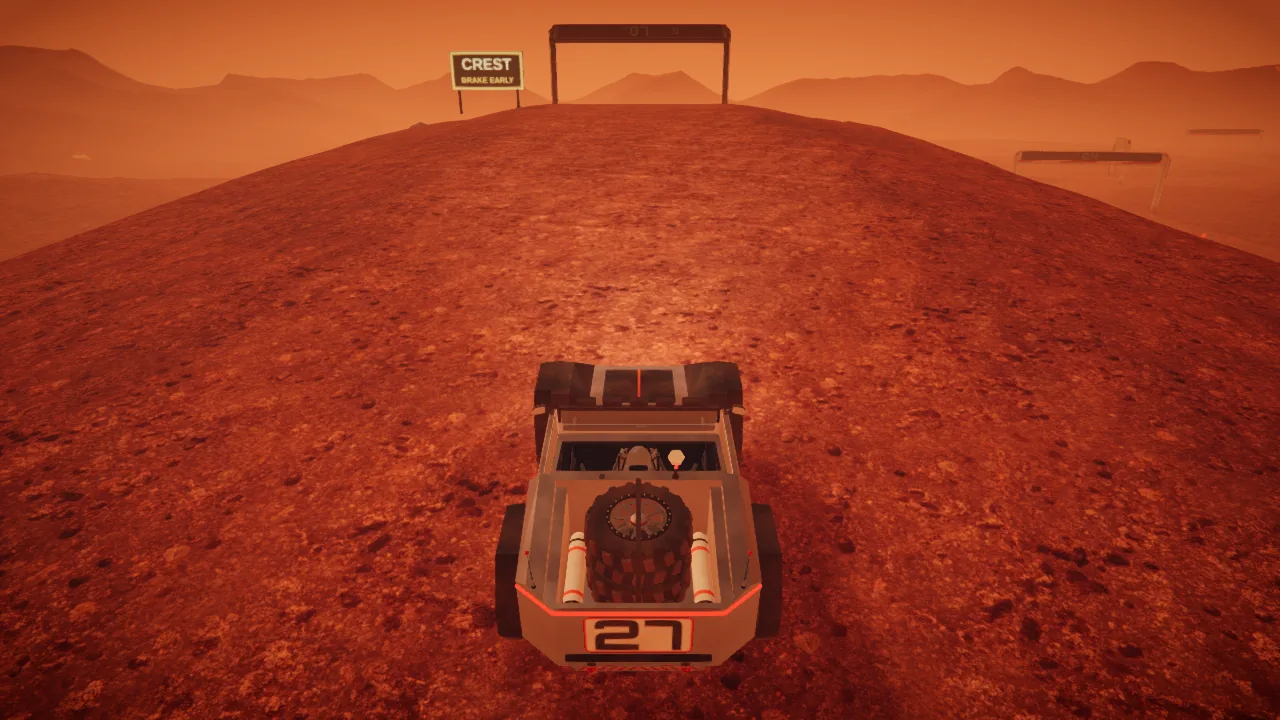
In-game screenshot: braking in a straight line before the Proving Ground's blind crest; once the nose goes light over the top, the brakes stop working.
Why 0.38 g rewrites the rulebook
Grip comes from load. On Mars, your rover presses into the regolith with roughly a third of the force it would on Earth, and every tire has correspondingly less to work with. A corner speed that would be routine on Earth is a four-wheel drift here. A crest that would be a polite hop becomes a genuine flight, and the surface itself is loose regolith — it moves under power, which is why every ambitious corner exit wants to become a slide.
The short version, as a conversion table:
| Earth instinct | Mars correction |
|---|---|
| Brake at the crest | Brake well before the crest |
| A jump is a brief hop | A jump is a flight — set it up at takeoff |
| Land and immediately steer | Land, settle on throttle, then steer |
| Muscle the car through hairpins | Let the rear swing — gravity barely resists |
| Flat-out everywhere | Watch the battery, lift-and-coast to regen |
Brake before the crest, always
Lower wheel loads mean longer braking distances — noticeably longer than they look. Do your braking in a straight line, on solid ground, before the terrain drops away. Once the nose goes light over a crest, the brakes do approximately nothing, and once you're airborne they do exactly nothing. Treat every crest as the hard end of a braking zone: your stopping power expires where the ground does.
The gearbox helps here. The rover runs H, D, and L; dropping out of high gear before a technical section gives you engine-side control instead of a panic stab at the brakes.
Airtime is a decision you make at takeoff
The moment the wheels leave the regolith, you are a projectile with a paint job. In 0.38 g that projectile phase lasts a long time, so everything about the flight — distance, angle, landing spot — is decided by your speed and attitude at the lip. Fast pilots don't fight the air; they choose less of it, skimming crests instead of launching off them. On a rhythm section of linked dune crests, matching your speed to the dune wavelength chains them together; overspeeding one crest ruins the next five.
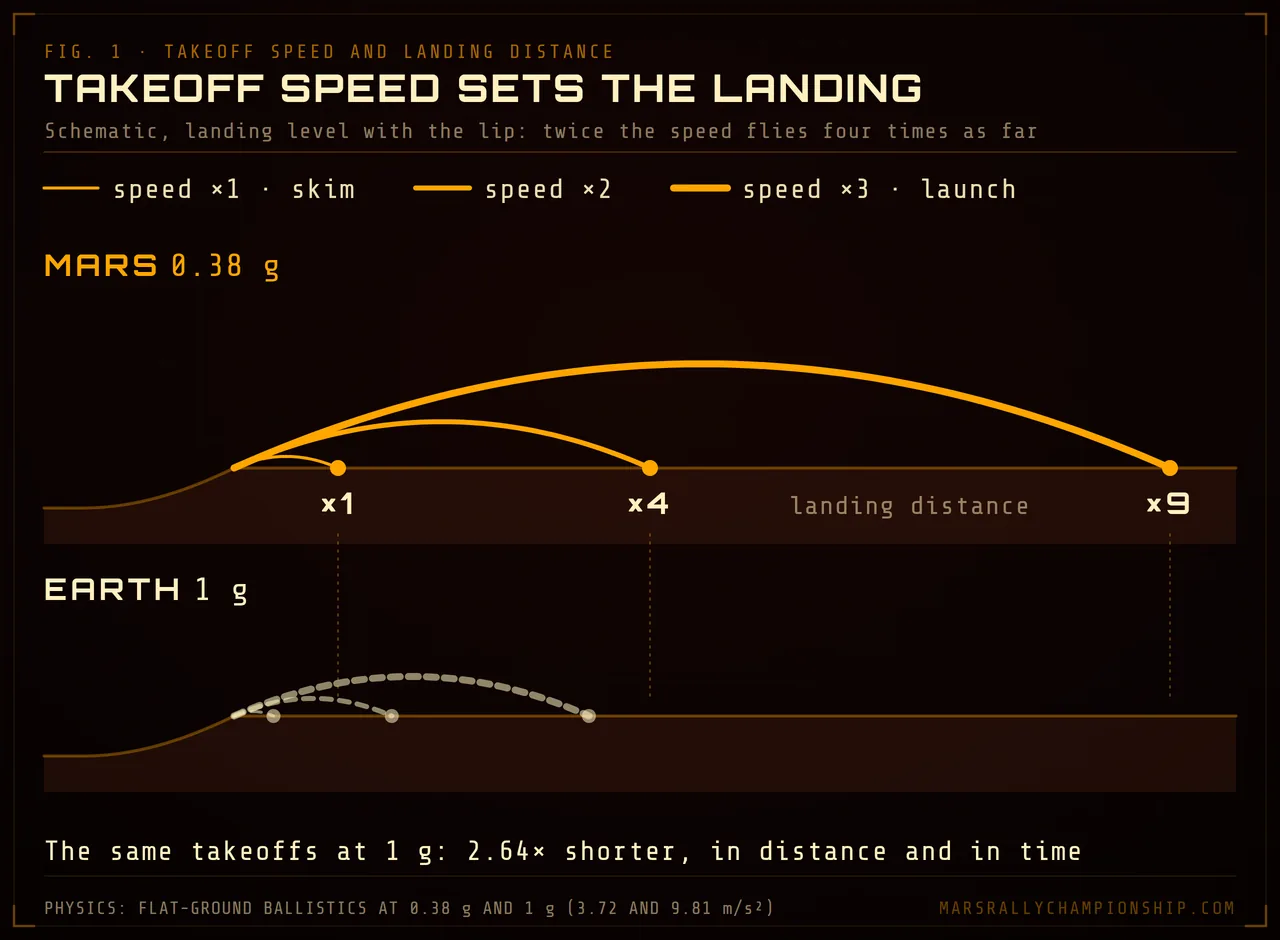
Diagram: landing distance grows with the square of takeoff speed, and at 0.38 g every flight runs 2.64 times as long as on Earth.
Then there's the landing throttle: feed in power just before touchdown. It settles the rear, straightens the car, and turns a nose-heavy crash-down into a rolling exit. Get it wrong often enough and the damage model will keep score for you — chassis, motor, and battery damage all follow you to the finish line.
The low-gravity hairpin
Hairpins are where Mars gets genuinely strange — and genuinely fast, once it clicks. With so little gravity holding the rear axle down, rotation is cheap: brake early and straight, turn in, and let the back of the car swing wide on its own. Your job is not to force the rotation but to time the catch — the instant the nose points at the exit, get on the power and let the regolith drift carry you out. Slow in, fast out, because every hairpin feeds a straight and exit speed compounds all the way down it. Any stage with linked switchbacks drills exactly this technique — run one on repeat until the exits stop costing you.
Drive the battery, not just the rover
The rover is electric, and the power/battery/regen readout on the HUD is not decoration. Sustained full throttle drains the pack faster than technical driving does, while lifting early into braking zones feeds charge back through regen. On short sprints you can ignore all of this. On the 2.3 km of Stage 2, The Long Run, battery management is the difference between attacking the final sector and limping through it. Lift-and-coast on the long straights, spend the saved charge where the stage is won.
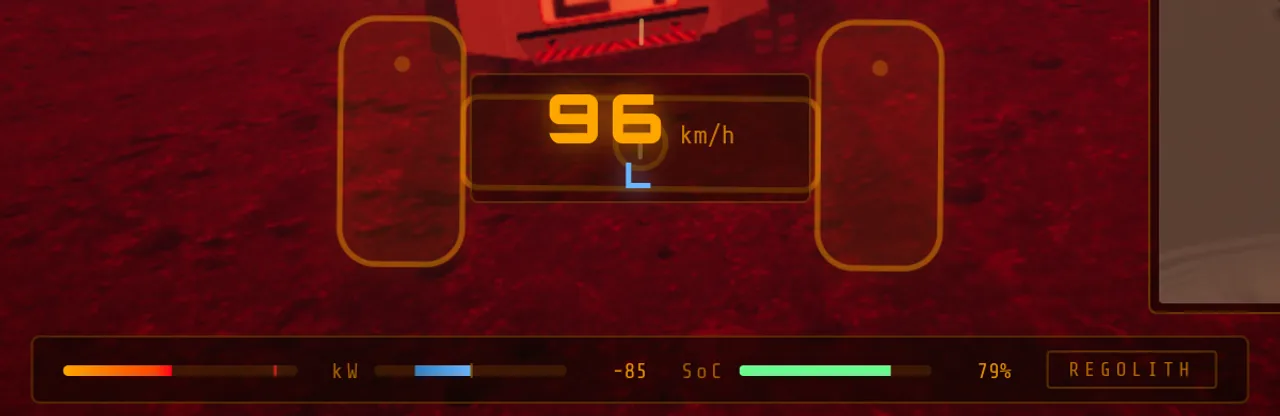
In-game screenshot: lift off and the kW readout goes negative: that is regen putting charge back into the pack for the final sector.
Driving the storm variant
The storm variant runs its dust storm at full strength for the whole stage, and it changes two things at once: you see far less, and the battery drains 50% faster. The response is the same discipline, doubled — braking points move earlier, jump speeds come down, and the throttle gets more polite precisely when the pack can least afford waste. The co-driver stays silent on storm runs, and the storm is a heavy brown haze, not a whiteout: the gate you are driving to still shines through it. Drive to the gate. A slow finish beats a DNF.
Where to build the habits
Run the Proving Ground tutorial first — its jump lesson shows how long the rover really hangs in the air — then take it to Stage 1, The Eight, where a first timed run starts: a 2.7 km night loop with gates 27 to 41 m wide. Stage 2 is the gentlest ground, 2.3 km with two real corners, and Stage 3, The Opener is the steeper test, a 1.16 km descent whose two tightest corners come 51 m and 75 m off the line. When the basics hold, ghost racing is the fastest teacher on the planet: the physics is deterministic — fixed substeps, seeded terrain — so replays are bit-exact, and you can download a stage's best ghost and study its braking points frame by frame. Split-delta timing tells you exactly which sector is bleeding time, and the rival ladder always serves up the next pilot worth beating.
One last calibration point: the results screen scores every finish against the stage's derived par times. The leaderboard is the real fight — pick a call sign, no account required, and post a time. The red planet is patient. Brake earlier than you think.