Stage 1 carries a nickname — The Opener — and a reputation as the friendly one. Both are deserved. There isn't a single hairpin on the stage; every corner the co-driver calls is a five or a six, rally shorthand for "fast" and "barely a corner." But between the bronze handshake and the Author medal at 1:04.0 sits a real driving exam, and the subject is restraint: how little you brake, and how flat you keep the rover, down a 65-meter descent at 0.38 g.
The terrain square is 2.5 km on a side; the timed checkpoint line threads about 1.16 km of it, dropping from the start pad at 167 m elevation to a finish gate at 93 m. Here's the route the way your co-driver will give it to you — these are the actual calls, at the actual distances.
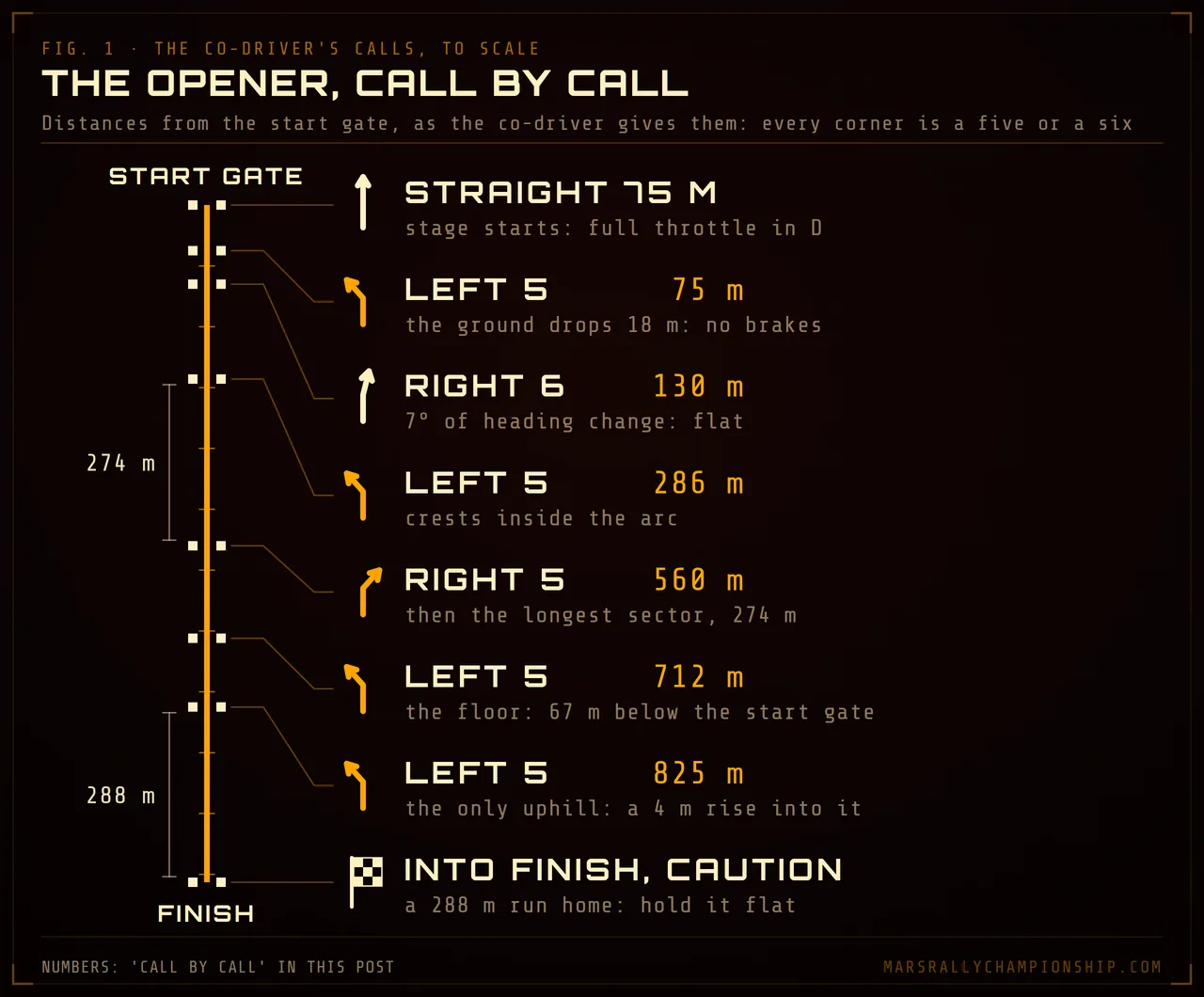
Diagram: every call on The Opener is a five or a six; what matters is the gaps, like the 274 m sector and the 288 m run home.
The pars
| Medal | Time | Average speed |
|---|---|---|
| Bronze | 2:09 | ~32 km/h |
| Silver | 1:33 | ~45 km/h |
| Gold | 1:13 | ~58 km/h |
| Author | 1:04.0 | ~65 km/h |
Bronze, silver, and gold are computed from the checkpoint line at fixed reference speeds (9, 12.5, and 16 m/s), so they scale honestly with route length. The Author time is different: it's a hand-set ceiling — a time actually driven, not derived. On Stage 1 it demands averaging 65 km/h on a stage with no real straights until the end.
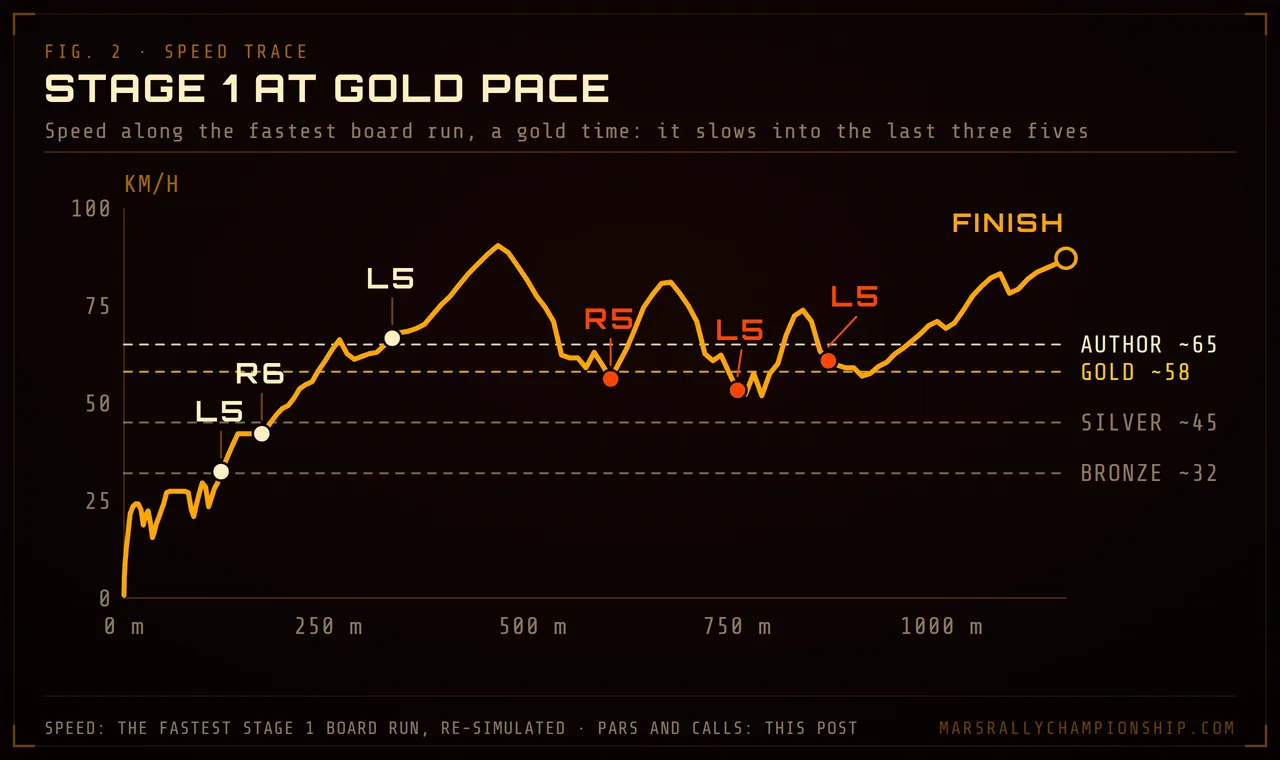
Diagram: the fastest board run against the pars' average speeds: it eases into the last three fives and runs flat out down the finish straight.
Call by call
"Stage starts, straight 75 meters." The start gate sits a short run below the launch pad and the road is already falling. Full throttle in D and let the descent do the work — you'll carry more speed into the first call than feels reasonable. That's correct.
Left five, 75 m. The first real corner arrives with the ground dropping 18 meters beneath it — a fast sweeper on a descending face. Do not brake. Turn in early, let the fall line pull you through, and treat the wide checkpoint gates (30 m radius) as permission to run a generous arc.
Right six, 130 m. Seven degrees of heading change. This is not a corner; this is the co-driver keeping you company. Flat.
Left five, 286 m. By now you're properly fast and still descending. The danger isn't the corner — it's the crests inside it. A rover that goes light mid-arc stops steering, so breathe the throttle before the bumps, never during.
Right five, 560 m. The longest sector of the stage: a 274-meter run where gold times are made or lost. The big descent flattens out along here, which means the free speed ends — from this corner on, what you carry is what you keep.
Left five, 712 m. The floor of the stage, 67 meters below the start gate. Taken clean, it's flat or nearly flat. Taken wide, it ruins the next call, and the next call is the tricky one.
Left five, 825 m. The only uphill on the stage: a four-meter rise into the corner. Crest and corner combined — the rise unloads the tires at the exact moment you ask them to turn. Author-pace runs skim it with a small lift; gold-pace runs breathe the throttle and keep all four wheels down. Launching here is the classic Stage 1 mistake, because what's on the other side is the finish straight, and you want to exit this corner accelerating.
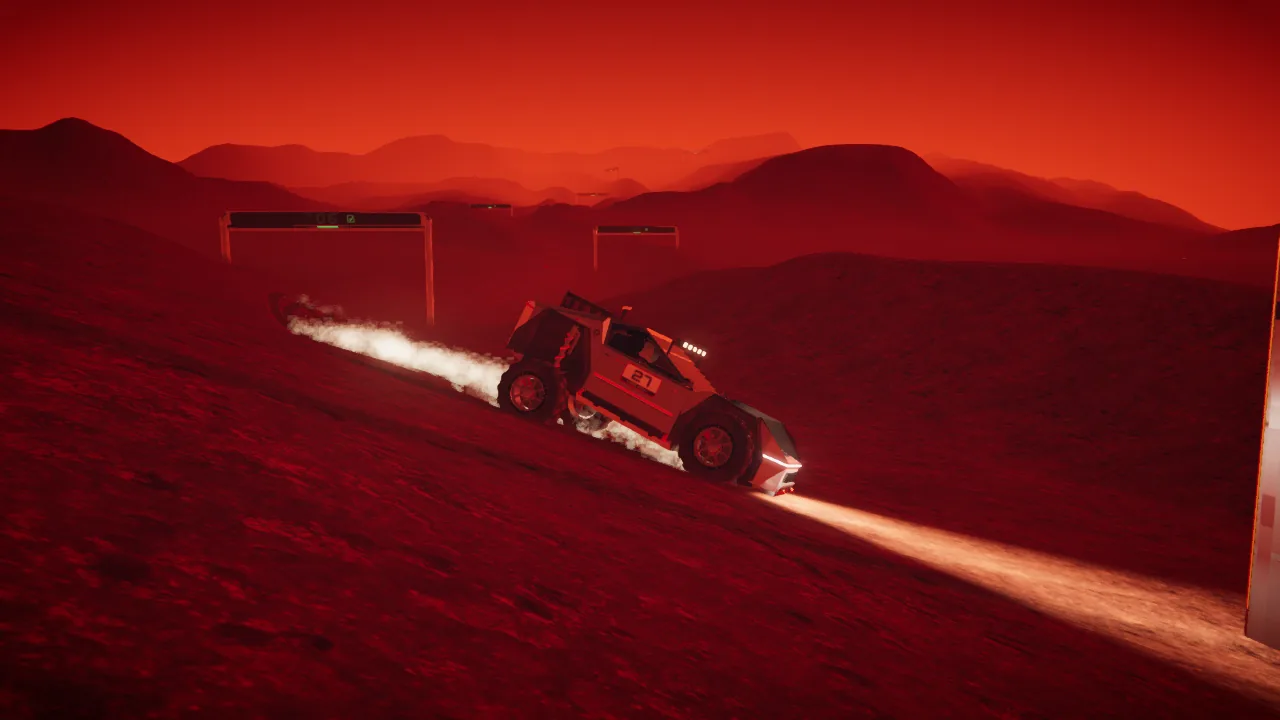
In-game screenshot: the only uphill on The Opener, where the rise unloads the tyres just as the corner asks them to turn.
"Into finish, caution." A 288-meter run home. Nothing left to manage but your nerve and the battery. Hold it flat.
What the Author run does differently
Averaging 65 km/h over this line means essentially zero braking events. Every five is taken as a line adjustment, not a slowdown; every crest is skimmed, not jumped; the landing throttle goes in before touchdown so the rover exits corners settled. Split-delta timing at every gate shows exactly which sector is bleeding time against your best — chase the sector, not the total.
The fastest way to learn the line is to watch it: download a top ghost and shadow its braking points (there are almost none), then check where you stand on the Stage 1 leaderboard. The stage dossier keeps the map, terrain notes, and your medal progress in one place. When the line feels automatic, the daily challenge will happily test it under a night sky or a dawn one.
Ready? The stage is one click away: drive Stage 1 now. Bronze is a formality. 1:04.0 is a conversation with the person who built the road.