In browser racing games, multiplayer with friends should cost nothing and install nothing, and six of the seven picks below manage both: Mars Rally Championship, a free browser rally game listed first because it is ours, then same-keyboard two-player games, Smash Karts, PolyTrack, Track Wars and Free Rally. SuperTuxKart, the seventh, is free but installs. They split into two designs: contact racing, where cars collide, and ghost-style racing, where nobody touches anybody. Mars Rally Championship is the second kind: up to 8 pilots on one Mars stage from one shared link, with no account.
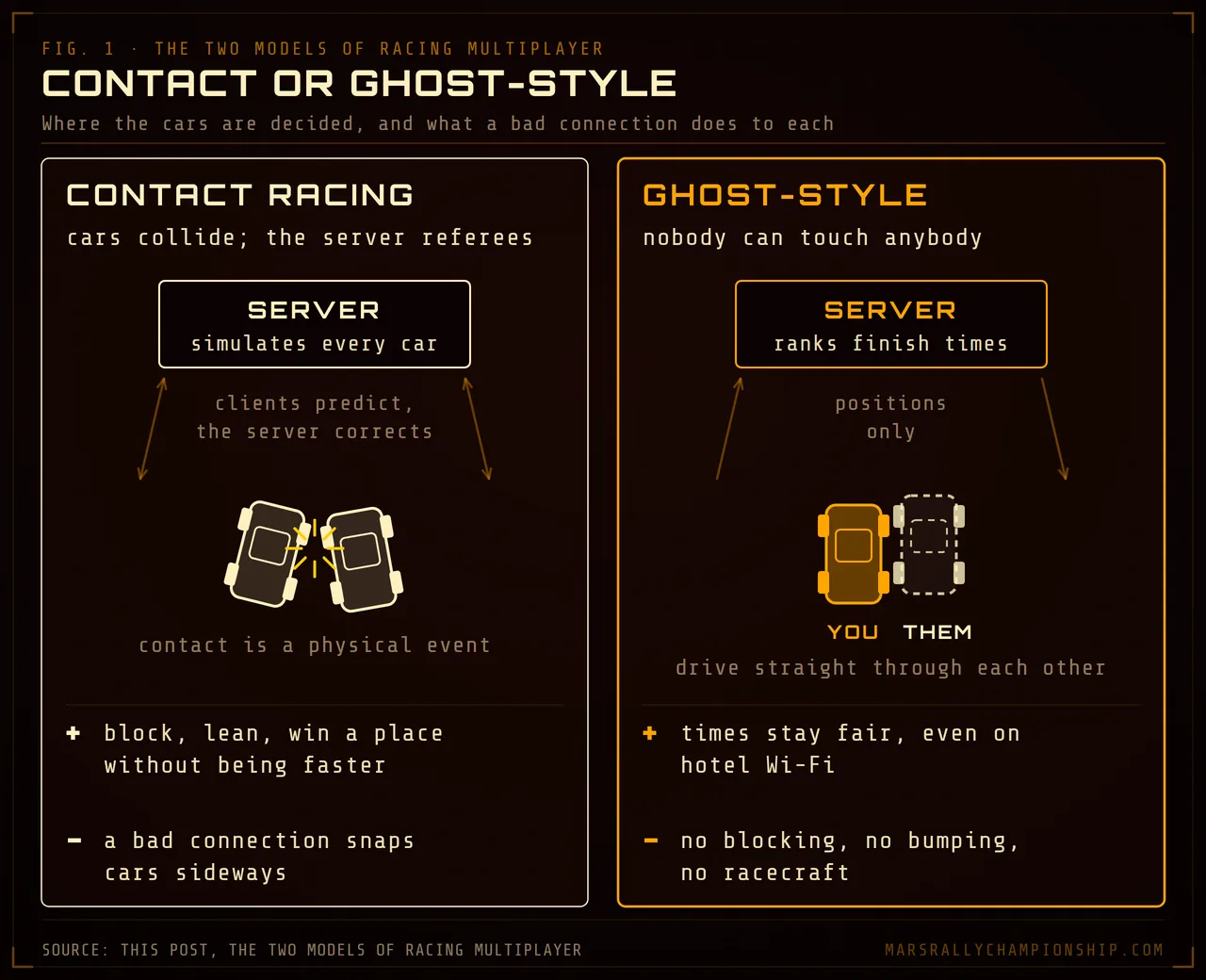
Diagram: contact racing lets you block and bump but lag snaps cars sideways; ghost-style gives up racecraft for a fair result.
Free, no download, multiplayer: what a group needs first
A five-minute race with friends fails at five predictable points. Install: the group waits for the slowest download and the one machine that blocks installers. Sign-up: an email confirmation detours at least one person, every time. Device mismatch: a phone, a work laptop, a school Chromebook. Getting into the same room: a random public lobby is not a link that puts five named friends on one start line. Connection quality: the game's model decides how fair the race feels.
A browser tab settles the first point and a game with no sign-up the second; six of the seven picks below do both, and all seven are free. Older lists of browser racers still name Need for Speed World, which EA shut down on 14 July 2015, and TrackMania Nations Forever, a Steam download.
Mars Rally Championship is first because it is ours; the rest are ordered by those five points, not by which game is deepest.
Contact racing or ghost-style: the two kinds of multiplayer racing
Contact racing: cars collide, and the server referees
In contact racing, two cars occupying the same space is a physical event, so somebody has to be the authority on where every car actually is — usually a server that simulates the world while each client predicts locally and corrects when the server disagrees. Done well it feels like real racing: you can block, lean on someone through a corner, and win a place without being faster.
Done over a bad connection it produces the familiar artifacts — cars snapping sideways as corrections land, a rival who was clearly behind you appearing ahead. Contact racing rewards low latency as much as skill, which is why an opponent across an ocean is a different opponent than the one next door.
Ghost-style simultaneous time trial: nobody can touch you
The other model removes collisions entirely. Everyone drives the same stage at the same moment, opponents render as translucent name-tagged cars beside you, and the server ranks finish times rather than adjudicating contact. Your physics run locally at full fidelity, and nothing another player does can push you off the road, because they are a live position feed drawn on your screen rather than an object in your world.
Neither model is better in the abstract. Contact racing is the sport most people mean by racing; ghost-style trades combat for fairness, and that trade makes an eight-way race survivable on hotel Wi-Fi.
Seven racing games to play with friends, ranked by how fast you get going
1. Mars Rally Championship — eight pilots on one link, no account
Our game, listed first for that reason. This is Mars Rally Championship's own site; everything below it is ranked on its merits.
Mars Rally Championship is a free 3D rally game that runs entirely in the
browser, with no download and no account. Online racing puts up to 8 pilots on
the same Martian stage at once: the host creates a private room and shares one
invite link of the form /play?join=<code>, which opens with the room code
already filled in. A public lobby is there for racing strangers, and the only
identity is a 20-character call sign stored in your browser.
It is the ghost-style model, deliberately: opponents are translucent rovers you can drive straight through. The rest is a physics-first rally sim, with Mars gravity at 3.72 m/s² and about 125 metres to stop from 100 km/h. What it lacks is as plain: one vehicle, three drivable stages and no contact. The netcode behind it has its own write-up.
Play free — no download2. Two-player games on Poki and CrazyGames — nothing to join at all
Both portals keep a two-player category with plenty of racers built around one keyboard: one driver on WASD, the other on the arrow keys, both cars on one screen. No netcode, no room code, no lobby — latency is structurally impossible. For two people on one couch this is the correct answer and everything else here is overkill, with limits exactly as sharp: two players, one device, and cramped controls for whoever gets the arrow keys.
3. Smash Karts — an arena match in about a minute
Smash Karts is a free browser kart battler: small 3D arenas, weapon pickups, and rounds of up to 8 players in a three-minute free-for-all won on kills. Loading the page drops you into a public match almost immediately, and a private game keeps the lobby to people you invite. Nothing to install, no account for a basic game, and an app for iOS and Android too.
It is contact racing, and combat first — the goal is knocking karts out, not setting a time. If your group wants chaos rather than a stopwatch, start here and stop reading. For more of it, our games like Smash Karts guide compares kart combat, car soccer and sandbox alternatives.
4. PolyTrack — live multiplayer, still labelled experimental
PolyTrack, Kodub's low-poly time-trial racer, added live multiplayer in version 0.6.0 on 10 March 2026: a host shares an invite code, and since the 0.6.1 update in May any player can hand out invites and a hosted game holds up to 16. It needs no download and no account, and on track count it beats our three stages without trying.
The caveat is Kodub's own word for the mode, experimental: a bonus on an excellent time-trial game, not yet the reason to open it.
5. Track Wars — one persistent track everyone shares
Track Wars is a free browser racer on one figure-8 circuit that is always live; its developer pitches it at hundreds of racers at once. You drop into sprint races, lap times and a King of the Track crown instead of assembling a match; oil slicks spin out the car behind you, mines launch rivals skyward, phones get touch controls, and there is no account to create.
The flip side is control: one shared track is not a private room, so "just us five" is harder to arrange than in a game built on invite codes.
6. Free Rally — an open city and eight vehicles
Free Rally is a 3D open-city driving game on CrazyGames, first released in 2017, with eight vehicles from a bus to a dune buggy and no set objectives. You join a running server and drive; when other players arrive you can race them or smash into them.
The friction is the lobby model — you join a server rather than send a private link — and it is free roam, so a race exists only if your group agrees on one.
7. SuperTuxKart — the best kart racer here, and it is a download
SuperTuxKart is the deepest game on this list: free and open source, with split-screen, LAN and online races on community servers or your own. Version 1.5 arrived on 20 October 2025 for Windows, macOS, Linux and Android, and reached iOS that November.
It is not a browser game. An experimental WebAssembly port runs in a tab without networking, so it cannot race anyone online, and online play in the real game needs a free STK account (the FAQ explains). For a group willing to install, it beats most browser racers on content; for the five-minute job, the install is the whole problem.
Multiplayer browser racing games side by side
| Game | Private invite | Public lobby | Same-device two-player | Max players | Account | Phones | How you race |
|---|---|---|---|---|---|---|---|
| Mars Rally Championship Play | Yes, invite link (/play?join=<code>) | Yes | No | 8 per room | No | Yes, touch controls | Ghost-style time trial, no collisions |
| Two-player games (Poki, CrazyGames) | No, nothing to join | No, no lobby | Yes, one keyboard | 2, same device | No | Rarely (needs two key sets) | Side by side on one screen |
| Smash Karts | Yes, private game | Yes, public match on load | — | 8 per round | No | iOS and Android apps | Arena deathmatch with weapons |
| PolyTrack | Yes, invite code | — | — | 16 when hosting | No | — | Live, labelled experimental |
| Track Wars | No, one shared track | Yes, one always-live track | — | Hundreds, says its developer | No | Yes, touch controls | Sprints and laps, with mines and oil |
| Free Rally | No, no private link | Yes, join a running server | — | — | No | — | Free roam, contact |
| SuperTuxKart | Your own server or LAN | Yes, community servers | Yes, split-screen | Set by the server | Free STK account to race online | iOS and Android apps | Kart racing with items |
A dash means not confirmed, not no. Third-party details move, so treat the table as an October 2026 snapshot of each game's model, not a contract.
How a race with friends starts in Mars Rally Championship
None of the steps involve a password. The host opens online racing and creates a private room; the room hands back an invite link, and that link is the whole invitation. Everyone who opens it and presses JOIN appears in the room under their call sign — up to 8 pilots in total.
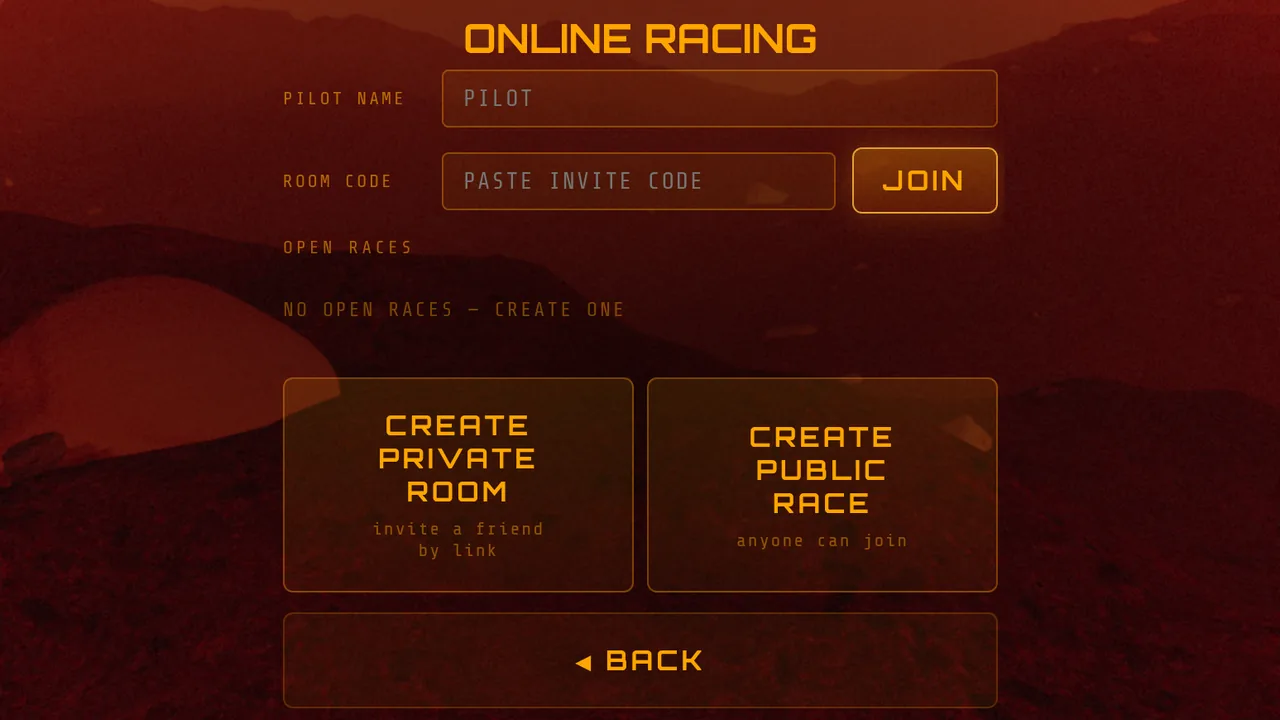
In-game screenshot: the lobby as it honestly looks with no public races open; a private room’s invite link opens it with the room code filled in.
The host picks the stage: today Stage 1, Stage 2 or Stage 3, the three with a full route. Pilots ready up, the countdown starts together on every screen, and each pilot's timer runs from their own GO. The server ranks finish times as the field comes in.
Two rules are worth knowing before you commit: mid-race pause is disabled, so a race is a race for its full length, and leaving mid-race is a DNF.
What ghost-style racing costs you
You cannot block. There is no defensive line, no closing the door at the apex, and no holding up a faster friend through a technical section. Every overtake is arithmetic, not craft.
You cannot bump, and you cannot draft, though on Mars the second costs little: the air is about 1.6% as dense as Earth's, so a slipstream would be worth almost nothing. Whether that matters depends on whether you came for racecraft or for a time.
What it buys is worth the loss for a group racing across bad connections. Times are fair, because your run was simulated on your machine with nobody else's packet loss in it. There is no rubber-banding and no host advantage, because there is nothing to arbitrate. Nobody can ruin your lap out of spite or incompetence, which matters more than it sounds when one pilot in the room is on a tethered phone.
How to run a race night with friends
Without contact, a group session needs a format rather than a referee, and three of them work well.
All three stages on combined time is the obvious format. Run Stage 1, The Eight, first: a 2,676-metre night loop with wide gates. Then Stage 2, The Long Run, 2,306 metres on easy ground, and last Stage 3, The Opener, whose two tightest corners come 51 m and 75 m off the start, down a steep descent. The lowest total wins, and nobody can be knocked out of contention by somebody else's mistake, so a slow first stage is recoverable.
Handicap starts are the second: the quickest pilot waits a few seconds on the line, and since every timer runs from its own GO, the wait goes straight onto their time.
The third is an honesty rule the game enforces for you. Leaving mid-race is a DNF, so the person who quits after a bad opening corner scores nothing rather than quietly restarting.
Racing friends who are in another country
It works. Mars Rally Championship sends each pilot's position 15 times a second and draws remote rovers with a 150 ms interpolation delay — every opponent you see is a smoothed reconstruction of where they were a fraction of a second ago.
In a contact game, that delay would be the whole problem. Here it is cosmetic. Nothing you see can hit you, your physics never wait on the network, and your timer is local. A high-latency pilot's ghost may stutter, and a rover that goes quiet for 500 ms is hidden until its updates resume. You lose visual company, not a fair result.
The practical upshot: a transatlantic room is fine, a phone on a train is fine, and the worst connection costs looks, not places. When the time zones never overlap, a challenge link does the job instead: it loads a board run's ghost for a friend to race whenever they like, the asynchronous half of ghost racing, explained.
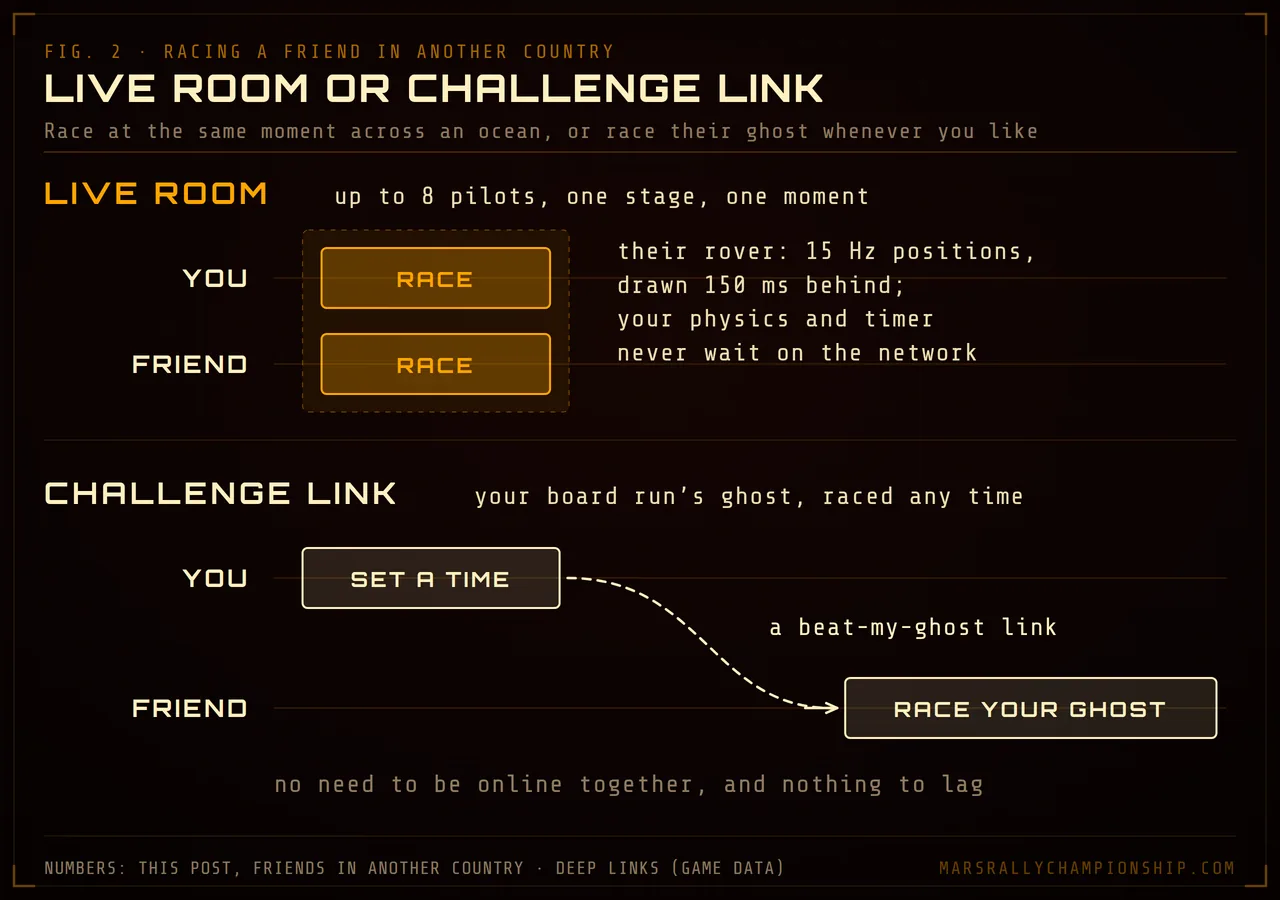
Diagram: across an ocean a live room costs only smoothness; a challenge link removes the need to be online at the same time.
Phones, laptops and Chromebooks in one race
Mars Rally Championship runs on desktop, laptop and phone from the same URL. Phones and tablets get a touch layout — gas, brake, handbrake, an analog steering track — and the game is landscape-locked. Keyboard and standard gamepads both work on desktop. Graphics ship on the high preset and step down to medium or low from the pause menu, which is the setting to reach for on a Chromebook or an older laptop before blaming the connection.
Nobody needs matching hardware. The physics steps at a fixed 60 Hz whatever the screen draws, so a slow laptop drives the same rover as a fast desktop, and in a game without collisions nobody's frame rate is anybody else's problem.
Where to start a race
Send one link and see who shows up. The multiplayer page covers room creation and the invite flow, and /play starts the game directly. If you are still shopping, free racing games with no download is the wider survey, and the best rally games online narrows it to stage rally. If your group wants to slide rather than race the clock, multiplayer drift games compares rooms, lobbies and player caps across the drift field.