Racing a clock tells you that you're slow. Racing a ghost tells you where. That difference is why ghost racing sits at the center of Mars Rally Championship — and why the game goes to unusual engineering lengths to make its ghosts honest. Here's how the whole system works, from the replay format to the challenge links you can drop in a group chat.
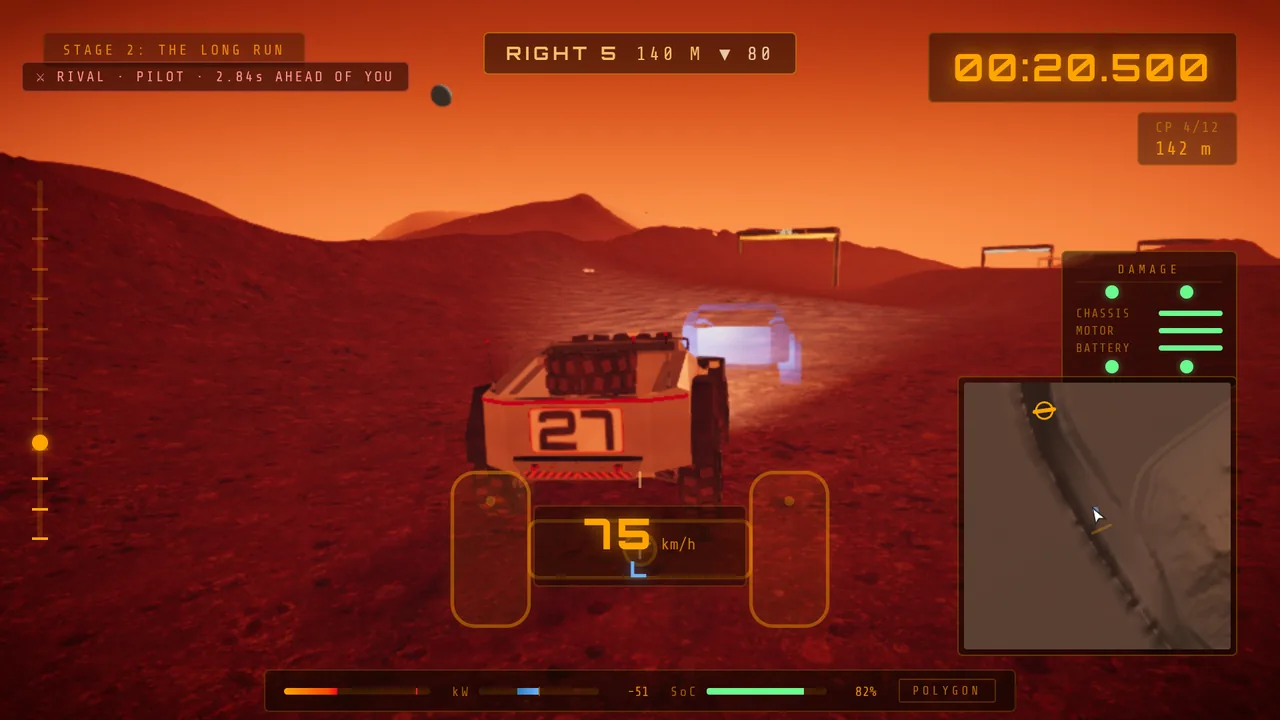
In-game screenshot: racing a rival ghost on Stage 2. The HUD tag names the rival and how far ahead of your best its time is.
What a ghost actually is
Every run you drive is recorded at 30 frames per second: position, orientation, and speed — plus a compact, quantized set of physics readings (throttle, brake, motor RPM, regen state, slip angle). Those extra fields exist so a replay doesn't just move like the original run; it sounds like it. The audio engine re-synthesizes engine note and tire skid from the same signals the live game reads, so a ghost braking late into a corner audibly brakes late.
The frames are rounded to centimeter precision and packed small on purpose: compact enough to ride along with a leaderboard entry, which is what makes everything below possible.
Why you can trust it
A replay is only as honest as the simulation underneath. Mars Rally Championship's physics is deterministic: the simulation ticks on fixed substeps regardless of your frame rate, terrain roughness is generated from a seed (the same seed builds the same Mars on every machine), and no force in the tire model depends on rendering speed. Same stage, same inputs, same result — bit for bit. Every run records those inputs, sixty times a second, and before a time goes on the leaderboard the server drives them through the same simulation: a run that doesn't reproduce its own finish is refused, and the ghost you download is the recording of that re-simulation.
That's what makes a downloaded ghost meaningful. The line it drives is a physically real line under exactly the physics you're driving; when it brakes two meters later than you and survives, that braking point is real and stealable. In games without determinism, ghosts are smoothed approximations and leaderboard times are folklore. Here they're evidence.
The rival ladder
Until you set a personal best, you race the board's record. After that the game runs a ladder: it fetches the ghost of the pilot just above your PB on the leaderboard and lines them up as your rival. Beat them, take their spot, meet the next one. The gap is the smallest one on the board, which is precisely the gap that keeps you pressing restart.
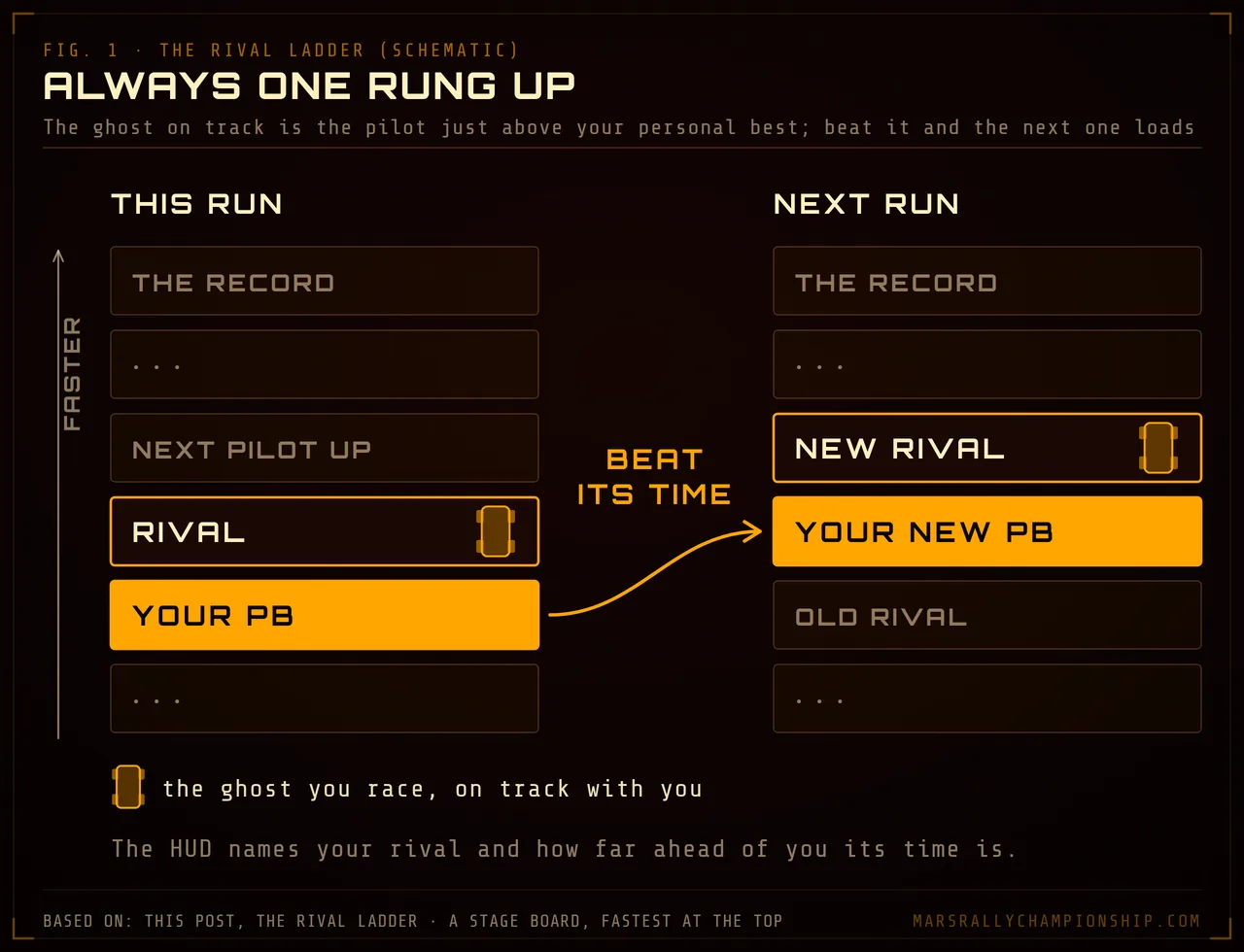
Diagram: the ghost on track is the pilot just above your personal best; beat its time and the next pilot up becomes your rival.
Split-delta timing does the diagnosis: at every checkpoint gate you see your live gap to the rival, so "I'm slower" becomes "I'm slower in sector two," which becomes a fixable habit. Start on Stage 1 — its six corners make deltas easy to read.
Challenge links: multiplayer for people in different time zones
Post a time worth defending and the results screen offers Challenge a Friend. That mints a link to a /race page for your exact run — it unfurls in chat as "Beat ⟨your call sign⟩'s ⟨time⟩ on Stage N," and one click drops your friend into the game with your actual ghost loaded as their rival. Not a screenshot of your time: the run itself, every correction and every mistake, re-rendered live at 30 fps. No account needed on either side of the link.
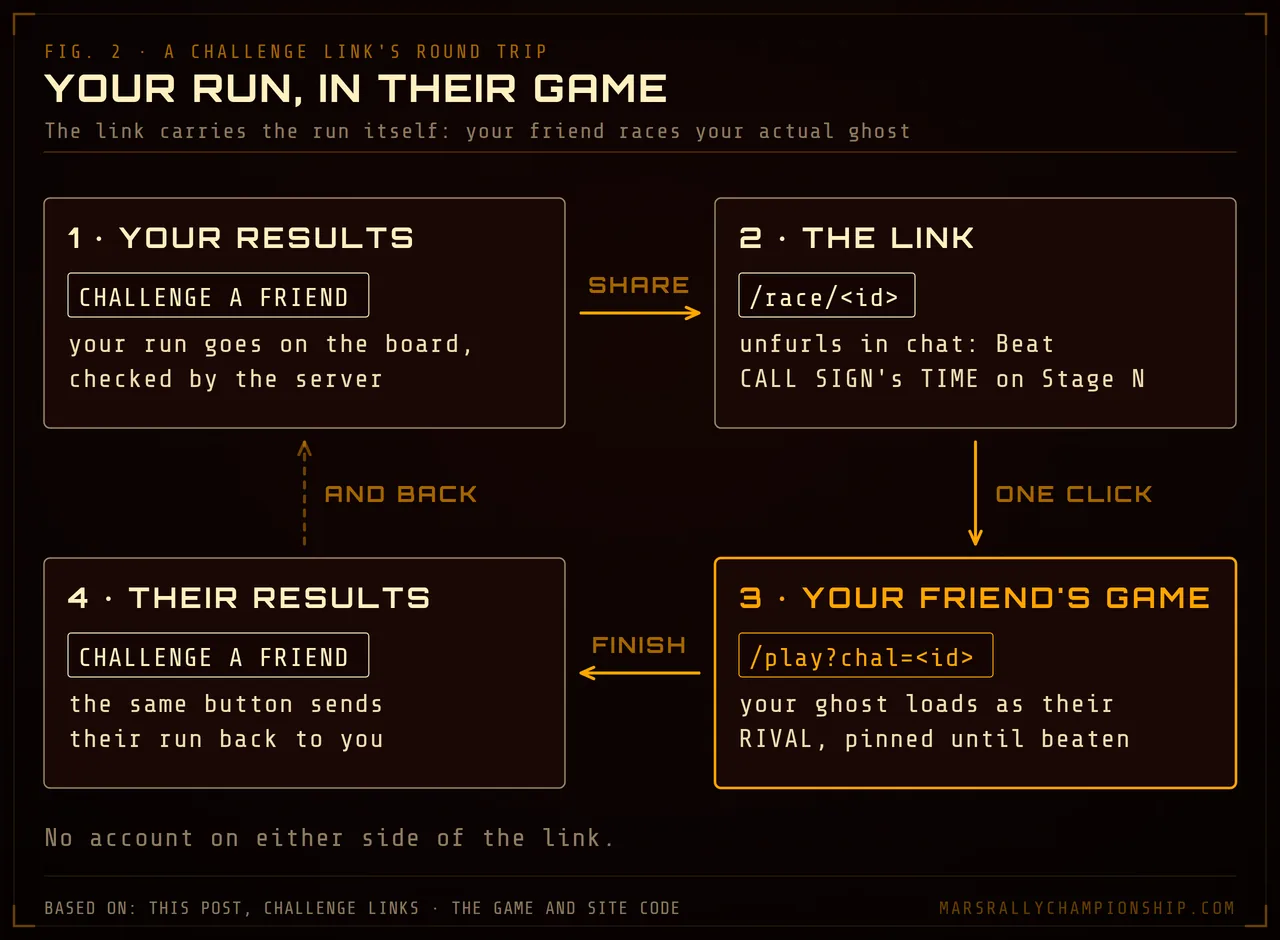
Diagram: Challenge a Friend turns your run into a race link; one click opens your friend's game with your actual ghost pinned as their rival.
One honest wrinkle: the leaderboard keeps only each pilot's best run per stage. If you later beat your own time, the old row retires — and a challenge link pointing at it starts reporting that the run has been beaten. Ghost racing has no participation trophies, including for your past self.
Multiplayer is ghost racing at 300 ms
The same architecture powers live online racing: up to eight pilots launch on a synced countdown and render for each other as named ghosts, with no collisions. Your physics runs entirely on your machine, so a ping spike can make an opponent's ghost stutter across the dunes but can never touch your wheels. The server's only job is ranking what everyone's clock says at the end.
And every midnight, the daily challenge reseeds the hunt: one identical stage for every pilot on the planet, and that stage's board of ghosts worth chasing. Set a time, mint a link, and go collect someone's braking points — the ghost racing hub tracks the whole hunt, and the start line is here.