A supply crate in Mars Rally Championship, a free browser rally game, costs 500 credits and rolls a single tier: 3% legendary, 10% epic, 27% rare, 60% common. A separate 12% roll then bumps whatever you got up one step, and a pity timer forces the tenth crate since your last epic-or-better to land epic. Duplicates refund 40, 80, 160 or 400 credits by tier. All 21 items are cosmetic — nothing in a crate makes the rover faster.
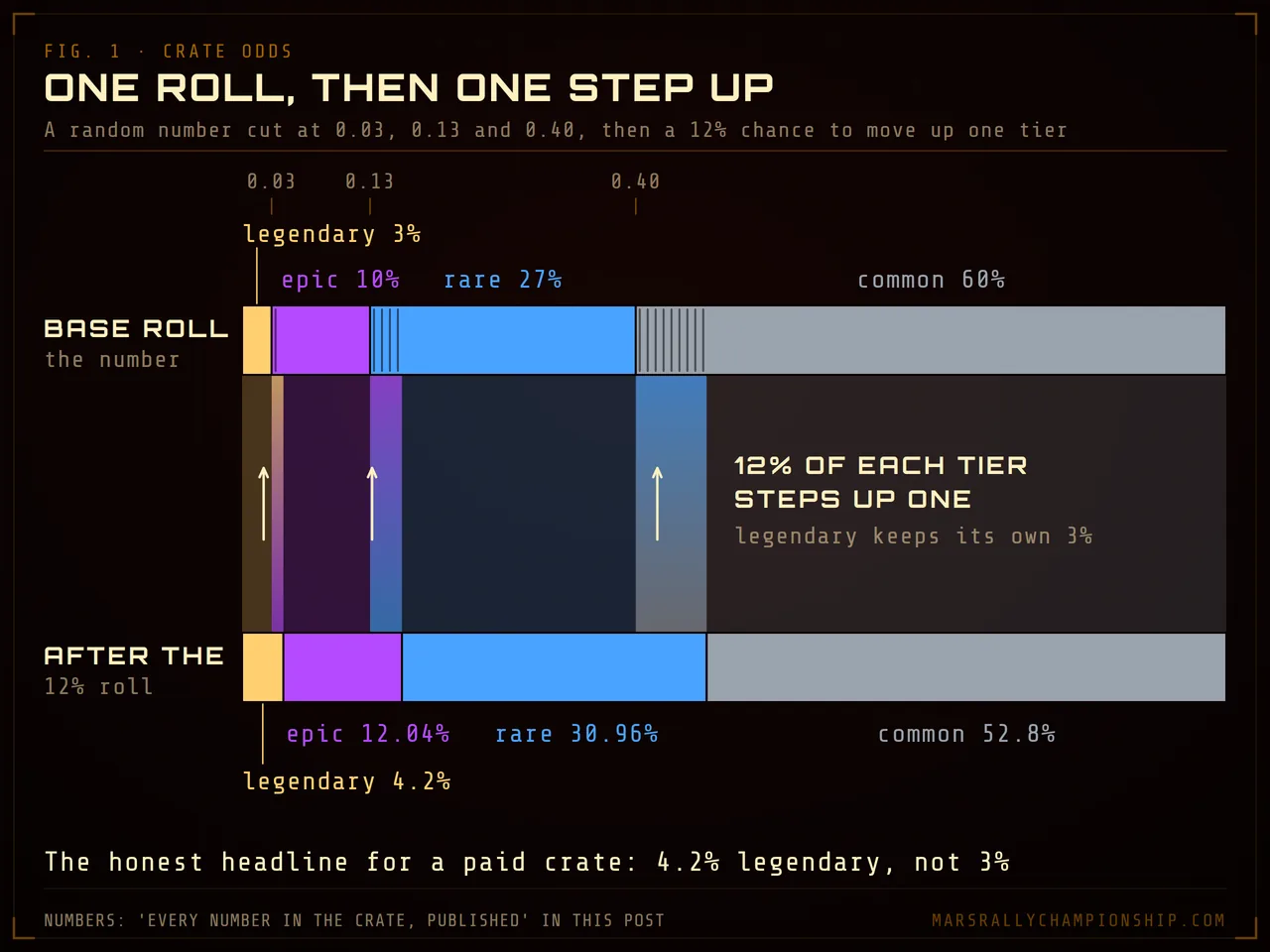
Diagram: the 12% upgrade moves a slice of every tier up one step, so a paid crate is 4.2% legendary, not 3%.
Every number in the crate, published
Most games treat drop rates as a trade secret. There is no reason to. Here are the actual constants Mars Rally Championship uses, read out of the crate roll itself.
A crate resolves in two steps. The fresh tier roll takes one random number and cuts it at 0.03, 0.13 and 0.40 — legendary, epic, rare, common. Then an independent 12% roll upgrades the result by exactly one tier, unless it is already legendary.
| Tier | Base roll | After the 12% upgrade roll | Duplicate refund |
|---|---|---|---|
| Legendary | 3% | 4.2% | 400 credits |
| Epic | 10% | 12.04% | 160 credits |
| Rare | 27% | 30.96% | 80 credits |
| Common | 60% | 52.8% | 40 credits |
The right-hand column is arithmetic, not a second table of secret numbers. Legendary keeps its own 3% and picks up 12% of epic's 10%, so 3 + 1.2 = 4.2%. Epic keeps 88% of its 10% and gains 12% of rare's 27%: 8.8 + 3.24 = 12.04%. Rare keeps 88% of 27% and gains 12% of common's 60%: 23.76 + 7.2 = 30.96%. Common only loses: 60% × 0.88 = 52.8%. The four add to 100.
So the honest headline number for a paid crate is 4.2% legendary, not 3%.
The pity timer forces an epic every tenth crate
Mars Rally Championship counts every crate you open. Any result of epic or better resets that counter to zero. If the counter reaches ten without an epic-or-better, that tenth crate is upgraded to epic and the counter resets. The garage page shows the gauge, so you always know where you stand.
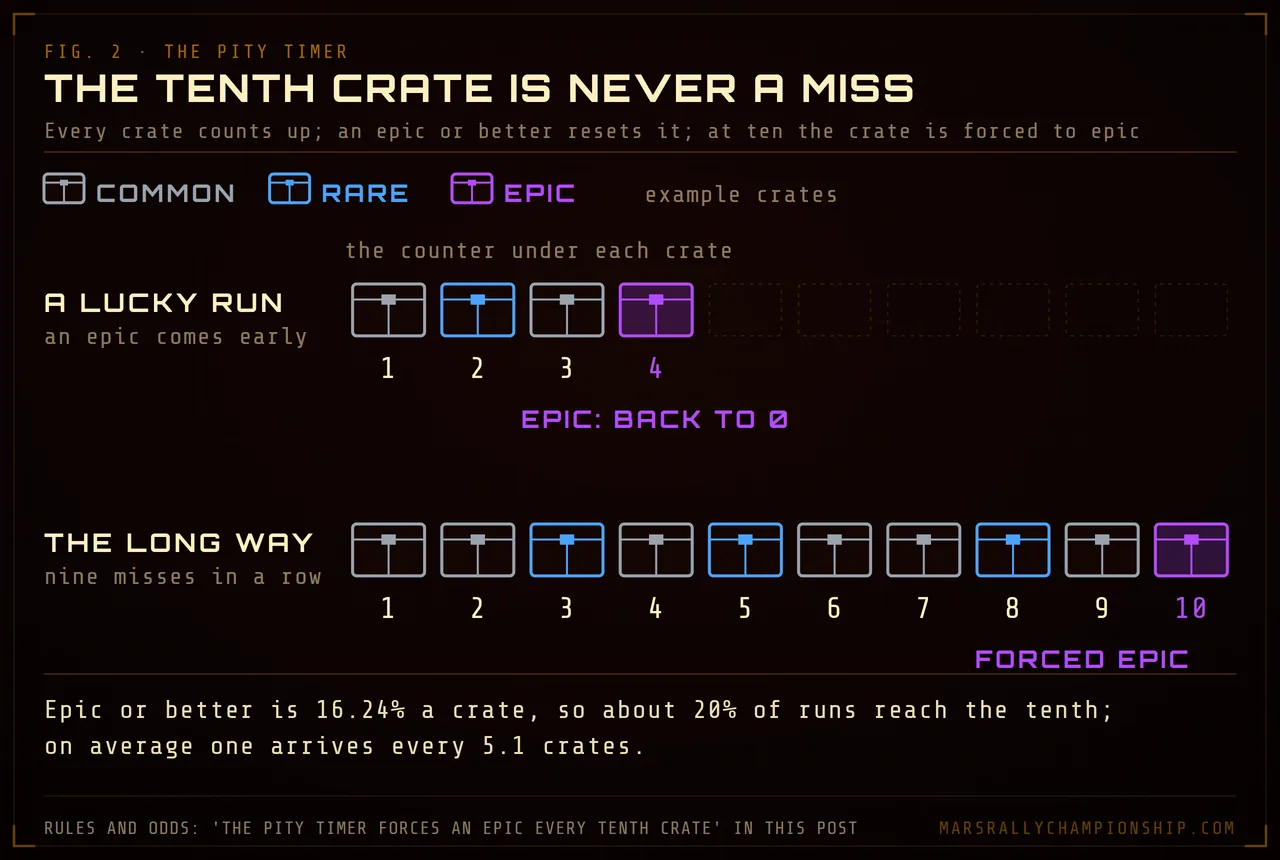
Diagram: about 20% of runs reach the tenth crate, and the floor brings the average wait for epic or better to about 5.1 crates.
That floor matters more than it looks. Epic-or-better is 12.04 + 4.2 = 16.24% per crate, which on its own averages one every 6.2 crates. The chance of missing nine in a row is 0.8376 to the ninth power, about 20% — a fifth of all runs go the distance and get caught by the pity rule. Adding up the survival probabilities across the capped run gives an average of roughly 5.1 crates between epic-or-better pulls.
The pity counter does not distinguish paid crates from granted ones. A crate from a level-up or an achievement advances the same gauge.
Duplicates, refunds, and the streak freeze
A crate first tries to hand you something new in its tier. If anything in that tier is unowned, you get one of those at random, and that is the end of it.
If the tier is exhausted — you already own every rare, say — the crate falls back. Rare, epic and legendary crates roll a 50% chance of a streak freeze instead, provided you are holding fewer than two; freezes cap at two. Fail that roll, or open a common crate with nothing new in it, and you get the tier's credit refund: 40, 80, 160 or 400.
That refund is the quiet reason late-game crates still make sense. An exhausted legendary tier pays 400 of the 500 credits back, so the marginal cost of a spin drops to 100 credits once your collection is deep.
Three of the 21 items are starters you already own on a fresh profile, which leaves 18 to actually win. Only four of the seven common items are winnable, so the common tier empties fast, and commons cannot drop freezes — once those four are yours, every common crate is a flat 40-credit rebate.
What a crate costs you in runs
Odds are meaningless without the earning rate, so here is that side too, and the arithmetic behind it.
Every finish pays 40 credits, plus a medal bonus of 10 bronze, 20 silver, 40 gold, 60 author. Then one unseeded roll multiplies the whole payout: 12% for ×2, 2% for ×5, otherwise ×1. The expected multiplier is 0.12 × 2 + 0.02 × 5 + 0.86 × 1 = 1.20.
Run that through a few medal rates. At silver pace a finish banks 40 + 20 = 60 credits, or 72 on average once the multiplier is applied, so 500 ÷ 72 works out at about seven runs per crate. Bronze pace: 50 × 1.2 = 60, about 8.3 runs. Gold pace: 80 × 1.2 = 96, about 5.2 runs. Finishing with no medal at all: 48 a run, about 10.4 runs.
Levels pay on top. Clearing a level hands over 100 + 25 × level credits plus a free crate, so the level that takes you to five is worth 225 credits and a spin. A lapsed pilot coming back gets a comeback drop of a rare crate and 100 credits. None of that is purchasable — credits only come out of driving, and crates are the only thing credits buy.
Chasing a specific legendary is a long project. At 4.2% a crate, the chance of seeing none in sixteen crates is 0.958 to the sixteenth, almost exactly 50%. Half of pilots find their first legendary inside sixteen crates; half wait longer. The daily challenge is the most efficient habit for funding that, because it is one guaranteed medal-paying run a day on a stage everyone shares.
Every item in the garage
Mars Rally Championship ships 21 cosmetics across three slots — 13 paints, 5 rims, 3 calipers — in four tiers. The catalogue is fixed. There is no rotating shop, no season pass, and nothing is ever removed.
Paints (13)
Common: STAINLESS STEEL (the starter), REGOLITH RED, BASALT GREY, DUNE TAN. Rare: POLAR ICE, OLYMPUS NAVY, OXIDE ORANGE. Epic: PHOBOS BLACK, PLASMA BLUE, AURORA GREEN. Legendary: SOLAR GOLD, PEARLESCENT and ION TRAIL.
ION TRAIL is the standout and the only emissive item in the whole catalogue — a near-black body with a blue emissive channel, which means it glows in the dark. Run it on a NIGHT sky and the rover lights itself while Phobos and Deimos track overhead. Every other paint is a colour, a roughness and a metalness value.

In-game screenshot: ION TRAIL, the only emissive item in the garage. Its near-black base glows blue as the Martian sun goes down.
Rims (5)
Common: ALLOY RIMS (the starter) and MIDNIGHT RIMS. Rare: BRONZE RIMS. Epic: CHROME RIMS. Legendary: GOLD RIMS — the only legendary that is not a paint.
Calipers (3)
Common: RED CALIPERS (the starter). Rare: BLUE CALIPERS. Epic: GOLD CALIPERS. There is no legendary caliper, which is why the legendary pool is four items rather than five.
Crates are granted inside the game — level-ups, achievements, the comeback drop — but they are opened on the site. The garage holds the ceremony, the collection album and the equip flow; the game reads whatever you equipped and paints it onto the rover at boot.
None of this makes the rover faster
Worth saying plainly, because it is unusual: cosmetics in Mars Rally Championship are cosmetic. There is one rover, one drivetrain, one tire model. No crate contains a power upgrade, a grip bonus, a lighter chassis or a better battery. A pilot on starter STAINLESS STEEL and a pilot in full legendary drive an identical car.
That is a deliberate design choice rather than an oversight. The leaderboard has to mean something, and it cannot if the fastest times are gated behind a drop rate. Every second on the board comes from lines, braking points and how much speed survives a corner exit — the ground covered in the beginner's guide.
One practical note on where your collection lives: the profile is a single localStorage record in your browser, on that device. No account, no server copy by default. Clear your site data and the paints go with it.
Where to open your crates
Open and equip on the garage page, and check your credit balance, level and medal record on the pilot dossier.
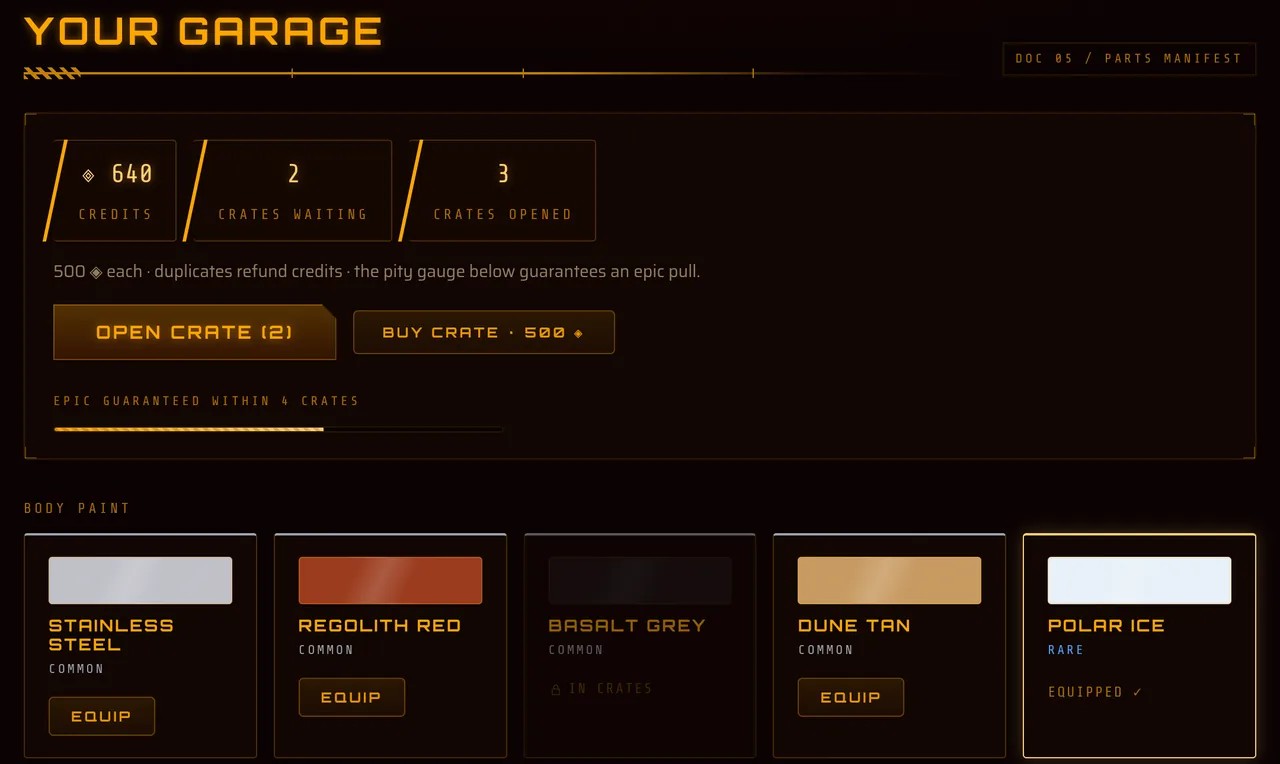
Screenshot: crates open on the site's garage page, where the pity gauge and the collection album sit beside the equip buttons.
Fund the habit with the daily challenge — one shared, date-seeded stage a day, and the same place your streak freezes get spent. The streak guide explains how a freeze absorbs a missed day, and why a daily seed works like Wordle covers the format.
When the collection is done, the only thing left is time on the board.