Daily games like Wordle share four properties: everyone gets the same puzzle on the same date, it takes a few minutes, it ends, and you can post the result without spoiling it. That format has spread well past word puzzles — geography in Worldle and Globle, film and music dailies, the daily chess puzzle on Lichess and Chess.com, and driving dailies from Trackmania's Track of the Day to the date-seeded daily challenge in Mars Rally Championship, a free browser rally game. Below is what is worth a bookmark, and which ones actually keep the format's promises.
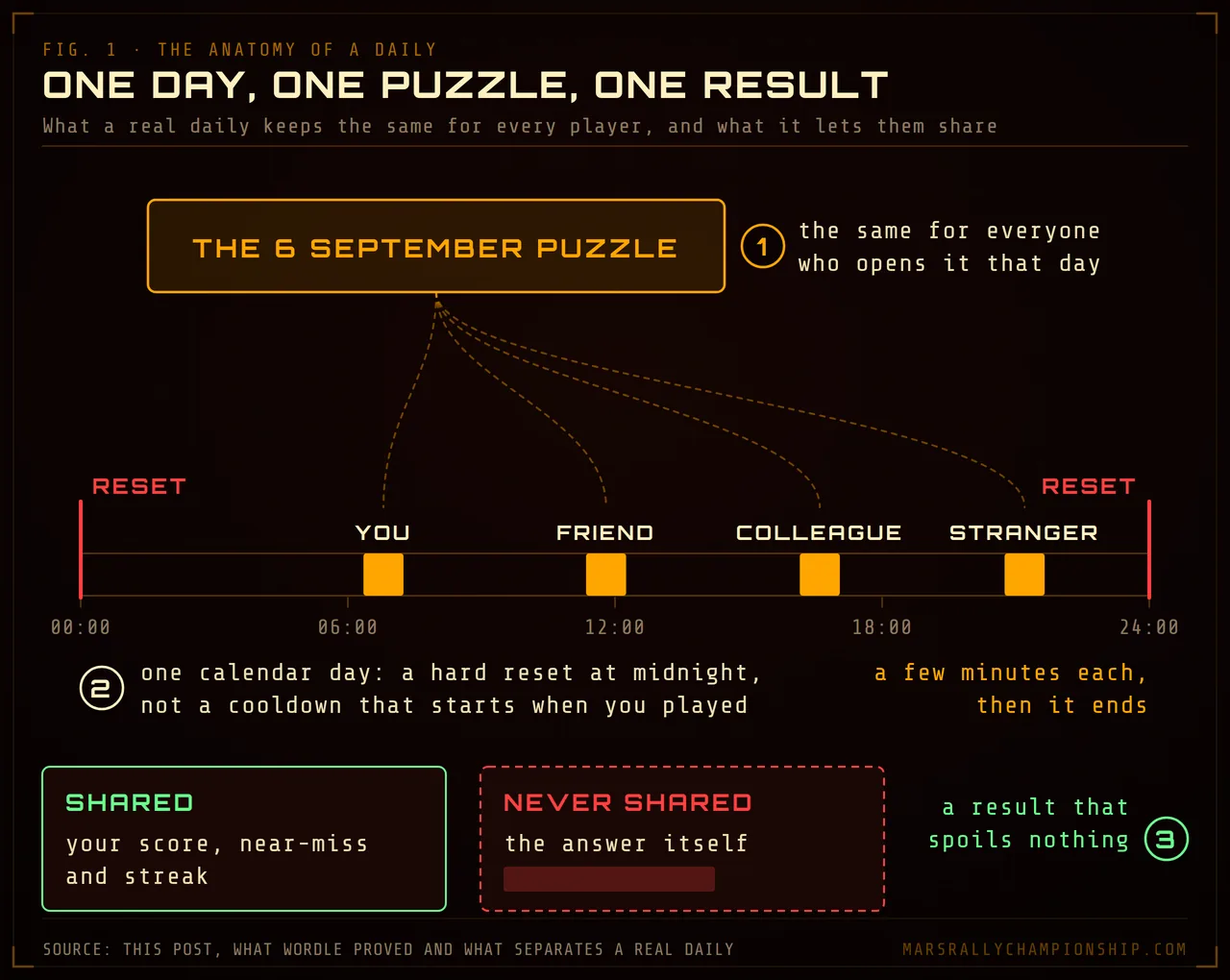
Diagram: four players at four times of day, one puzzle; what travels afterwards is the score, never the answer.
What Wordle proved was a format, not a genre
Wordle is five letters and six guesses, which is the least interesting thing about it. The interesting part is the delivery. Four properties, and any game can borrow them.
One puzzle, shared. Everybody who opens it on 6 September gets the same 6 September puzzle. That single decision turns a solitary game into a conversation, because your result and your friend's result are about the same object.
It fits in the gap between two things. A few minutes. Not a session, not a sitting — a coffee, a lift, a train stop.
It ends. When you are done you are done, and the game politely stops asking. Almost nothing else in games does this. A daily is the rare loop that respects the exit.
The result travels without the answer. Those grey and green squares carry your score, your near-miss and your streak, and they leak nothing. A share format that spoils the puzzle kills the thing that spreads it.
What separates a real daily from a game with a "daily" tab
Three tests, and a surprising number of games billed as dailies fail at least one.
A shared seed. If the puzzle is generated per player, or drawn at random each time you load it, you have a random level with a timer attached. Nobody can compare results, so nobody talks about it, so the loop never starts.
A hard reset on a calendar day. A rolling 24-hour cooldown that begins when you played is not a daily. It drifts, it turns into a chore, and it never gives two people the same today.
A share format that conveys a result without the answer. This is the one that most imitators skip, and it is not decoration — it is the distribution mechanism. If posting your result requires spoiling somebody's puzzle, nobody posts.
Grade the games below on those three and the field thins out fast.
The daily games at a glance
Session lengths are typical estimates, not measured statistics. A dash means I could not confirm the answer, not that it is no — several of these are made by one or two people and change without announcement.
| Game | Category | Typical session | Same puzzle for everyone? | Streaks? | Account needed? |
|---|---|---|---|---|---|
| Mars Rally Championship daily Play | 3D rally racing | 5–15 min | Yes | Yes (local) | No |
| Wordle | Word | 3–6 min | Yes | Yes | No (sync needs one) |
| Connections | Word association | 4–8 min | Yes | Yes | No (sync needs one) |
| Worldle | Geography, outlines | 2–4 min | Yes | Yes (local) | No |
| Globle | Geography, hot and cold | 3–6 min | Yes | Yes (local) | No |
| Framed | Film stills | 1–3 min | Yes | Yes (local) | No |
| Heardle-style music dailies | Music | 2–4 min | Yes | — | No |
| Lichess Daily Puzzle | Chess | 1–3 min | Yes | — | No |
| Chess.com Daily Puzzle | Chess | 1–3 min | Yes | Yes | No (streak needs one) |
The account column is close to unanimous, and it is the reason the format lives in a browser tab rather than an app store. All nine start on the first click.
Our game first: the Mars Rally Championship daily
Our game, listed first for that reason. This is Mars Rally Championship's own site; everything below it is grouped by category, the way the format spread.
Mars Rally Championship is a free browser rally game with no download and no account, and its daily challenge is generated from the calendar date rather than fetched from a server. The date seeds two things: which stage you run, and which sky you run it under. Everybody who plays on the same local day gets the identical pairing, and it resets at local midnight. There is no backend involved at all — the seed is the date, so two browsers with no connection between them roll the same challenge.
The sky is the part that makes a repeat stage feel new. The daily re-rolls it at 32% sunrise, 30% day, 26% night and 12% sunset, weighted away from the sunset you get in practice on Stages 2 and 3 (Stage 1 is a night stage). On most days the daily is lit differently from the version of the stage you learned, and a night run is a genuinely different problem — the terrain reads by headlight, and the sky renders stars and both Martian moons while you are trying to find a braking point.
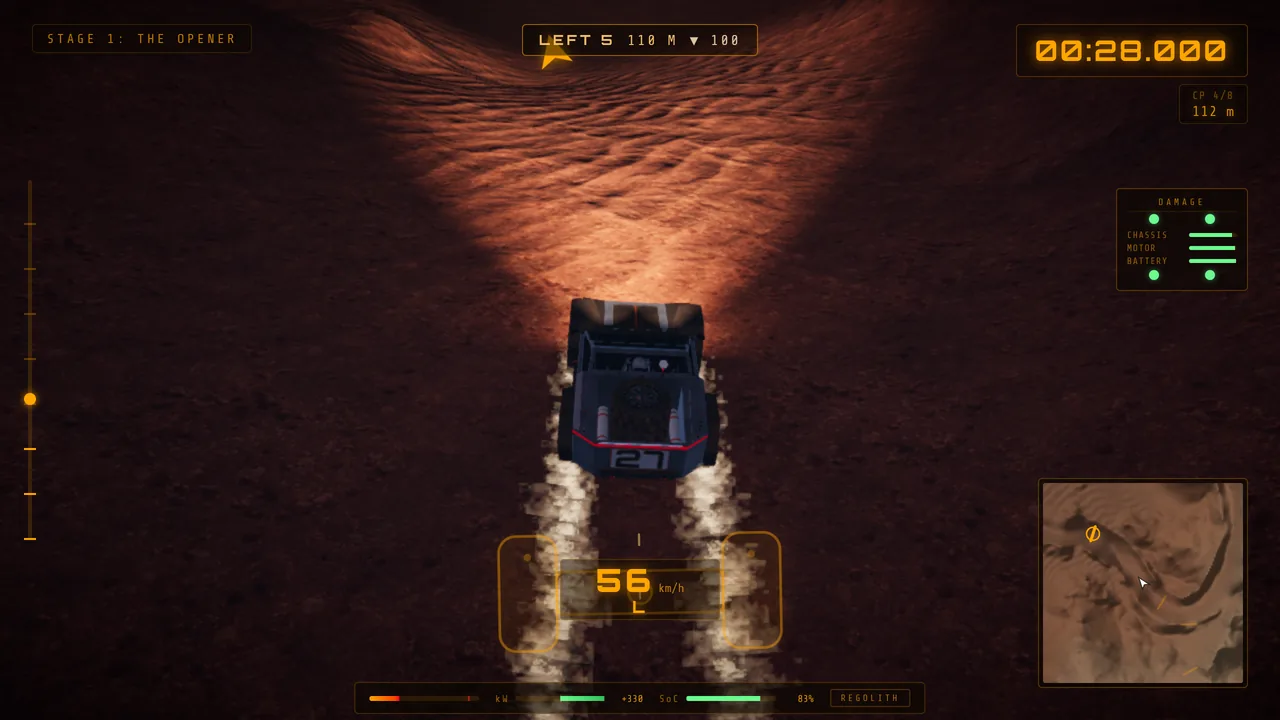
In-game screenshot: the daily rolls a night sky about one day in four, and the terrain then reads by headlight.
Alongside the challenge, three quests roll from a pool of ten templates: drift for a number of seconds, hold air time, hit a top speed, finish a number of stages, take a clean run under two impacts, cover a distance, earn a medal, medal on a named stage, win the daily, or pass a count of checkpoints. Same three for everyone, same reset.
Streaks are tracked on local day keys. Miss one day and a streak freeze covers it if you are holding one; miss two in a row and the streak starts over. You can hold at most two freezes, and they drop from rare-or-better crates that contain nothing new. Lapse entirely and the game pays a comeback drop when you return — a rare crate plus 100 credits — which is the opposite of the usual punishment design. The mechanics are written out step by step in the daily streak guide.
Three achievements sit on the streak counter: three days, seven days and thirty days. There is also a hidden one for winning a daily that rolled a night sky, a 26% chance on any given day — you cannot farm it, only be ready when it comes up. The full set is catalogued in the achievements guide.
The honest caveat: a racing daily cannot end after six guesses. What bounds it is the calendar day, not an attempt count, so the discipline of stopping is yours rather than the game's. A single run is short — The Opener's timed line is 1,164 metres and the author time is 1:04.0 — but the minutes go on repeats, which is why five to fifteen is the realistic session rather than three.
Play free — no downloadWord dailies: the format's home ground
Wordle itself moved to The New York Times in 2022 and now sits in a games suite alongside Connections, Strands and the Mini Crossword. Connections is the better puzzle of the two on most days — four groups of four, one shared grid, and a failure state that arrives through overconfidence rather than bad luck. The whole suite plays free in a browser; a login only carries your streak between devices.
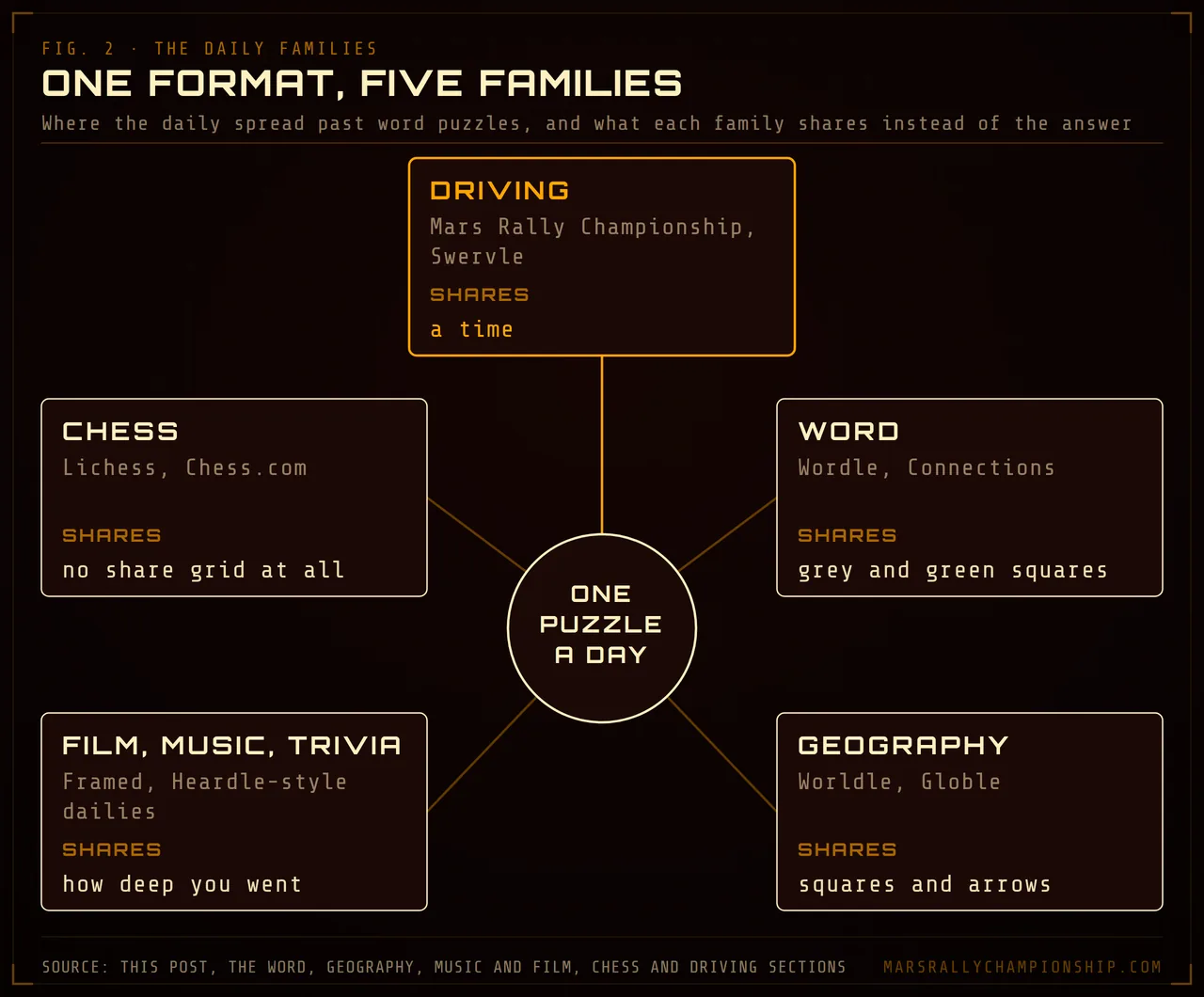
Diagram: every family keeps the shared puzzle; what differs is the share, from grey and green squares to a time, and chess never had one.
The clone families are the format stretched until it snaps. Quordle runs four boards at once, Octordle runs eight. Both keep the shared puzzle and the spoiler-free grid, and both take long enough to lose the format's best property.
Geography dailies: Worldle, Globle and the outline guessers
Worldle shows a country's silhouette and gives you six guesses, each answered with a distance, a compass direction and a proximity percentage. It is the cleanest non-word adaptation anybody has made, because the feedback is numeric and therefore shares as squares and arrows without naming anything.
Globle drops the outline entirely: you name countries and the globe heats up as you get closer. One target a day, no guess limit, and a share image that is a picture of your search rather than the answer. The wider family — trade data, flags, skylines, travel routes between two countries — runs on the same daily seed and the same spoiler-safe share.
Geography suits the format for a specific reason: the answer space is finite, publicly known, and roughly equally hard for everyone.
Music, film and trivia dailies
Framed gives you one frame from a film, then a second, then a third, up to six. Guess early for a better score. The share is a row of red and green boxes showing how deep you went, which tells your friends how badly you did without telling them the film.
Music dailies have had a rougher history. The original Heardle was bought by Spotify and shut down, and the format survives in clones and successors that play a track in growing slices, or a song one instrument at a time. Licensing, not design, is what keeps killing them, so treat any specific music daily as temporary.
Trivia dailies are the weakest fit. General knowledge is unevenly hard across players, so results compare badly, and most trivia shares are a raw score with no texture. The format works best where the puzzle is one object everybody is looking at.
Chess puzzles did this before it had a name
Lichess and Chess.com have both served one puzzle a day for years, and newspapers ran a crossword and a sudoku on the same schedule for decades before that. The daily puzzle is not a 2021 invention; Wordle's contribution was the share grid, which is the piece the older dailies never had.
Both are free and neither requires an account to solve the position. Chess.com tracks a streak if you log in. Lichess keeps its daily puzzle open to everyone and holds a far larger archive behind it, which is the honest reason to prefer it if you want more than one.
Driving dailies: Trackmania, phone apps and a rally stage a day
Racing took longer to adopt the format because a lap is not a guess, and the driving dailies we could verify are mostly downloads or phone apps rather than browser games.
Trackmania's Track of the Day is the best known. Ubisoft Nadeo showcases one community map a day, a new one at 19:00 Central European time, each with its own records board and 24 hours to set your best time. A lap time shares the way a Wordle grid does, as a result that spoils nothing. It is a download, and Track of the Day needs Club access, the paid tier; the guide to Trackmania in a browser covers the cost and the streaming route. The art of rally store listings name leaderboards for daily and weekly challenges, and per the App Store, Daily Racer on iPhone serves a new racetrack every day with a worldwide leaderboard, while Daily Drivers on iPad offers a new course every day to race against friends' times. We could not confirm reset times or streaks for those three, and none of them runs in a browser.
Mars Rally Championship (covered first, above) applies the format to a full 3D rally stage, and of the driving dailies here it is the one that runs in a browser tab with no download and no account. It is also the one I can describe from the inside. How the five racing dailies compare on shared courses, attempt limits, streaks and reset times is in racing games with daily challenges.
Where daily games go wrong
The most common failure is a personal cooldown dressed as a daily. If the timer starts when you played, two people never share a today. Check whether the reset is a wall-clock hour or a countdown from your last attempt.
The second is a daily that never closes. Infinite attempts with no boundary is a level, not a daily, and the part that makes Wordle work is precisely where the game tells you to leave.
The third is a share that spoils. Any format that requires naming the answer to report a result will not spread, however good the puzzle is. The squares were never cosmetic.
The fourth is the live-service daily: log in, claim, close. Shared reset, streak counter, no puzzle. A daily has to be worth doing on the day you would have skipped it.
Where to try this
If you want a two-minute daily, Worldle and Framed are the best-designed non-word entries. If you want a puzzle with decades of depth behind it, the Lichess daily. If you want a daily that involves a stopwatch, Mars Rally Championship runs in a tab, and Trackmania's Track of the Day is the download to try.
Mars Rally Championship's daily is free, needs no account and runs in any modern WebGL browser on keyboard, gamepad or touch. Run today's challenge to get the seeded stage and sky, check the leaderboard before you set a time, and track your streak and medals on the pilot dossier. If you are shopping more broadly, the free browser racing list covers ten other games worth a tab.