A drifting game lets the rear tires slide at a bigger angle than the front ones, then gives you the tools to hold that slide: countersteer to point the front wheels where the car is travelling, throttle to keep the rear sliding, and a handbrake, weight shift or burst of power to start it. The other half is the reward. Asphalt drift games score angle, line and style, while racing games such as Mars Rally Championship, a free browser rally game made by this site, only care about the clock.
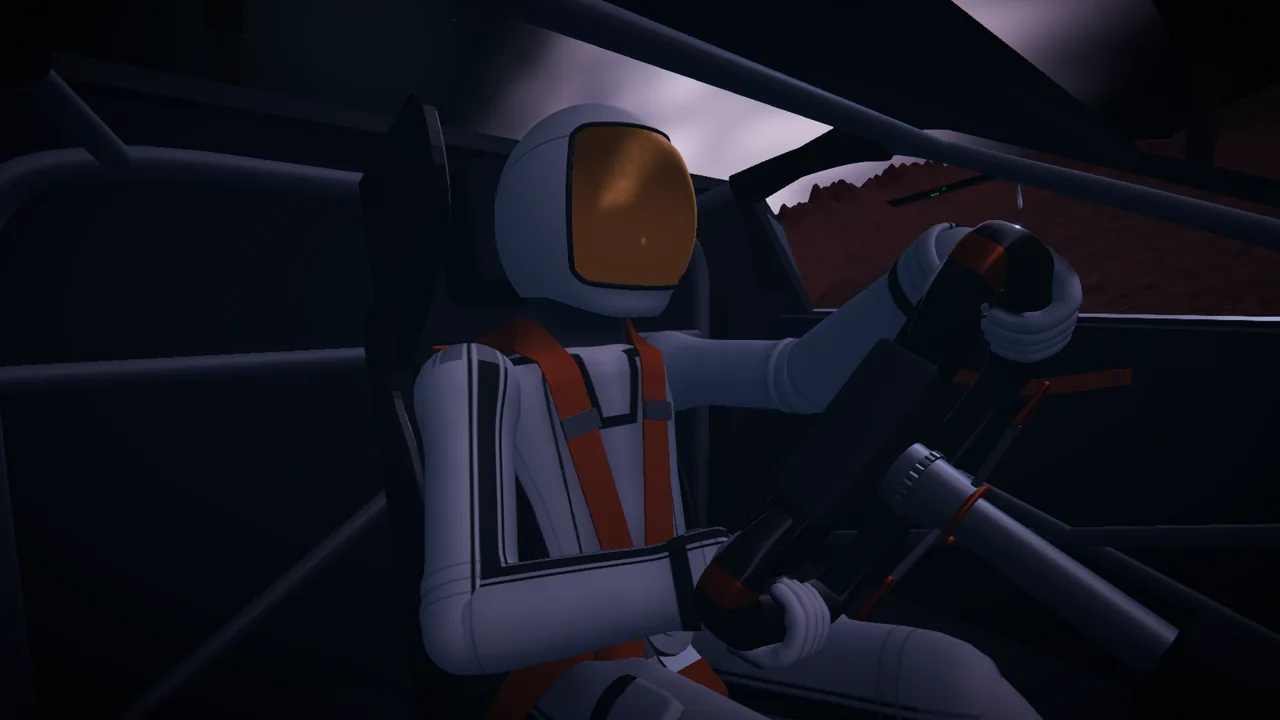
In-game screenshot: the ONBOARD camera on Stage 1, The Eight, at night, the pilot's yoke turned against the slide on the run into gate 11, a 65° left-hander.
Every example below comes from that game's tire model, so you can try each one in your browser.
The short version:
- Grip peaks at a small slip angle (about 10° in Mars Rally Championship's tires) and does not vanish past it.
- A drift is the rear sliding more than the front; you hold it with countersteer and throttle.
- Starting one takes a handbrake, a weight shift, power or a clutch kick, depending on the car and the game.
- Scoring: judged drifting rewards line, angle and style; racing rewards the clock.
- Loose surfaces push back on a sideways tire, which is why rally drivers slide and circuit racers mostly don't.
How we know: the Mars Rally Championship numbers are read from the game's own physics code; the drift-competition and game-scoring details come from Formula DRIFT's announcements, Forza's release notes and published guides, linked where they appear. Last checked: October 2026.
Grip and slip: what a tire does in a corner
A tire corners by running at a small angle between where the wheel points and where it actually travels. That gap is the slip angle. Sideways force rises with slip angle to a peak, then levels off or falls.
In Mars Rally Championship, lateral grip peaks at 0.18 rad, about 10°. Past the peak the game's curve eases to about 92% of peak force by 15° and holds there. A sliding tire still pushes, which is what makes a long slide controllable.
Each tire also has one friction budget, shared between braking, power and cornering. On regolith it is about 3.1 m/s² under 3.72 m/s² of gravity, so a stop from 100 km/h takes about 125 m, against about 52 m on Earth gravel with the same tires. The braking distance calculator lets you vary it.
The game leaves out wheelspin: there is no slip-ratio model, so the rover cannot be spun up into a power slide. Most car games do model it.
What makes it a drift: the rear slips more than the front
Drifting is deliberate oversteer held through a corner. The rear tires run at a larger slip angle than the front ones, often so large that the front wheels point away from the turn. That is opposite lock, or countersteer.
Two angles get confused here. A tire's slip angle belongs to one wheel. The car's own slip angle, its body slip, is the gap between the direction the car points and the direction it moves, and Mars Rally Championship's drift counter uses that one.
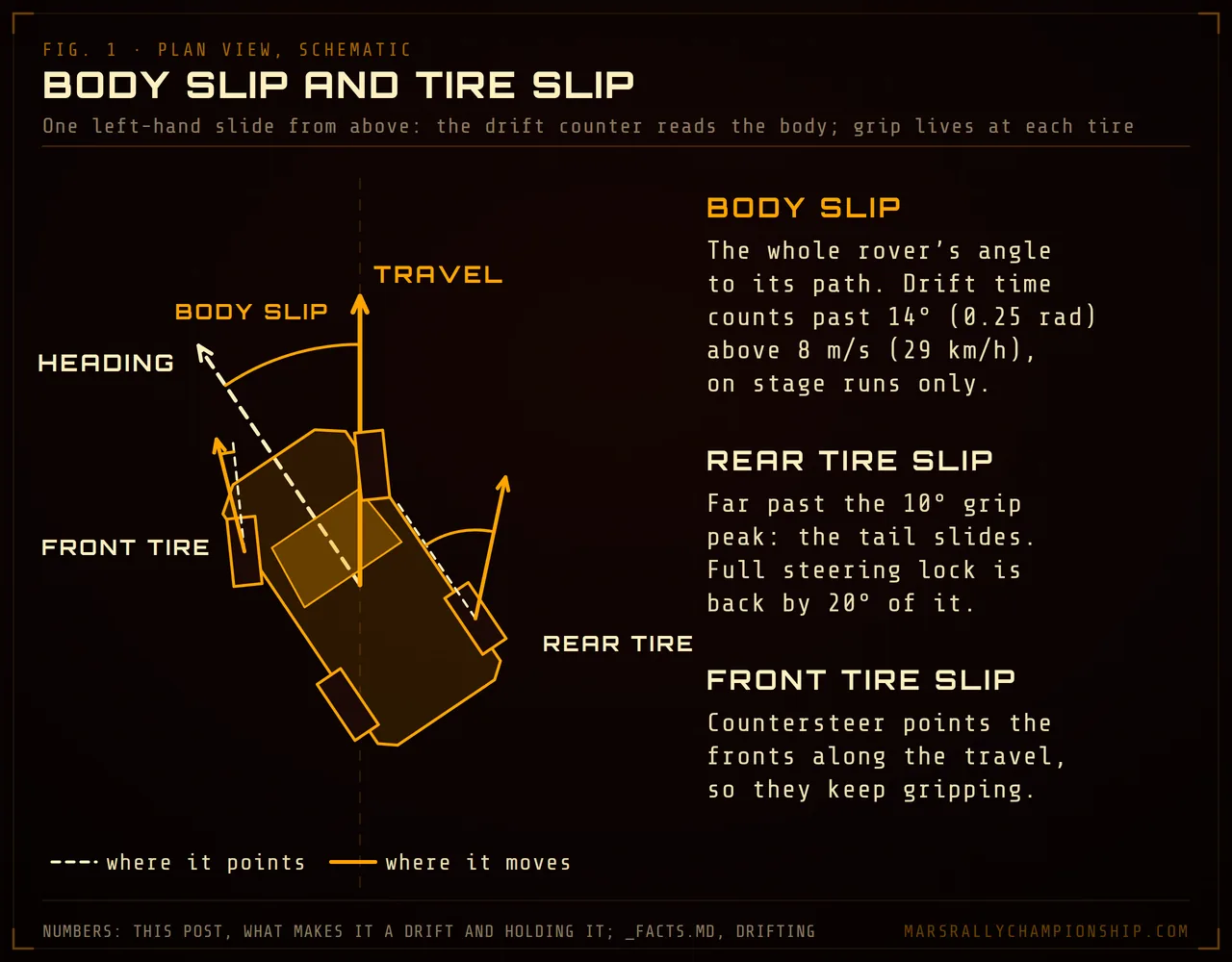
Diagram: body slip is the whole rover's angle to its path, read by the drift counter past 14°; each tire has its own slip angle, larger at the rear.
The game counts drift time when the rover travels more than 0.25 rad, about 14°, off its heading while moving faster than 8 m/s, about 29 km/h. The clock runs on stage runs only, never in free roam or the Proving Ground tutorial, and feeds the SIDEWAYS achievement (60 s in total), DRIFT ROYALTY (10 minutes in total) and the daily DRIFT quest, whose goal rolls between 8 and 15 seconds. There is no drift score.
How a drift starts: handbrake, weight transfer, power and the clutch
The Drifting (motorsport) article lists four traditional ways to start a slide: a clutch kick, power oversteer, weight transfer (which covers the Scandinavian flick and lift-off oversteer) and the handbrake turn.
Games choose which of these they simulate: some arcade drift games start a slide from a button press, while simulators model the clutch and the differential.
In Mars Rally Championship the handbrake is the starter. It locks the two rear wheels, and a locked tire spends its whole friction budget on stopping, so it has almost no sideways grip left and the tail steps out. Full steering lock, 49° at low speed, returns with the handbrake, so the front wheels can follow the rotation. That is the whole handbrake turn: Space on a keyboard, A on a gamepad, HANDBRAKE on a touchscreen.
The others have nothing to work with. Traction control holds each tire to 90% of its own grip under power, and there is no wheelspin to exploit. Body roll moves load from side to side, but braking and lifting off move no load onto the front tires; the nose dip you see is drawn, not simulated. That is why a feint does not rotate the rover, as the Scandinavian flick post shows, and why the handbrake is the way in.
Holding it: countersteer and throttle
Countersteer points the front wheels along the direction of travel, so the fronts keep gripping while the rear slides. Throttle keeps the rear loaded and sliding. Too little of either and the car straightens; too much and it spins.
The rover helps in two ways. The steering ratio normally tightens with speed, but full lock opens up again as the rear tires pass about 9° of slip and is fully available by about 20°, so countersteer keeps its whole range mid-slide. Outside a slide, turn-in is capped at about 6°/s at 100 km/h, which is why corners are planned rather than flicked.
The rover is all-wheel drive with 35% of the drive at the front. When the rear passes about 26° of slip and you steer into the slide on more than 30% throttle, up to 20% of the rear axle's drive moves to the front wheels, ramping in over the next 9° or so. The front axle then pulls the nose back into line.
A slide costs little: a fully sideways drift wears tires by about 0.08 HP per second, under 5 HP a minute, and impacts do nearly all the tire damage. The Proving Ground teaches the move as "catching the slide", countersteer plus throttle, among its nineteen lessons.
Asphalt drifting and loose-surface rally slides
On tarmac a tire past its peak has nothing extra to give, so a big angle mostly costs speed. That is why circuit racers rarely use the handbrake, and why asphalt drifting became a judged sport of its own: the slide is the point, not the fast way round.
Loose ground behaves differently. A tire sliding sideways ploughs a wedge of soil ahead of its sidewall, and that bulldozing resistance adds sideways force the tread alone could not give. One terramechanics paper puts lateral force down to the soil's shear stress under the wheel plus bulldozing resistance at its side.
Mars Rally Championship models that bite. A sideways tire on regolith gains up to 35% extra sideways grip, starting at about 11° of slip and full by about 34°; polygon ground gets 20% and hardpack only 6%. Hardpack has more total grip (about 3.6 m/s²) but little sideways bite; the regolith explainer covers the soil.
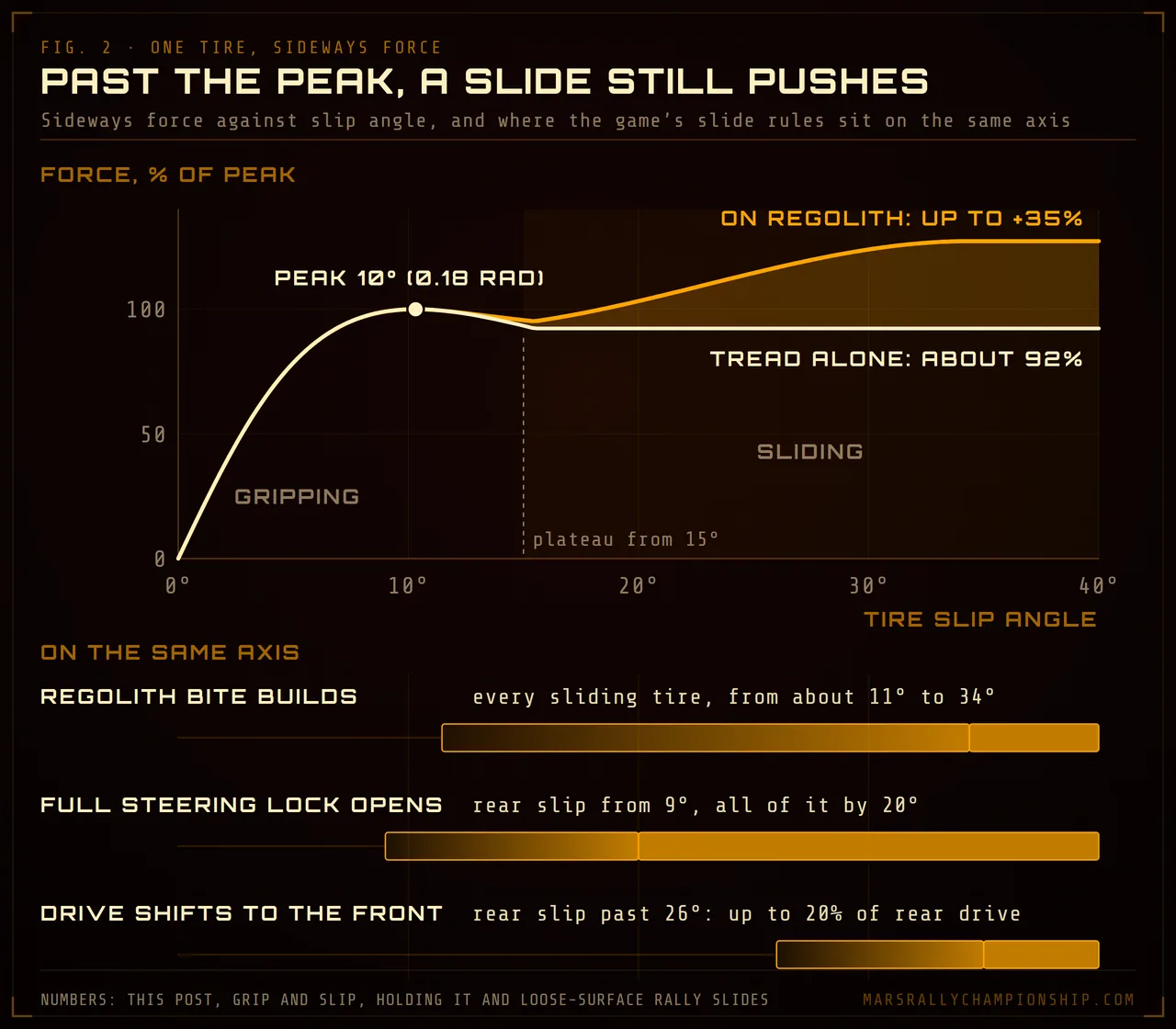
Diagram: past its 10° peak the tread keeps about 92% of its grip, regolith adds up to 35% more, and slide helpers switch on from 9° to 26°.
The same slide means different things depending on what is under the tires and what the game scores.
| Kind of slide | Goal | How it starts | What holds it | How it is judged | What the surface does |
|---|---|---|---|---|---|
| Asphalt competition drift | Angle, line and style | Clutch kick, power, weight transfer, handbrake | Countersteer and throttle | Formula DRIFT 2026: telemetry scores line and angle, judges score style | Little beyond the tire's own peak |
| Drift scoring in games | Points and multipliers | Depends on the game | Countersteer and throttle | Angle, speed, duration and clipping zones, by game | Depends on the game |
| Rally slide on gravel | Fastest stage time | Weight transfer or handbrake | Countersteer, throttle and the loose surface | The clock | Loose soil pushes back on a sideways tire |
| Mars Rally Championship on regolith | Fastest stage time | Handbrake only | Countersteer, throttle, up to +35% sideways bite from the regolith | The clock; drift time counts toward achievements | About 3.1 m/s² of grip under 38% of Earth's gravity |
How drifting is scored
Formula DRIFT's 2026 format, announced with Race Data Labs, hands line and angle to telemetry in PRO qualifying: Race Data Labs' UDSM system sets about 80% of the score, and three judges decide style, about 20%. PROSPEC splits it 40% angle, 40% line and 20% style. Before 2026, three judges scored line, angle and style by hand.
Games borrow the same vocabulary. CarX Drift Racing Online's own achievement list names Fast Entry, Fast Transition, Drawn-out Drift, Clipping Zone and Clipping Point. Forza Horizon 6's release notes describe Drift Attack as a permanent mode with Clipping Zones, and guides say its Drift Zones reward angle, speed and duration, though the formula is unpublished. Drift Hunters MAX judges its Drift Attack on timers and clipping points. Treat game formulas as guide-level.
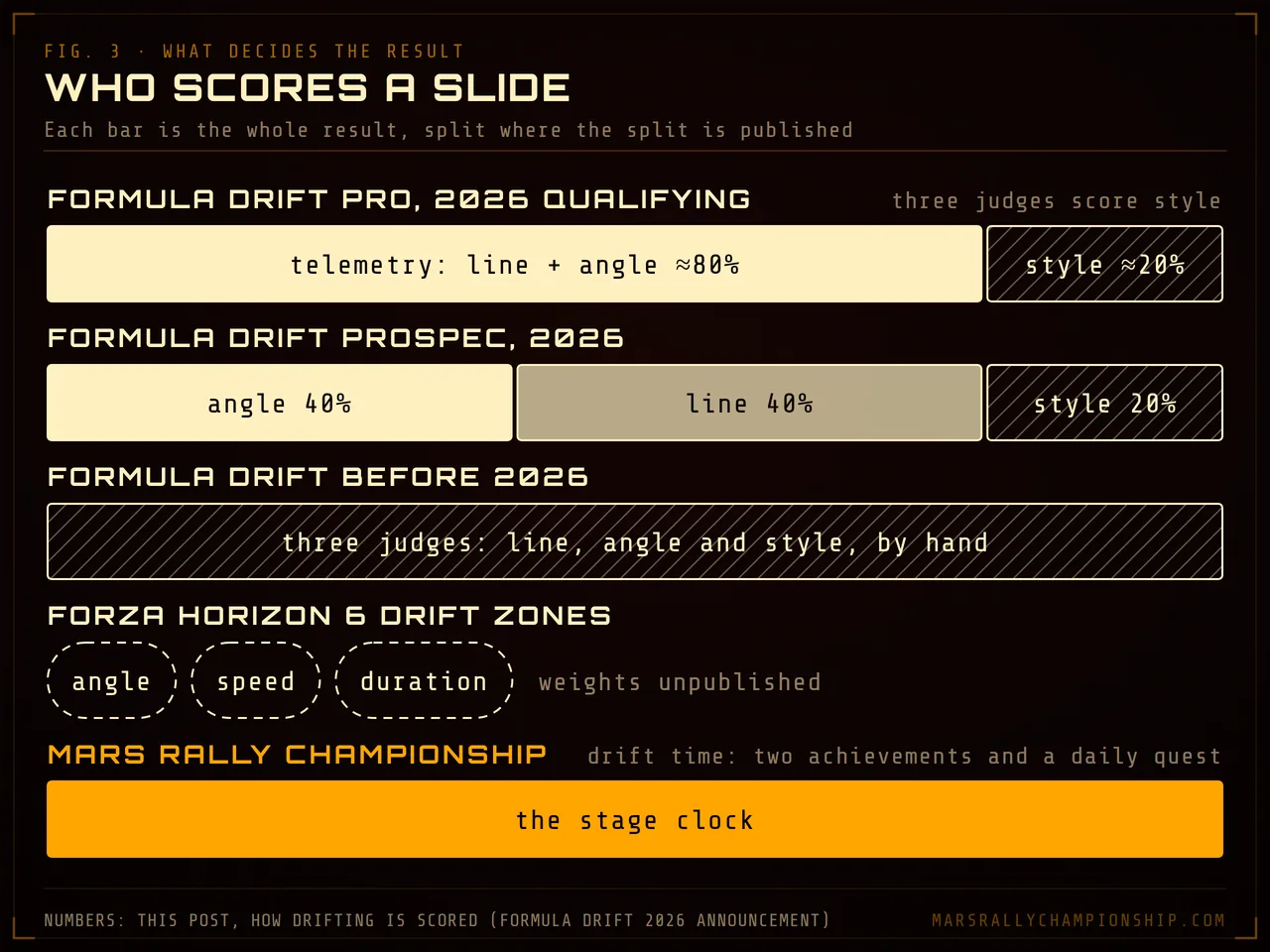
Diagram: Formula DRIFT now hands line and angle to telemetry; Forza Horizon 6 publishes no weights; Mars Rally Championship scores only the clock.
Mars Rally Championship has no drift score, no multiplier and no judged event, by design. The stage clock decides everything, and drift time counts only toward two achievements and a daily quest. It is also one rover for everyone, with a cosmetics-only garage and no car-to-car collisions online.
Which drifting games model what
Eight lists on this site each answer a different question. Best drifting games is the hub across browser, PC and console. Free online drifting games covers what runs free in a browser, and multiplayer drift games covers rooms, tandem runs and collisions. For tire models compared, go to best drift simulator games; for the easiest starts, best arcade drifting games. PC players can use best drift games for PC, including free and low-spec picks, best drift racing games sets judged drifting against racing, and best 3D drifting games looks at cameras and replays.
Try it yourself
Start with the Proving Ground, where catching the slide is a lesson of its own. Free roam has no timer, but nothing banks to career stats, so slides there do not count toward SIDEWAYS. For a real stage, The Long Run has two corners of about 35° to 40° between the 500 m and 700 m marks, with room to practise a slide at speed.
The Scandinavian flick post explains why the feint fails here, and the per-wheel tire model write-up is the engineering version of everything above.