The most realistic browser racing game on this list is Mars Rally Championship, a free browser rally game and our own: it simulates more of the car than the others, from tire slip at each wheel to damage that changes the handling, steps its physics at 480 Hz and needs no download. After it come 3D off-road games such as Offroad Island for suspension, PolyTrack for precision and Drive Mad for weight transfer. The most realistic driving sims, BeamNG.drive among them, are still downloads.
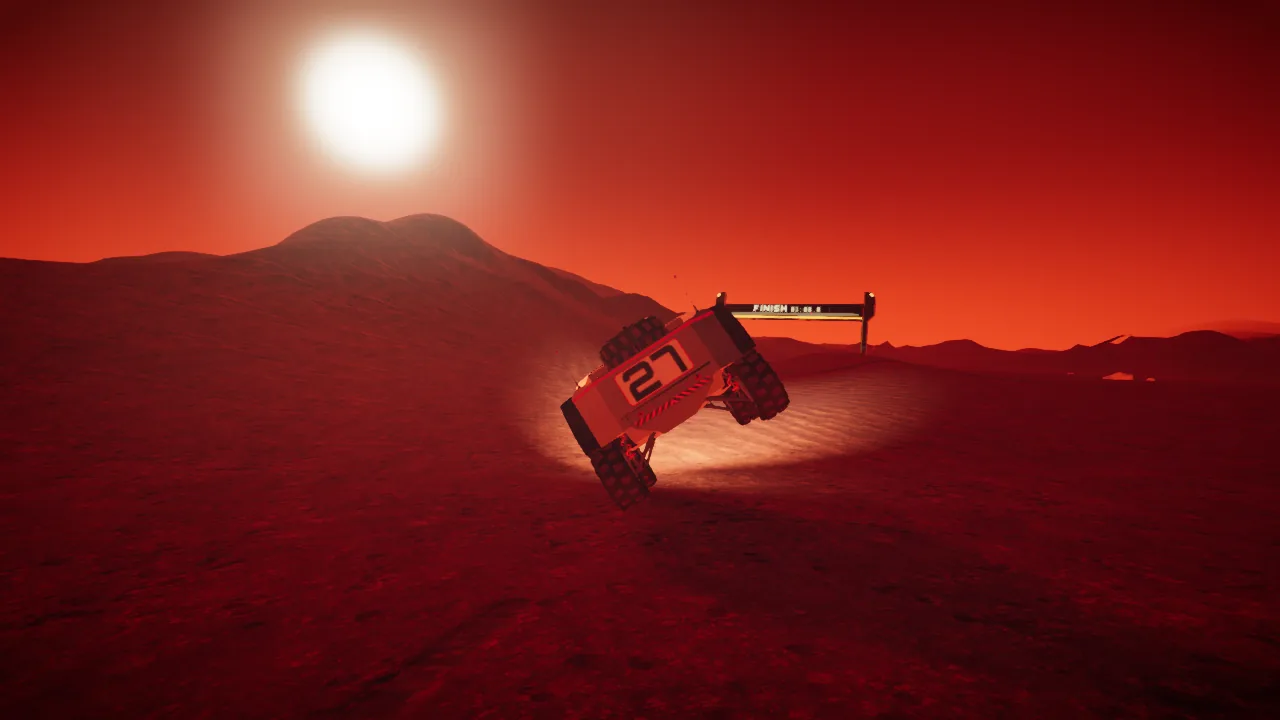
In-game screenshot: arms and coilovers follow each wheel, one corner reaching down while the opposite one compresses, from the LOW camera.
What makes a driving game realistic
The marketing test for "realistic" or "physics-based" is whether the car can flip over. Any engine with a rigid body and a convex collider passes it, which is why both labels mean little on a games portal. The useful test is narrower: whether the game computes forces at the contact patch, and whether the rest of the car responds to them.
Five things separate a realistic driving game from an arcade racer wearing the label, and you can check most of them in a minute of driving.
A tire model, not a steering multiplier
A real tire generates lateral force from slip angle — the difference between where the wheel is pointed and the direction it is actually travelling — and longitudinal force from slip ratio, the difference between wheel surface speed and ground speed. Force rises with slip to a peak, then falls away. That falling edge is what a slide feels like: past the peak, more steering gives you less grip.
Arcade games skip the curve. Steering input becomes yaw rate, and grip is a constant you either have or do not. An arcade car never gets progressively worse as you ask for more.
Mars Rally Championship runs a per-wheel Pacejka-style curve that peaks at 0.18 rad of slip angle, about 10 degrees, and everything past that is the sliding regime. Braking and drive forces share each tire's friction circle with cornering; how that per-wheel tire model works in JavaScript has its own write-up.
Per-wheel load transfer
Grip grows with the load a tire carries, though not quite in proportion. Brake hard and load moves forward: the fronts gain grip, the rears lose it. Turn in while braking and the outside front carries the most load. A game that computes forces per wheel gets trail braking, lift-off rotation, and inside-wheel lift for free, because they are consequences rather than features. A game with one grip value for the whole car cannot produce any of that, however good the suspension animation looks.
Suspension that tracks the terrain
On tarmac you can almost get away without it. Off-road you cannot. Each corner needs a spring and damper with real travel, the wheel needs to reach into dips instead of hanging in the air, and the chassis needs to pitch and roll freely on top of the four contact points.
Mars Rally Championship carries a soft-contact spring constant of 30 specifically so wheels reach over crests rather than skating off them, and it computes rollover geometrically: with a 0.9 m half-track and a 0.7 m centre-of-gravity height, the rover tips at roughly 52 degrees of lean.
Deterministic integration
Fixed timestep, fixed substep count, seeded randomness. If a game integrates against a variable frame delta, two runs with identical inputs diverge, and everything built on repeatability — ghosts, replays, leaderboard verification — turns approximate. Mars Rally Championship steps its physics at a fixed 60 Hz with 8 substeps each, 480 Hz whatever the display is doing, and seeds its world so a recorded input stream replays bit-exact — its leaderboard re-simulates every submitted run that way before posting the time. Bit-exact replays and deterministic physics has the long version.
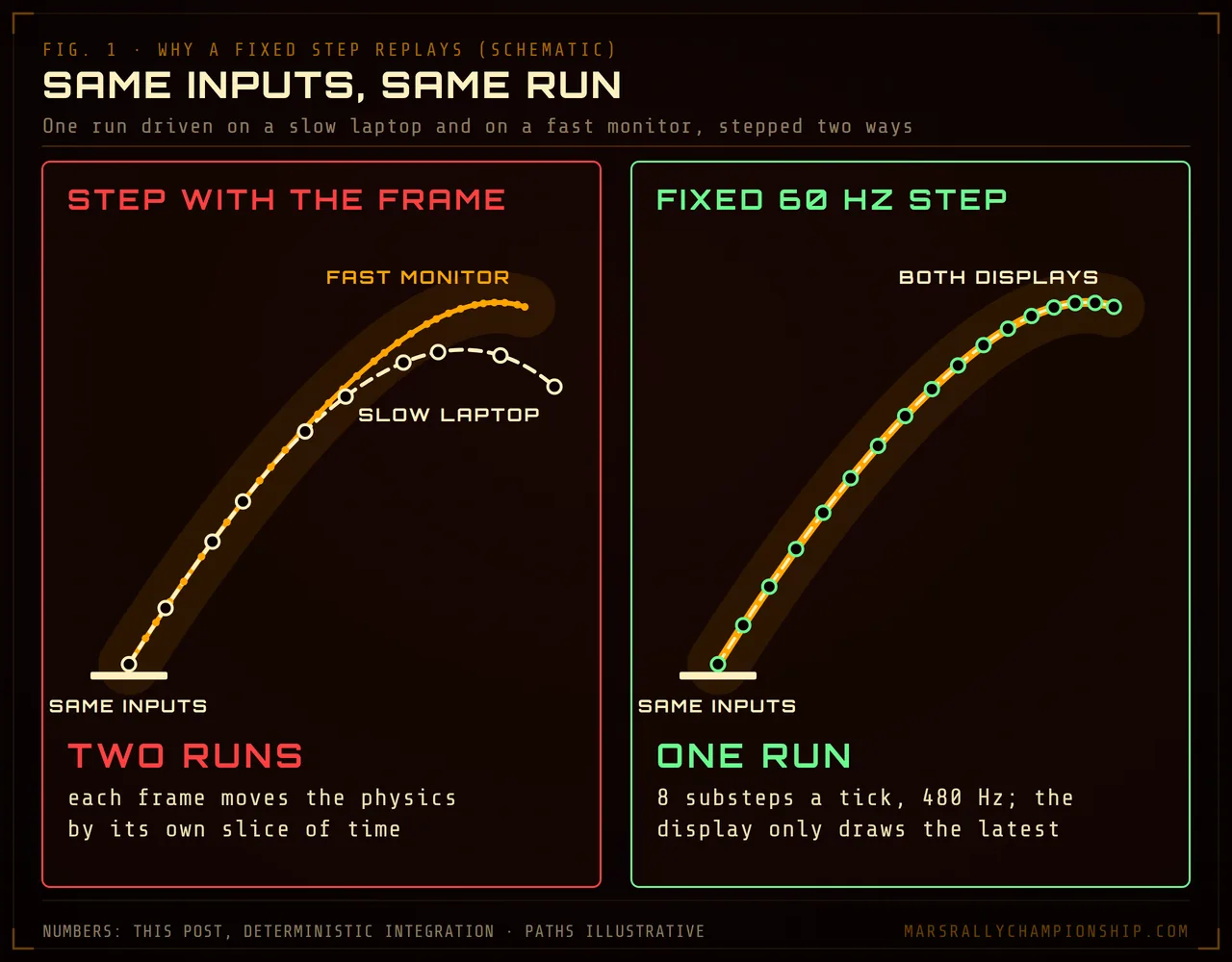
Diagram: with a fixed step the display only draws the latest tick, so the same inputs make the same run on any machine.
Damage that changes the handling
Cosmetic dents are a rendering feature. Damage counts as physics when it feeds back into the model: a bent corner that pulls the steering, a dead motor that halves torque, a tire losing pressure until it will not hold a line. Very few browser games do it; how ours wires four health pools into the handling is covered separately.
Why full soft-body physics does not run in a browser tab
Search for a car physics game in a browser and plenty of pages claim to be BeamNG.drive. None of them are, and the reason is architectural rather than a matter of effort.
BeamNG simulates each vehicle as a lattice of nodes joined by beams. Deformation is not authored; it emerges when beams stretch, buckle, and break. Solving that lattice for every vehicle at a very high internal rate takes native threads with tight memory locality, which is why it ships as a download.
A browser tab gets one main thread, workers that talk by message passing, and WebAssembly that lands near native for arithmetic but pays for every crossing. A rigid-body vehicle with per-wheel forces runs comfortably at high substep counts. A full node-beam solver for a car, its opponents, and a rendered world at 60 fps does not.
The honest position: browser driving games top out at rigid-body simulation with detailed per-wheel forces. Within that ceiling there is a wide range, and most games sit near the bottom of it.
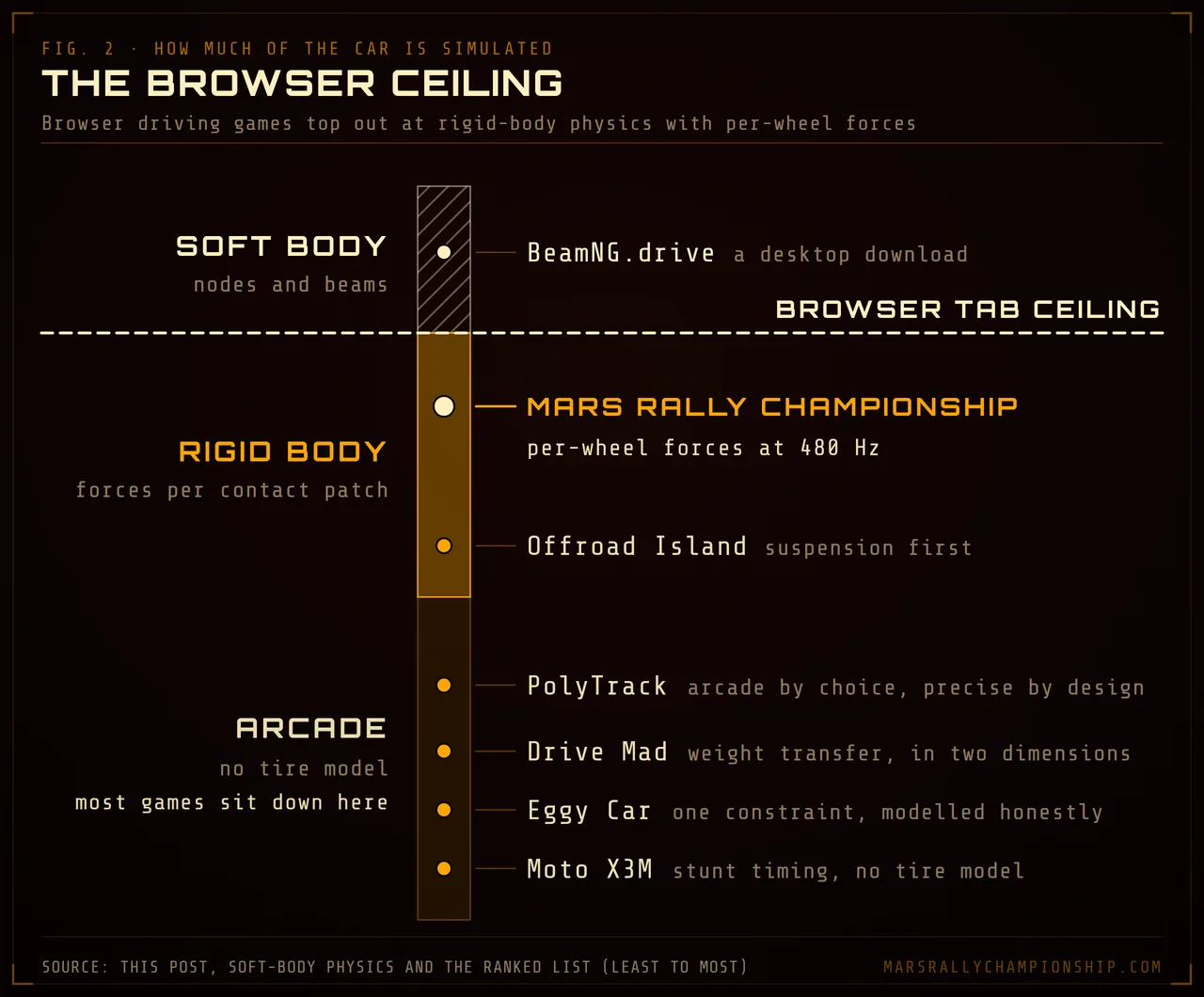
Diagram: every browser game sits under the ceiling, most of them near the bottom; BeamNG’s nodes and beams need a desktop download.
For BeamNG.drive itself, BeamNG in a browser covers where the real game runs, what the BeamNG online sites are, and how to stream a copy you own.
Realistic browser racing games, ranked by how much physics they run
Mars Rally Championship is first because it is ours; the rest, checked in October 2026, are ranked from least simulation to most, so the most realistic comes last. Low here is not an insult — read the fairness section below first.
Mars Rally Championship — per-wheel forces at 480 Hz
Our game, listed first for that reason. This is Mars Rally Championship's own site; everything below it is ranked on its merits.
Mars Rally Championship is a free browser rally game running the full stack in JavaScript: a Pacejka-style tire curve per wheel and sideways load transfer from a 3,000 kg rigid body rolling on four spring-damper corners, 480 times a second. Fore-and-aft transfer is not simulated: the nose dip under braking is drawn, and the front tires gain no load from it.
The setting does the teaching. Mars gravity is 3.72 m/s², and with a base tire friction coefficient of 0.70 plus the regolith's own cohesion the entire grip budget is about 3.1 m/s² — braking, cornering, and acceleration all drawing on the same account. Braking from 100 km/h takes roughly 125 metres. Surfaces move the effective coefficient between about 0.53 on cracked polygon ground and 0.81 on ancient hardpack lakebed. The arithmetic is in what 3.72 m/s² does to rally driving.
Damage is four pools — chassis, suspension, motor, battery — and each one changes the car. Flatten the suspension and grip drops to 40% of nominal. Kill the motor and torque halves. Uneven damage pulls the steering by up to about 4.5 degrees, so a bad hit on the left front follows you for the rest of the stage.
Where it falls short: one rover with one handling model and no upgrades, three stages, and no soft-body deformation. It plays on keyboard, gamepad or touch and has not been tested with a steering wheel. Its realism is Mars physics, not Earth cars, on terrain sculpted to Martian morphologies rather than mapped from a real place.
Play free — no downloadMoto X3M — stunt timing rather than vehicle dynamics
A 2D bike on a timer, with rotation control in the air and a ragdoll rider. The suspension reads well and the body rotates with input, but there is no meaningful tire model, and a crash sends you back to the last checkpoint with the clock still running instead of degrading the bike. What it simulates precisely is time: each level is a memorisation puzzle with a stopwatch, and it is very good at that.
Eggy Car — one constraint, modelled honestly
An egg balanced on a car over rolling hills. Almost everything else is stripped out, but the one thing left is real: longitudinal load transfer. Accelerate too hard and the egg goes backwards, brake into a downslope and it goes forwards. It is a physics game in the strict sense with a single degree of freedom, and it teaches throttle modulation better than most games with ten times the code.
Drive Mad — weight transfer as the entire puzzle
The most physics-literate of the 2D obstacle-course games, created by Martin Magni in Fancade. Each level is a question about pitch, asked with throttle and brake alone: how much throttle you can carry before the truck rotates nose-up, when to lift so the front drops onto a ramp, how to land flat. Suspension is present and matters. There is no lateral tire model, because there is no lateral axis, and damage is pass or fail: land badly and the truck falls to pieces, then the level restarts. Within two dimensions the model is consistent, which is why the levels feel solvable rather than random.
PolyTrack — arcade by choice, precise by design
PolyTrack does not pretend to simulate tires, but it gets right the thing that matters most for time attack: the same inputs give you the same run. Handling is a tuned arcade model with sharp, readable limits, built around ghosts, leaderboards, and a track editor. Its developer, Kodub, is still adding to it: version 0.6.0 brought multiplayer. If your definition of realistic is "I can shave a tenth and know the tenth was mine", PolyTrack delivers it with almost none of the machinery a simulator needs.
Offroad Island and the 3D off-road games — suspension first
The 3D off-road browser games invert the usual priority. Speed is low, so slip curves matter less and articulation matters more: wheels dropping into ruts, one corner unloading on a side slope. Offroad Island, by Hihoy, puts trucks, quads and bikes on three open-world maps. What you typically get is a raycast spring per wheel with a friction approximation on top — a real suspension model with an estimated tire. That is the right trade for crawling terrain, and it is why these feel more simulated than a fast arcade racer despite the simpler tire. If suspension and ground are what you came for, off-road games online is the wider list.
OTR, a name that turns up beside these in searches, is not a browser game: OTR 2 - Offroad Simulator is a Google Play app from Dogbyte Games.
Car physics in browser games, compared
"Full" means the game models the thing properly, "basic" means an approximation stands in, "—" means it is absent, and "not confirmed" means it could not be checked. Surfaces counts the ground types that change grip, and Input devices lists only what was confirmed for the game, so a short entry is not a ban on the others. Mars Rally Championship is first because it is ours; the rest run from most simulation to least. BeamNG.drive is the desktop reference point, not a browser option.
For controller and touch support across a wider set of browser racers, the browser racing game compatibility table sets them side by side.
| Game | Tire model | Suspension | Weight transfer | Surfaces | Damage affects handling | Fixed simulation rate | Deterministic replays or ghosts | Input devices |
|---|---|---|---|---|---|---|---|---|
| Mars Rally Championship Play | full (per-wheel slip curve) | full (spring-damper per corner) | sideways only (body roll); not fore-and-aft | three (regolith, hardpack, polygon) | full (four damage pools) | fixed 60 Hz, 8 substeps (480 Hz) | full (runs re-simulated bit-exact) | keyboard, gamepad, touch |
| Offroad Island and similar 3D off-road games | basic (friction approximation) | full (per-wheel travel) | not confirmed | not confirmed | not confirmed | not confirmed | — | not confirmed |
| PolyTrack | — (arcade by design) | — | — | not confirmed | — | not confirmed | full (ghosts and leaderboards) | keyboard (no gamepad) |
| Drive Mad | — (2D contact friction) | basic | pitch only (2D) | not confirmed | — (pass or fail) | not confirmed | — | touch on phones |
| Eggy Car | — | basic | longitudinal only | not confirmed | — | not confirmed | — | touch on phones |
| Moto X3M | — | basic | not confirmed | not confirmed | — (a crash resets to a checkpoint) | not confirmed | — | touch on phones |
| BeamNG.drive (desktop download) | full | full (soft-body) | not confirmed | not confirmed | full (soft-body deformation) | very high (figure not confirmed) | n/a — not a browser game | not confirmed |
What changes when you hold a slide
A drift is the same tire model asked for more. Push the slip angle past the curve's peak and the tire stops giving more grip for more steering; in Mars Rally Championship the peak sits at about 10 degrees, and from about 15 degrees the sideways force settles on a plateau near 92% of that peak instead of falling away. That plateau is why a held slide stays catchable here: you are sliding, but the tire is still pushing. Countersteer then points the front wheels where the car is travelling, and the throttle decides how the rover comes out. A game with a constant-grip car has no peak to pass, so it has no slide to hold. How a drift works in a racing game walks through the mechanism, and the best drift simulator games compares how deeply other games model it.
A simpler physics game can be the better game
Depth of simulation is a measurement, not a verdict. Eggy Car models one axis and is more immediately satisfying than plenty of games with per-wheel solvers, because that axis is legible, instant, and funny when it fails.
Simulation depth buys two things. First, transfer: what you learn on a real tire model — trail braking, catching a slide before the peak, reading load — carries to other simulators and, roughly, to a real car. Second, headroom: a deeper model keeps producing new problems after you have memorised the track, which separates a game you finish from a game you keep a personal best in.
If you want a fifteen-minute puzzle, pick the simple one. If you want something to get measurably better at over months, pick the one with the tire curve.
Realistic driving games online, free and with no download
Every game ranked above is free in a browser tab, with nothing to install; realism is the part to check yourself. Round-ups of realistic browser games praise City Car Driving Simulator for its traffic and signals and Racing Limits for its "realistic physics engine", but none of those descriptions says what the tires do. Run the checks above instead: push past the grip and see whether it comes back gradually, brake into a corner and feel the nose take the load.
The most realistic driving is still a download: BeamNG.drive for crashes, and the desktop rally sims scored in what the most realistic rally game is. For the arcade side of the free field, see our list of free racing games with no download. To sort browser games by kind of driving instead, our best browser driving games guide covers rally, time trial, drifting, free roam, off-road, stunts and city traffic.
Where to try this
Mars Rally Championship needs no download, no install, and no account. It runs in any modern browser with WebGL, including on a Chromebook, and phones and tablets get touch controls in landscape.
- Play Mars Rally Championship — three stages open today, plus free roam with no timer
- Stage 1, The Eight — a 2,676 m night loop through 12 checkpoints, where a new pilot's first timed run happens
- Ghost racing — race the board's ghosts, and watch any board run rebuilt from its inputs
- The Proving Ground tutorial — nineteen lessons, from throttle and the 125 m stop to catching a slide