Beat a rival's ghost by two tenths and a reasonable pilot asks the obvious question: was that ghost telling the truth? In most racing games, the honest answer is "more or less." A ghost is usually a smoothed recording — position samples captured a few times per second, interpolated back into something car-shaped. It looks like the run. It is not the run.
Mars Rally Championship does it differently. Every run here is bit-exact: replay the same inputs on the same stage and the simulation reproduces the original run down to the last floating-point digit — which is exactly what the server does before any time goes on the leaderboard. That one engineering decision quietly powers half the game — the ghost racing and rival ladder, the daily challenge, and the way online multiplayer shrugs off lag. Here's the deep dive, kept light enough to read between stages.
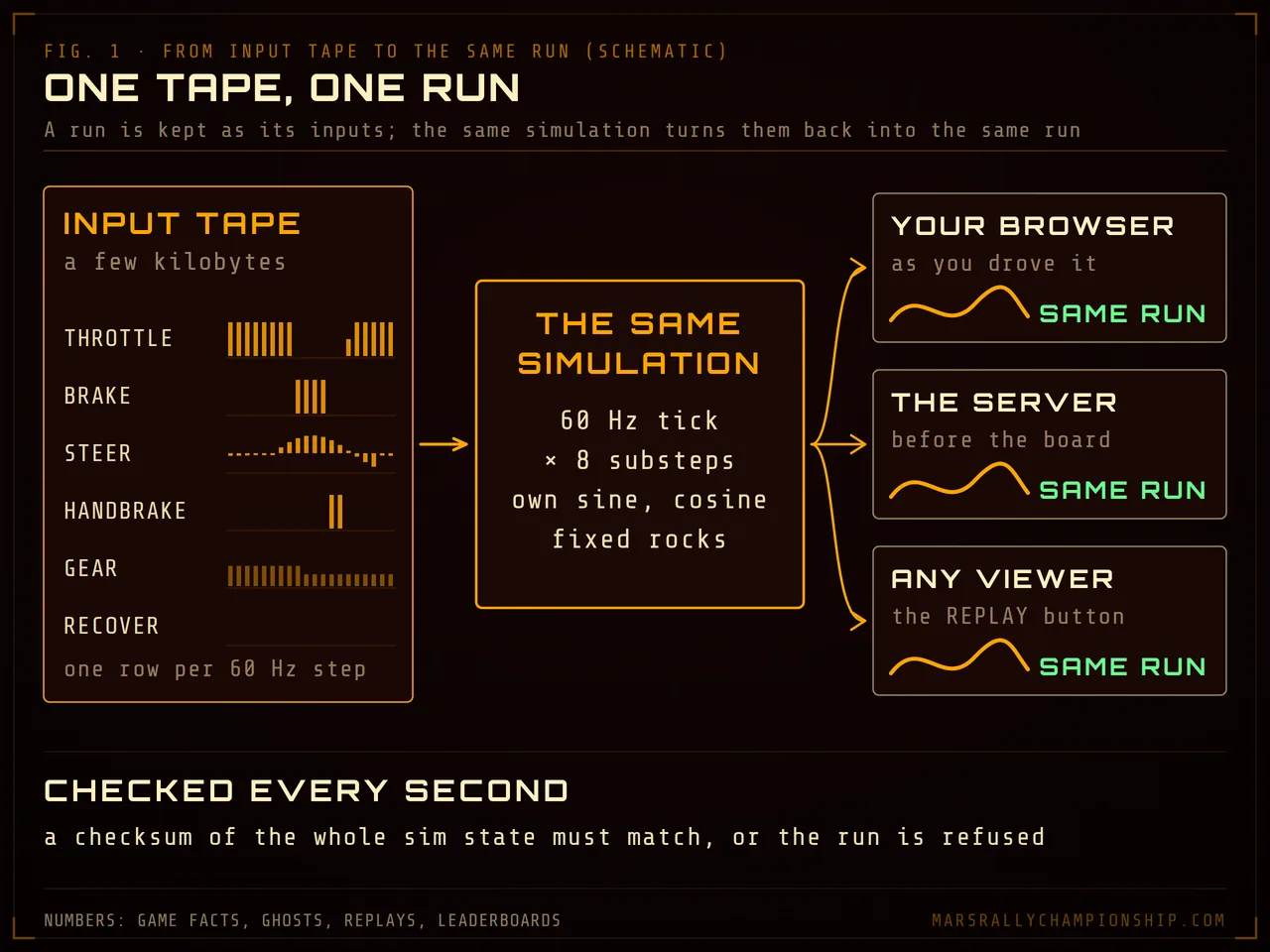
Diagram: a run is stored as its inputs, and the same simulation rebuilds it bit for bit in your browser, on the server and for any viewer.
What "deterministic" actually means
A simulation is deterministic when the same starting state plus the same inputs always produce the same output. Not roughly the same. The same. Every wheel-contact calculation, every suspension tick, every plume of regolith kicked sideways lands on identical numbers, run after run, machine after machine.
That sounds like it should be table stakes for a physics engine. It is not — and the reasons are worth knowing, because they explain why so few games ship a real replay system.
Why most games can't replay bit-for-bit
Three things quietly break determinism in a typical engine:
| Nondeterminism source | What goes wrong | How Mars Rally handles it |
|---|---|---|
| Variable timestep | Physics integrates once per rendered frame, so a 144 Hz machine computes a different trajectory than a 60 Hz one | Fixed substeps — the sim ticks at a constant rate no matter what your GPU is doing |
| Unseeded randomness | Terrain scatter and any stray random() call diverge between runs | Seeded noise and seeded rocks — terrain roughness and every boulder come from the stage's seed, so the same seed builds the same Mars |
| Frame-dependent math | Forces scaled by "time since last frame" bake your framerate into the physics, and a browser's own Math.sin can differ from another's in the last bit | The per-wheel tire model runs entirely inside the fixed step, so render framerate is purely cosmetic, and the simulation's trig and exponent functions are its own, written with basic arithmetic |
Once any of those leak in, replays drift — a millimeter of error on tick one becomes a meter by the first crest and a DNF by the ravine. So most games give up on re-simulation and store position snapshots instead. Fine for a highlight reel. Useless as evidence.
Honest ghosts, downloadable rivals
Because the sim is deterministic, a run doesn't have to be kept as footage — it can be kept as what the pilot did: a recorded input stream that re-simulates into the identical run. The leaderboard keeps every run that way and checks it: before a time goes up, the server drives the inputs through the same simulation, and the ghost you download is the recording of that re-simulation, not something the pilot uploaded. That makes ghosts genuinely honest. When the ghost brakes two meters later than you into a ridgeline hairpin, that braking point is physically real and physically stealable.
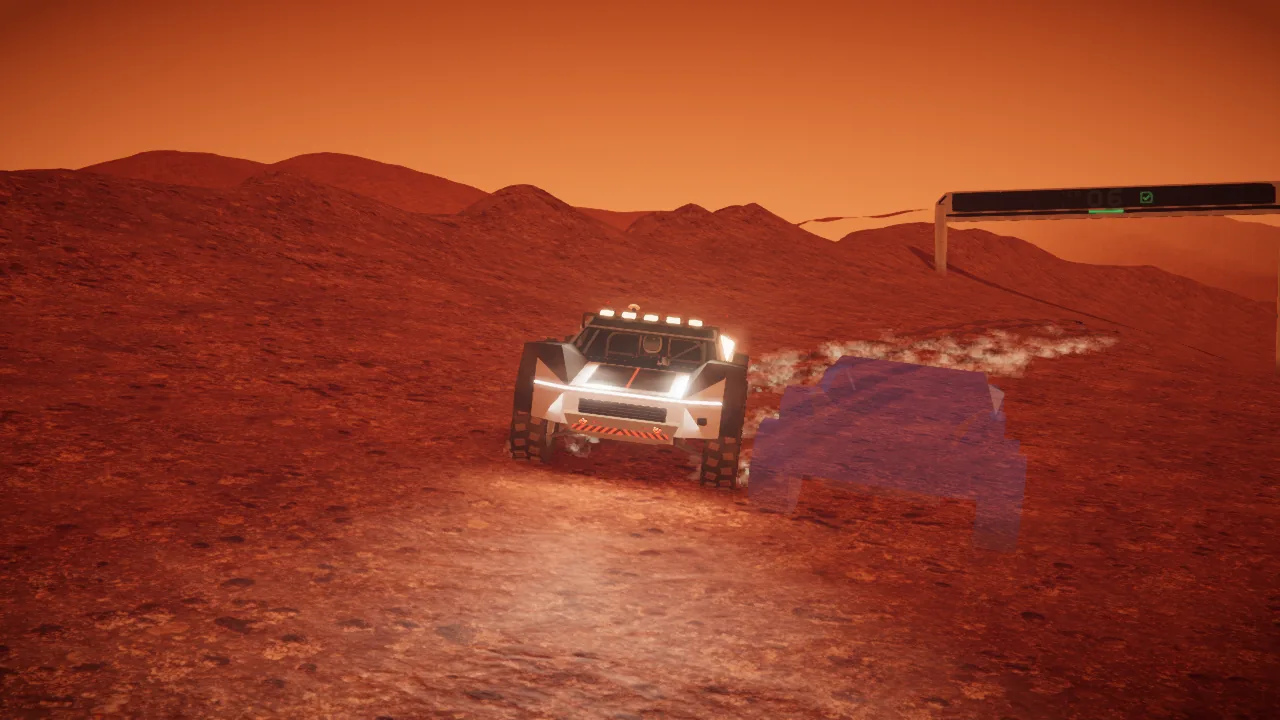
In-game screenshot: a ghost running alongside the rover on Stage 2. Board ghosts are recorded from the server's re-run of the inputs, not uploaded by the pilot.
It also makes ghosts cheap and portable. Every stage keeps a downloadable best ghost, and split-delta timing shows exactly where the gap opens — not "you're slower," but "you're slower through the second basin, specifically." The rival ladder builds on the same foundation: you're always chasing the pilot just above your personal best, and the ghost you're chasing did exactly what its time claims it did.
Mars raises the stakes on all of this. At 0.38 g, a crest taken 3 km/h faster turns a jump into a flight plan — long air, late landings, drifty regolith on arrival. When your stage time is decided by airtime, you want the ghost's airtime to be real.
Multiplayer that ignores your ping
Online racing runs the same trick in real time. Up to 8 pilots launch the same stage on a synced countdown, and everyone else renders as a live, name-tagged ghost — no car-to-car collisions, no server-side physics arbitration. Your rover's simulation runs entirely on your machine; the network only carries where everyone is and, at the end, what everyone's clock says.
That architecture means lag cannot touch your run. A ping spike might make an opponent's ghost stutter across the dunes, but it can't nudge your wheels, eat your inputs, or rewrite your landing. Each pilot's timer runs from their own GO, the server ranks the finish times, and disconnecting earns you a DNF like a grown-up — nobody else's stage is affected.
Fair seeds, fair daily
Determinism also does quiet work in the daily challenge. Each day's challenge is seeded and resets at your local midnight — and because the seed picks only the stage and the sky, and each stage's ground and rocks are fixed, "same seed" means every pilot in every timezone drives the identical stage. Your leaderboard neighbor didn't get a friendlier ridgeline. There is no friendlier ridgeline.
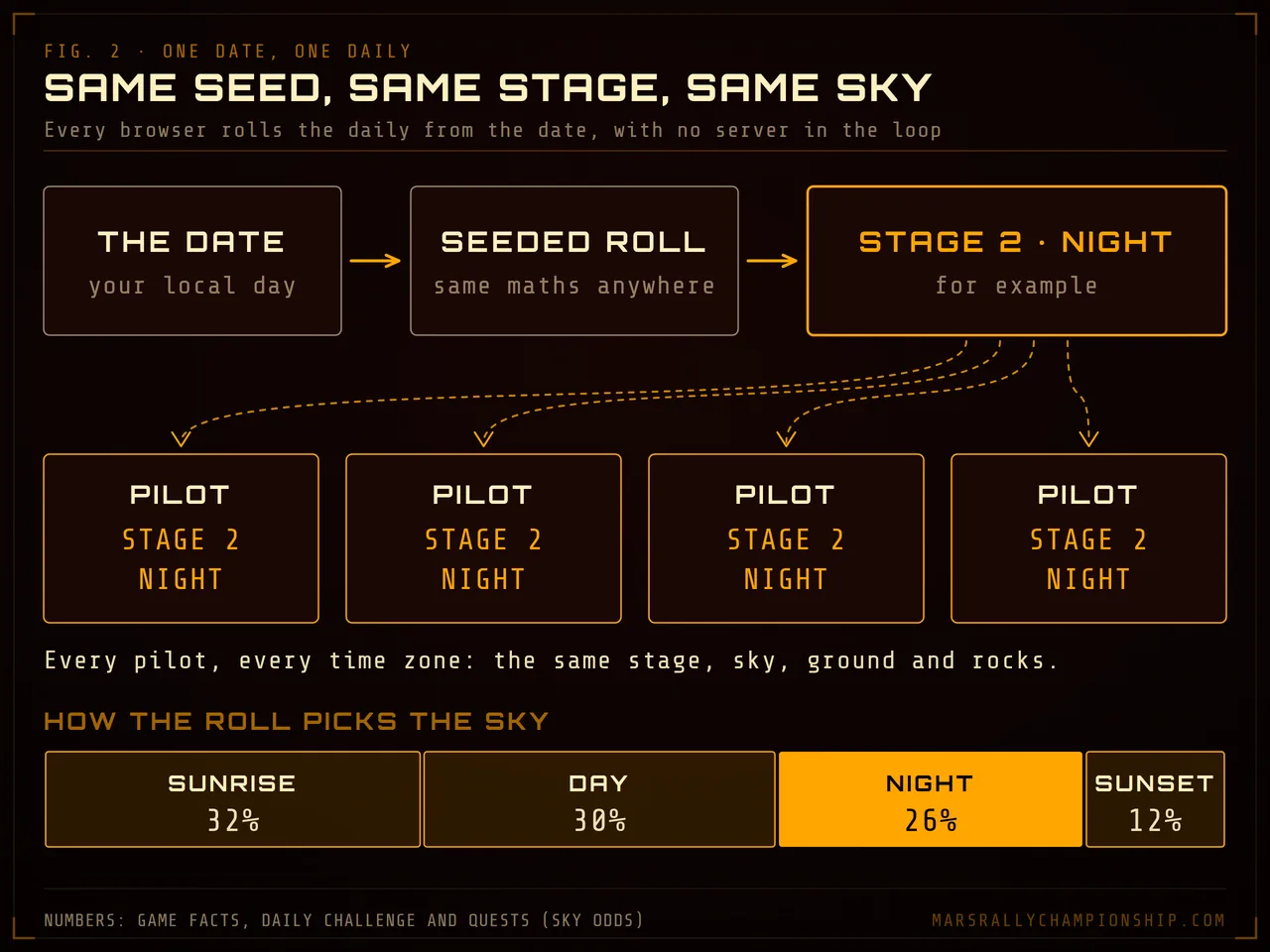
Diagram: the date seeds one roll in every browser, so every pilot gets the same stage under the same sky, with no server involved.
Same story on the global leaderboard: times submitted under a call sign are comparable across every machine that ever ran the stage, because every machine ran the same math. Every run on the board can also be watched rebuilt from its inputs, which makes the top of the board a public audit trail. Our racing games with leaderboards guide compares leaderboards on who checks a run before it posts, whether you can watch it and whether you need an account.
The takeaway
Deterministic physics is a feature you never see directly — there's no HUD readout for "fixed substeps." What you see is everything built on top of it: ghosts you can trust, rivals you can download, splits that tell the truth, multiplayer that doesn't care about your wifi, and a daily stage that's the same red planet for everyone.
Pick a stage, set a time, then race the ghost of the pilot who did it better. It knows exactly what it did — and now you know why.