Every racing game you have ever played was tuned around one number: 9.81 m/s². It hides inside braking points, corner speeds, jump arcs, and every aerodynamic wing ever bolted to a virtual car. Mars Rally Championship swaps that number for 3.72 m/s² — real Martian gravity, 38% of Earth's — then simulates the consequences honestly with a per-wheel tire model. This is a tour of what that one substitution does to rally driving, using the actual numbers from the physics configuration.
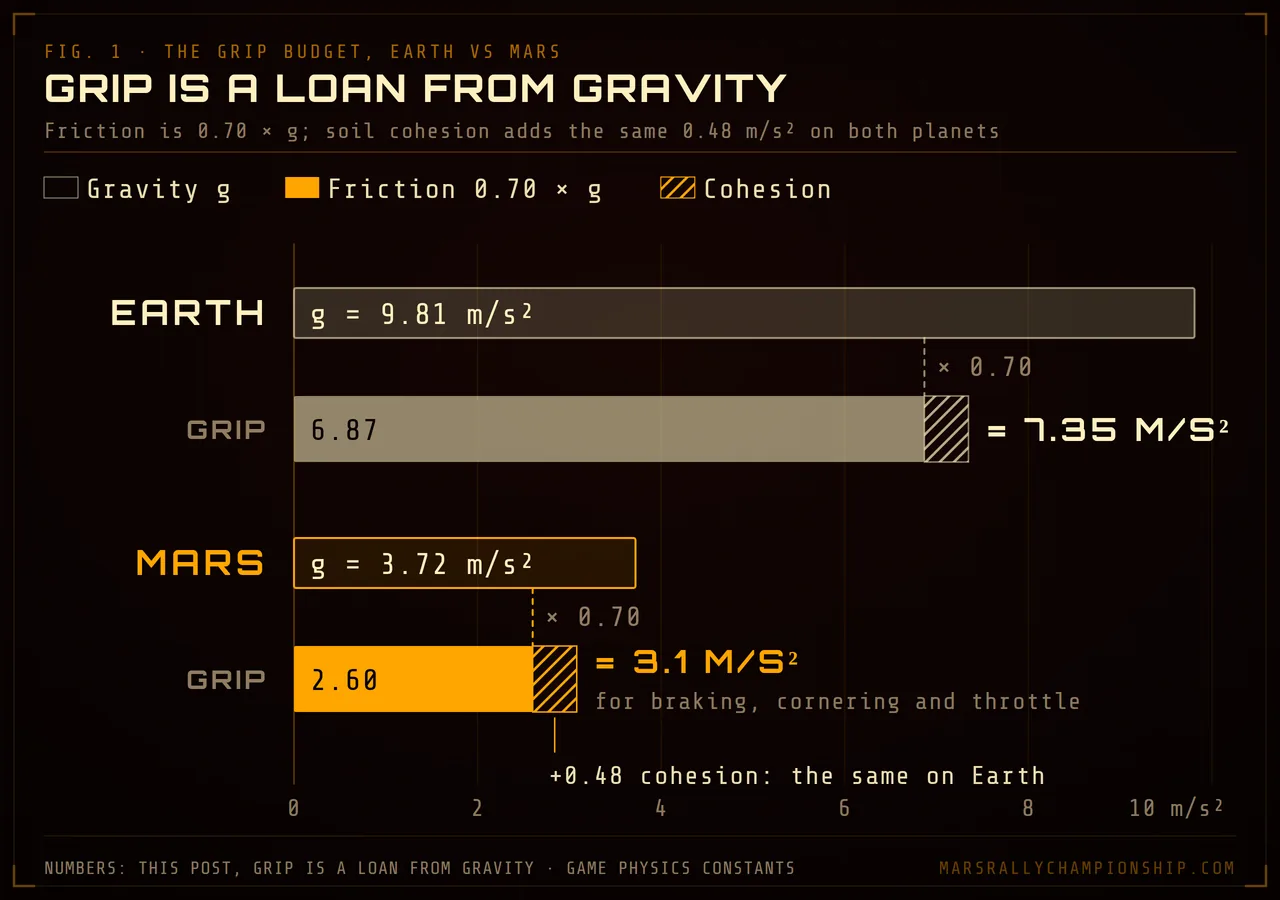
Diagram: friction is 0.70 of gravity on both planets, and cohesion adds the same 0.48 m/s², so Mars has 3.1 m/s² to spend where Earth gravel has 7.35.
Grip is a loan from gravity
A tire's grip budget is friction coefficient times load, and load is mass times gravity. Mars doesn't change the rover's 3,000 kg mass, but it presses that mass into the surface with 38% of the force — so every wheel earns 38% of the friction grip. The game models dry basaltic regolith under aggressive lug tires at a friction coefficient of about 0.70, which is honest gravel-rally rubber and would be plenty on Earth. Multiply by Mars gravity and friction comes to 2.6 m/s²; the regolith's cohesion — soil strength that low gravity does not take away — adds about 0.5, so the whole car has roughly 3.1 m/s² of total acceleration to spend — on braking, cornering, and throttle, combined.
That budget is the entire game. Everything below is the same number wearing different costumes.
Braking: 125 meters from 100 km/h
Run the equation and stopping from 100 km/h takes about 125 meters and 9 seconds. An Earth gravel car on identical tires and soil does it in roughly 52 meters. Nothing on the HUD warns you about the difference; your instincts simply lie to you by a factor of about 2.4, every corner, until retrained.
The co-driver is calibrated for it. Pace notes fire a full eight seconds ahead at speed — an Earth-tuned 4.5-second call was tested and arrived after the braking point had already gone by. When the voice says "right five," the correct response is to have lifted already.
The brakes at least spend that budget well. Full pedal demand deliberately exceeds the grip ceiling, and ABS holds each tire at the peak of its curve — so a straight stop takes the shortest distance the tires allow, and if you steer with the pedal held, each tire shares its grip between stopping and turning, so the rover turns while it slows. The handbrake goes further and locks the rear wheels outright, because sometimes that is the point.
Cornering: the geometry gets ruthless
With about 3.1 m/s² of lateral budget, the minimum corner radius at 100 km/h works out to about 250 meters. Not a typo. A corner the same car takes at 100 on Earth gravel needs either about 65% of the speed or about 2.4 times the room here.
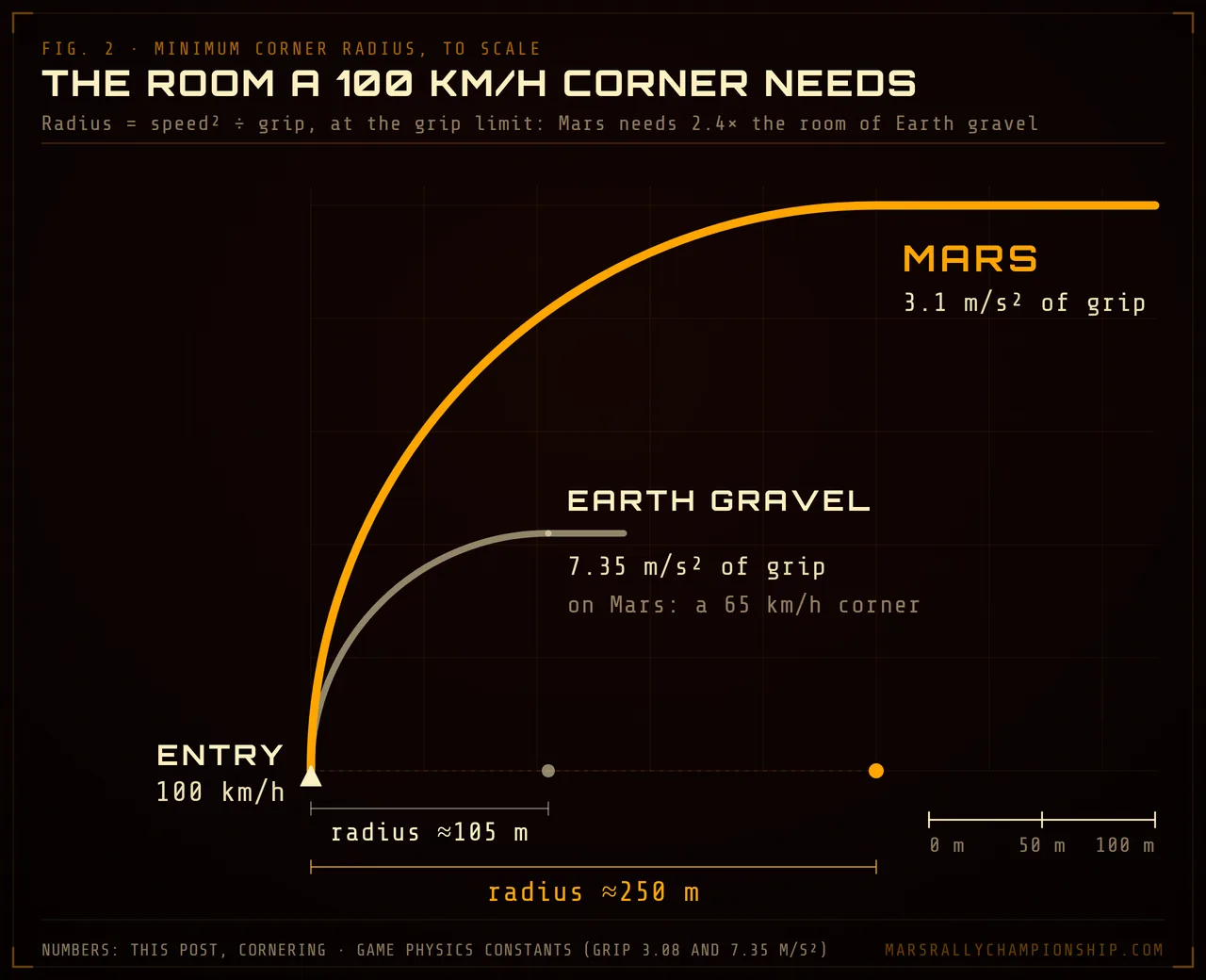
Diagram: at 100 km/h the rover needs a 250 m radius on Mars, 2.4 times Earth gravel; the tighter Earth corner is a 65 km/h corner here.
So the fast line on Mars is long, low arcs: turn-in absurdly early, apex treated as a suggestion, exit speed protected at all costs. Acceleration is traction-limited too — 0 to 100 km/h takes around 11 seconds no matter how hard the motor tries — so every km/h scrubbed in a corner is bought back at agonizing interest on the following straight.
Downforce: not available at any price
Mars' atmosphere is about 1.6% the density of Earth's. Downforce scales with air density, so a wing that plants an Earth car would generate a rounding error here — aero grip simply isn't on the menu, at any speed, ever. The same thin air cuts the other way: there's almost no drag, so lifting off the throttle barely slows you. Regen braking is the closest thing to free deceleration on the planet, and it feeds the battery while it works.
Jumps: hang time, multiplied by 2.6
Airtime and jump range scale inversely with gravity, so the same crest at the same speed throws you about 2.6 times farther and keeps you airborne 2.6 times longer than Earth would. A polite hop becomes a flight plan — and while you're flying, that 3.1 m/s² grip budget is doing exactly nothing for you.
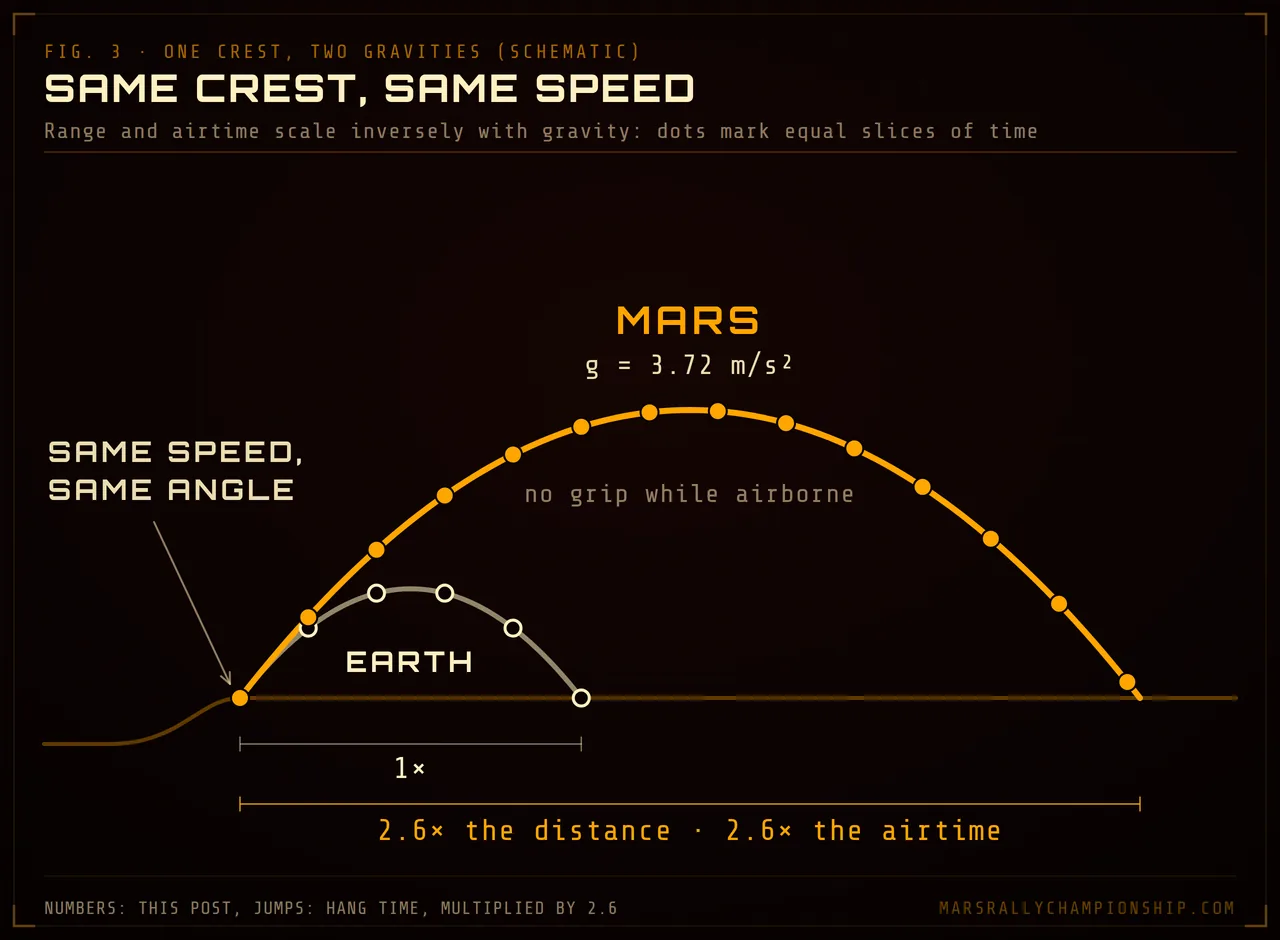
Diagram: dots mark equal slices of time; from the same crest at the same speed, Mars carries the rover 2.6 times as far and 2.6 times as long.
Fast pilots respond by choosing less air: skim crests instead of launching off them, and feed in throttle just before touchdown to settle the rear. Low gravity also makes rollovers easier — there's very little force pulling a tilted rover back onto its wheels, so drift angles that self-correct on Earth become slow-motion barrel rolls here.
Where to feel each number
Theory converts to lap time quickly on Mars. The Proving Ground tutorial drills braking distances and flat landings. Stage 1 is the exam — a steep downhill opener built around exactly these lessons, which is why a first timed run starts on the easier Stage 2. Ghost racing shows you, checkpoint by checkpoint, where your grip budget is leaking compared to a faster run. And the daily challenge hands everyone the identical seeded stage, so the leaderboard argument is settled by driving, not luck.
One number changed. Everything followed. Brake earlier than you think — then earlier than that.