Driving on Mars would feel unnervingly slow to stop and unnervingly easy to launch. Gravity is 3.72 m/s², 38% of Earth's, so each tire presses into the ground with 38% of the load and earns 38% of the friction — with soil cohesion on top, a total budget of about 3.1 m/s² for braking, cornering and throttle combined, and roughly 125 meters to stop from 100 km/h. The atmosphere, at 1.6% of Earth's density, gives you no downforce and almost no drag. Mars Rally Championship, a free browser rally game, runs on exactly those constants.
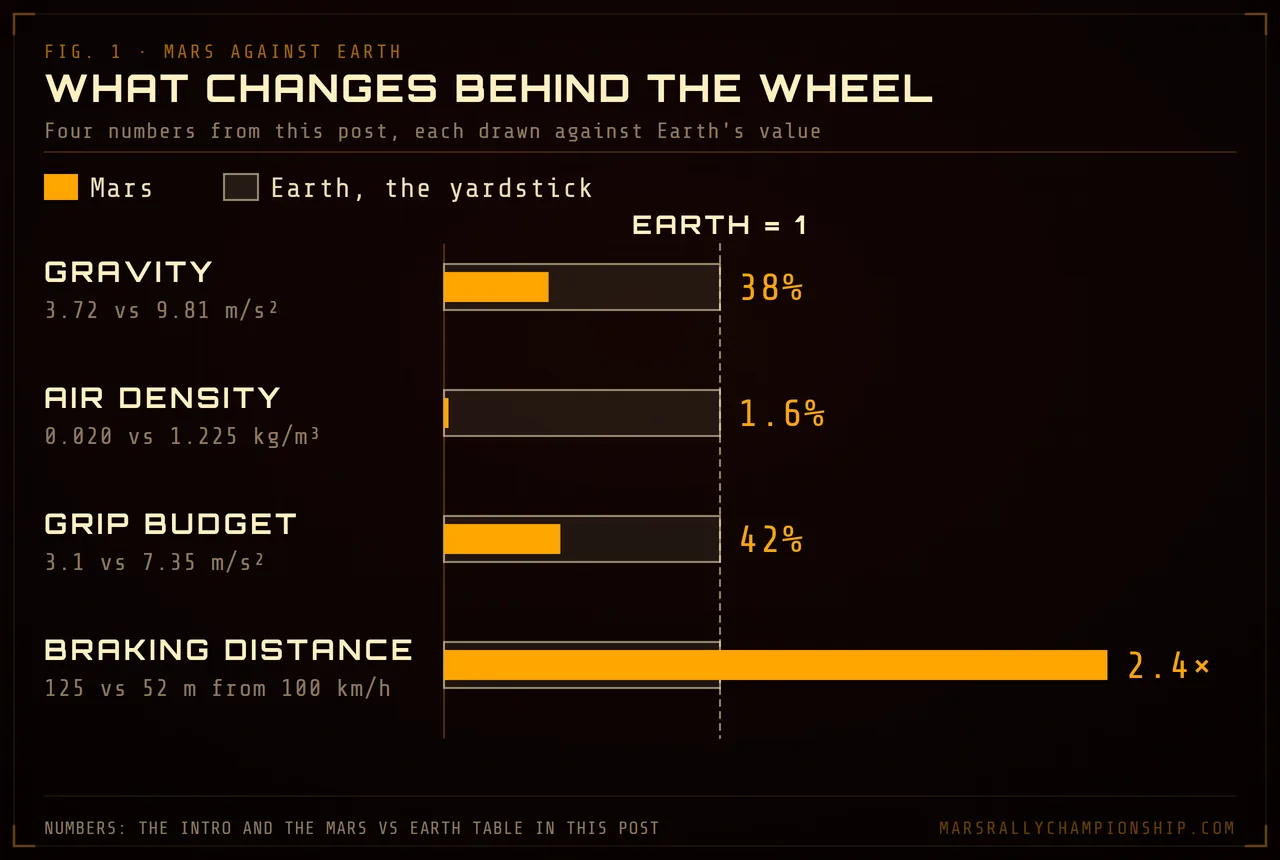
Diagram: Mars gives a driver 38% of Earth's gravity, 1.6% of its air and about 42% of its grip, so stops run 2.4 times as long.
Gravity is the whole problem, and Mars has 38% of one
Grip is friction coefficient times load, and load is mass times gravity. Everything below is that sentence being cashed.
Mars pulls at 3.72 m/s², against Earth's 9.81. A three-tonne rover on Mars still has three tonnes of inertia — mass does not change when you change planets — but the surface pushes back with only 38% of the force. You keep all of the momentum and lose almost two-thirds of the friction that would normally take it away. No driver adapts to that in one corner.
Put a number on it. Mars Rally Championship models dry basaltic regolith under gravel-rally lugs at a friction coefficient of about 0.70 — an unremarkable figure that would be perfectly good on Earth. Multiply by Martian gravity, add about 0.48 m/s² of regolith cohesion — soil strength that does not shrink with gravity — and the whole vehicle has roughly 3.1 m/s² of acceleration to spend, in any direction, across braking, turning and driving combined. The same rubber on the same soil on Earth would have about 7.35 m/s². Mars is not a slippery planet; it is a normal surface that is barely holding your weight down.
The other half of low gravity is the part you feel in your stomach: crests throw you farther and hold you longer, and a wheel in the air contributes nothing to the 3.1 m/s² budget. That side of the ledger gets its own post. Other games use weak gravity in their own ways, from moon-level jumps to zero-g salvage, and our guide to low-gravity games sorts them by what it changes.
Mars vs Earth: the numbers that change how you drive
Six numbers do the work. The first two cause the rest.
| What changes | Mars | Earth |
|---|---|---|
| Surface gravity | 3.72 m/s² (38% of Earth) | 9.81 m/s² |
| Air density | 0.020 kg/m³ | 1.225 kg/m³ (about 61× denser) |
| Traction budget (µ 0.70 × g + cohesion) | ≈3.1 m/s² | ≈7.35 m/s² |
| Braking 100→0 km/h, same tires and soil | ≈125 m, ≈9 s | ≈52 m |
| Downforce available | none, at any speed | grows with speed; the main grip source for a fast car |
| Aero drag at 240 km/h | ≈0.02 m/s² — negligible | roughly 61× greater at the same speed and shape |
Stopping takes about 125 meters, and nothing comes to help
From 100 km/h, a Mars rally rover on 0.70-friction tires needs about 125 meters and 9 seconds to stop. An Earth gravel car on identical rubber and soil does it in roughly 52 meters. That is not a handling quirk; it is the same braking equation with a different constant underneath. Your instincts will be wrong by a factor of about 2.4 at every corner until you retrain them.
On Earth, three things slow a car: the tires, aerodynamic drag, and rolling resistance. On Mars only one of them does real work. Drag at 240 km/h amounts to about 0.02 m/s², a rounding error; rolling resistance contributes around 0.15 m/s². Lift off everything at speed and you coast until the terrain intervenes. Regenerative braking is the closest thing to free deceleration on the planet, and it puts the energy back in the pack.
Because full pedal demand always exceeds what the surface can supply, a held pedal in a straight line takes the whole budget: Mars Rally Championship's anti-lock brakes hold each tire at the peak of its grip, and the wheels never lock. Steer with the pedal held and the ABS shares that grip between slowing and turning, so the rover turns while it slows — but every bit spent on the brake is grip the corner cannot have. On a keyboard or a touchscreen the brake is all or nothing; a gamepad trigger can be feathered. The arithmetic is worked through in braking distance on Mars vs Earth.
The atmosphere is real, and it does almost nothing
Mars has an atmosphere: mostly carbon dioxide, with weather, clouds and wind. Its density is about 0.020 kg/m³ against Earth's 1.225 — roughly 1.6%. For a driver, that single ratio deletes an entire branch of automotive engineering.
Downforce scales with air density, so downforce on Mars is not weak — it is absent. A wing that plants a Formula car would produce a rounding error here at any speed you could reach. There is no aerodynamic grip to earn. Your 3.1 m/s² at 20 km/h is the same 3.1 m/s² at 200 km/h. Cornering speed does not improve with velocity, which inverts most of what a fast driver knows.
The same thin air cuts the other way, mostly in your favor. There is nearly nothing to push through, so straight-line speed is cheap: acceleration stays traction-limited rather than power-limited all the way to 100 km/h. What thin air does punish is heat. Air is how a motor and a battery dump waste energy, and 1.6% of the air means 1.6% of the convective cooling — which is why a Mars powertrain has to be derated well below its hardware limits. That trade is unpacked in Mars aerodynamics and why there is no downforce.
What you would actually be driving on
Mars is not one surface. The rovers that have driven it — Curiosity in Gale Crater, Perseverance in Jezero — have crossed loose drift sand, wind-packed plains, fractured bedrock and ancient lakebed within a few kilometers of each other. The soil under all of it, from its perchlorate to the sand that trapped Spirit, is taken apart in what Martian regolith is like to drive on.
Mars Rally Championship models three of them, each with its own grip and rolling-resistance multiplier:
- Regolith — the default: loose Martian dust and gravel, the baseline the 0.70 figure describes.
- Hardpack — ancient lakebed. About 15% more grip and 30% less rolling resistance, which makes it both the fastest and the most forgiving surface on the map.
- Polygon ground — cracked, patterned terrain from freeze-thaw cycling. About 25% less grip and 30% more rolling drag. It is where runs end.
Across those three, effective friction ranges from roughly 0.53 to 0.81 — better than a 50% spread between worst and best, with no warning beyond texture. Reading the ground is a real skill here, and it is the first thing Stage 3, The Opener teaches, descending 65 meters over its 1,164-meter timed line.
Cold and dust are engineering problems, not driving problems
The thing that would actually stop you on Mars is not a corner. It is dust.
Martian dust is fine, electrostatically clingy, and abrasive. It works into bearings and seals, scours optics, and settles on solar panels until they stop producing — dust, not mechanical wear, is what has ended or nearly ended solar-powered Mars missions. A storm makes all of it worse at once: in Mars Rally Championship the storm variant runs at full strength for the whole stage, thickening the fog 7.5-fold into a heavy brown haze that hides 95% of the view by about 100 metres, while the wind grows louder and battery drain rises 50% from panel obscuration.
Cold compounds it. Mars runs far below anything a terrestrial vehicle is qualified for, batteries lose capacity when cold, and the thin air that will not cool your motor will not warm your cabin either. A real vehicle spends a meaningful share of its energy budget simply staying alive. ESA's Mars Express has watched these storms grow to planetary scale; there is more on the modeling in Mars dust storms explained.
Why real Mars rovers drive so slowly, and why a rally rover would not have to
Perseverance and Curiosity move at centimeters per second. It is tempting to read that as Mars being undriveable. Almost none of the reason is physics.
Latency. Radio takes minutes to cross to Mars and minutes more to come back, so nobody steers a rover with a joystick; commands are written, uplinked, and executed later. A vehicle that cannot be corrected in real time has to drive slowly enough to stop itself.
Power. A rover works from tens or a couple of hundred watts. The rally rover here carries a 90 kWh pack and a motor rated in hundreds of kilowatts — three orders of magnitude more to spend on going forwards.
Consequence. There is no recovery vehicle and no second attempt; Spirit ended its mission embedded in soft soil it could not drive out of. When one mistake costs a decade and a launch window, the correct speed is the slowest one that still finishes the science.
Autonomy. Much of a rover's time is spent not moving: imaging the ground ahead, building a terrain mesh, and computing a safe path on a processor chosen for radiation tolerance, not speed.
Take those four constraints away — a human in the seat, a real battery, an accepted risk of breaking things — and physics allows a great deal more. Traction still caps you at 3.1 m/s², but nothing in the air holds back top speed. Fast on Mars is entirely possible. Up is another matter: driving up Olympus Mons, the biggest climb on the planet, would take more energy than the rally rover's 90 kWh battery holds.
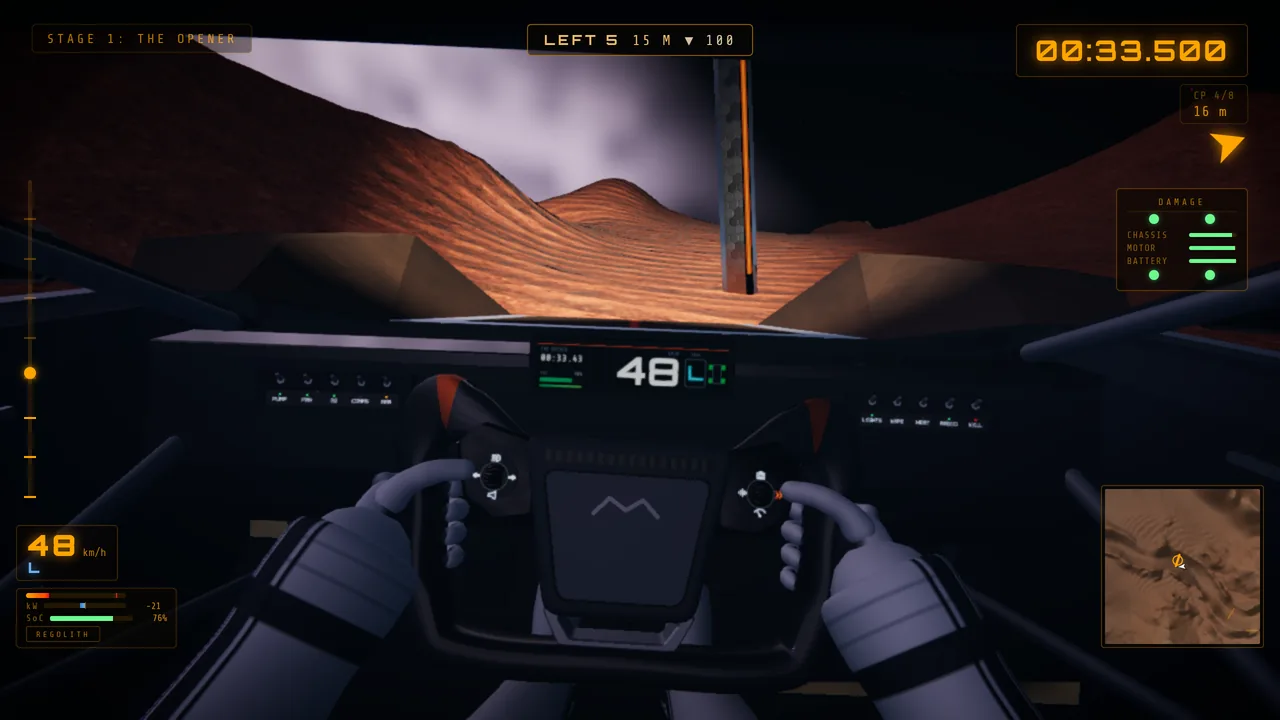
In-game screenshot: the driver's seat at night in the game, gloves on the yoke and only the headlights' reach of ground to read the next corner by.
The person in the seat: pressurized, suited, and short of horizon
You would be driving sealed. Martian surface pressure is a tiny fraction of sea-level Earth's, so a crewed rover is a pressure vessel with wheels, and the driver is either in a shirt-sleeve cabin with a suit within reach or already inside the suit. NASA's 12-wheeled prototype of that vehicle, and the suitports that let a crew skip the airlock, are covered in what a pressurized Mars rover would look like. No vehicle with a driver aboard has reached Mars yet, and is there a car on Mars sorts the six robotic rovers that have driven there from Elon Musk's Tesla, still circling the Sun. Suit gloves are stiff and thick, which removes most of the tactile feedback a rally driver steers by, and a helmet costs peripheral vision exactly when you need it.
Then there is the view. Mars has a radius of about 3,390 kilometers, a little over half of Earth's, so the ground curves away from you faster. From a seated eye height the horizon sits roughly three kilometers out — closer than you have ever seen it. On a fast straight that is a handful of seconds of visible world, so blind crests arrive constantly and pace notes stop being a luxury. Set that against a 125-meter stopping distance and the rule is simple: you can rarely see far enough ahead to justify your speed.
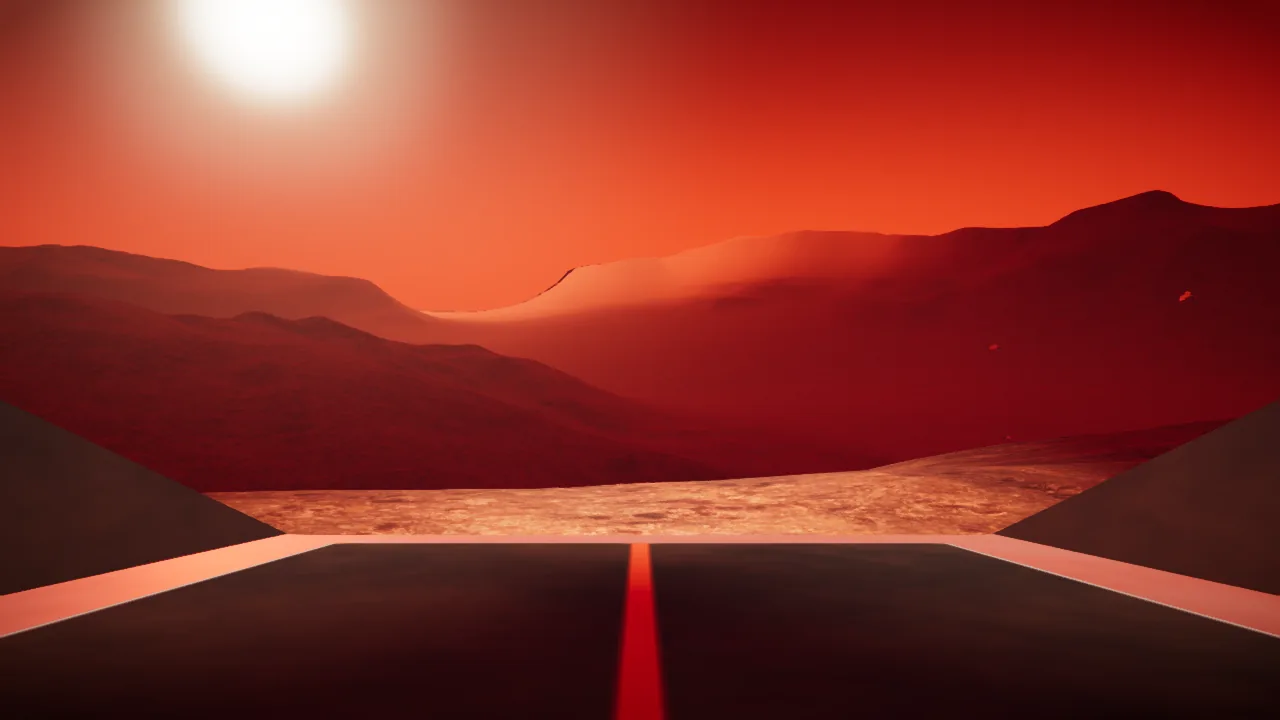
In-game screenshot: from a crest in free roam the ground drops out of sight close ahead; in the game that is the landform, not the planet's curve.
Where to try this
Reading these numbers and feeling them are different exercises, and the second runs in a browser tab.
- The Proving Ground tutorial is nineteen lessons built to recalibrate Earth instincts: braking distance, jump landings, and what 3.1 m/s² feels like through a chicane.
- Stage 3, The Opener is the steep test, a downhill run across all three surface types; a first timed run starts on Stage 1, The Eight.
- How 3.72 m/s² gravity changes rally driving goes deeper on cornering geometry and the friction circle.
- Mars Rally Championship is free, runs in a browser tab with no download and no account, and works on a phone, a laptop or a school Chromebook.