NASA drives a Mars rover by sending it a day's work at a time, not by steering it. A signal takes 3 to 22 minutes each way, so there is no joystick: rover planners on Earth pick the route and its waypoints, the plan goes up overnight, and the rover drives it alone. Perseverance's AutoNav finds the path between waypoints, and it drove more than 90% of the record 45.22 km it reached on 11 October 2026. Mars Rally Championship, a free browser rally game, is where you steer a rover live.
That split between a human who chooses where to go and a rover that chooses how to get there is the whole story of rover driving in 2026. Methodology: figures come from NASA, JPL, USGS and peer-reviewed sources linked below. Last checked: November 2026.
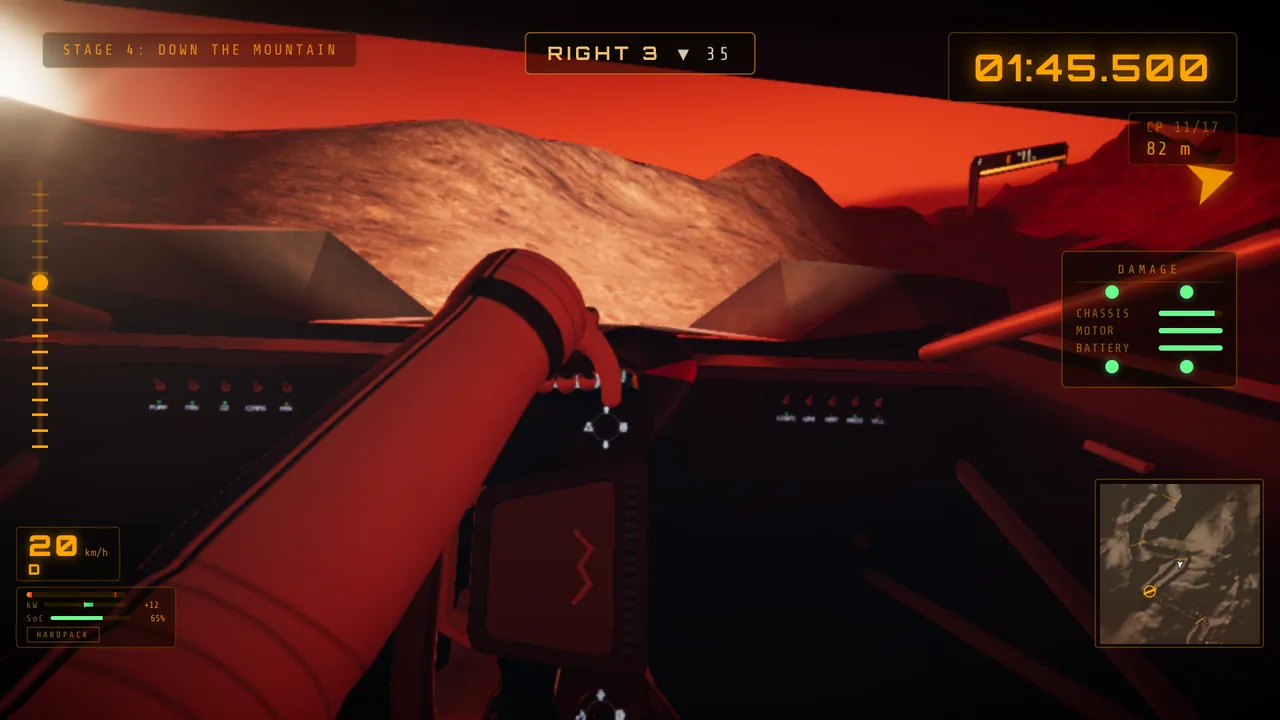
In-game screenshot: steering live out of gate 10 toward gate 11 of Stage 4's left-right-left triple at sunset; a real rover's drive is written a sol earlier.
How does NASA drive a Mars rover?
NASA drives a Mars rover by sending it a day's worth of commands at a time: rover planners on Earth choose the route and its waypoints from orbital and rover images, the plan goes up through the Deep Space Network before the Martian morning, and the rover drives it alone, with Perseverance's AutoNav steering around hazards between the waypoints.
The chain runs in plain steps:
- Images come down. The rover's cameras and the orbiters overhead return pictures, mostly through orbiters that relay the rover's data to Earth.
- Planners study the ground. They read orbital images and the rover's own pictures, and the drivers put on special 3D glasses to judge the terrain.
- They draw a route with waypoints. Waypoints are usually spaced no more than 100 m apart.
- The plan is checked. For the first drives planned by AI, JPL ran the commands through a digital twin of the rover, verifying over 500,000 telemetry variables before sending.
- The plan goes up through NASA's Deep Space Network.
- The rover executes it the following day, with nobody watching live.
A tactical plan typically covers one sol, a Martian day, but often as many as three, according to the 2023 Science Robotics paper on Perseverance's driving. On Curiosity, a Friday planning day can carry the rover through the whole weekend: the team's own blog said its first planning day after a break "gave Curiosity a full weekend of activities".
Why can't NASA drive a rover in real time?
Because the signal is slow and the rover is often out of reach. Mars sits between 54.6 million km and about 400 million km from Earth, which is 3 to about 22 minutes of light travel one way. Add the return trip and you wait 6 to 45 minutes to see what a steering input did. At the average distance of 225 million km the one-way trip is about 12.5 minutes.
Distance is only part of it. The rovers have no line of sight to Earth for about 12 hours a day. Every two years Mars passes behind the Sun, and NASA stops commanding for about two weeks; in 2023 the pause ran from 11 to 25 November. The latest one ran over the turn of 2025 into January 2026.
Even the Moon does not fix it. A NASA Ames analysis found that at lunar distances, the round trip plus communications overhead "does not enable joy stick driving of a rover." For the radio side in depth, see how the internet works on Mars, and for the general idea of a rover, what a space rover is.
What does a rover planner's day look like?
The working day is built around the rover's schedule, not the team's. A USGS account of working on Mars time describes it: data arrives through orbiters in the Martian afternoon and evening, the team plans the next sol during the Martian night, and the uplink has to be ready for the communication window the following Martian morning. If the uplink is at 08:00 Mars time, the team starts around 16:00 the sol before.
Mars time slides 39 minutes 35 seconds later each day against Earth's, so teams keep it only for the first months of a mission and then move to Earth time, with some sols restricted. How long a day on Mars is explains that drift. The USGS write-up has the worked example.
Planners also draw fences. AutoNav cannot see deep sand in its images, so planners mark keep-out regions from orbital images. They can also mark keep-in regions that limit where AutoNav is allowed to explore.
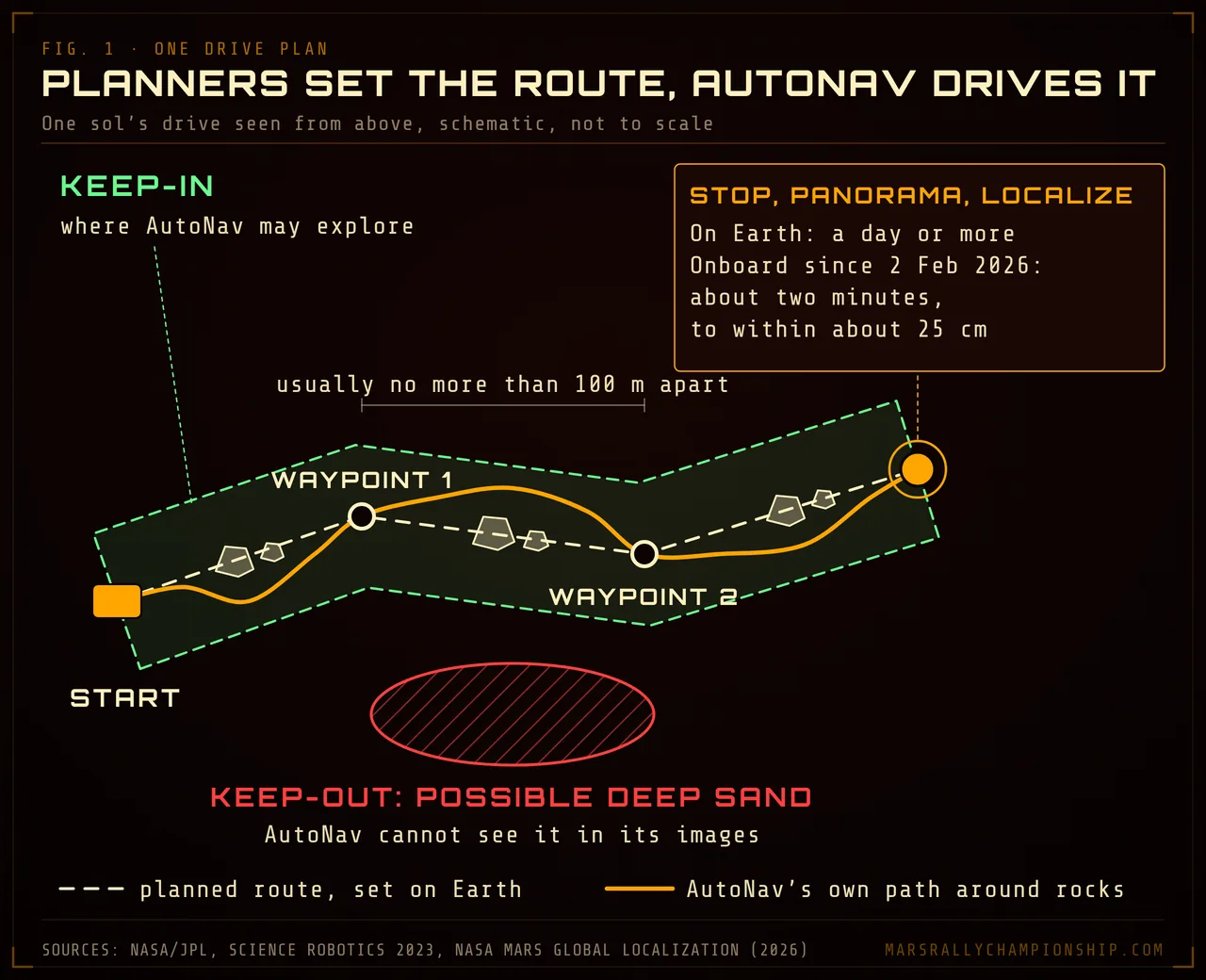
Diagram: planners on Earth set waypoints and keep-out zones; between them, Perseverance's AutoNav picks its own path.
From blind drives to AutoNav: Perseverance's drive modes
Perseverance has five drive modes, from counting wheel turns to planning its own path.
| Drive mode | Tracks its own motion | Maps the ground ahead | Decides where to go |
|---|---|---|---|
| Unguarded, non-imaging (a "blind drive") | No: distance comes from wheel rotations, with no check for slip | No | No: follows the commanded path |
| Unguarded with visual odometry | Yes: compares images to measure how far it really moved | No | No |
| Unguarded with visual odometry and mapping | Yes | Yes: builds a terrain map, but does not use it | No |
| Guarded | Yes | Yes | Checks each planned step against its map and stops if unsafe |
| AutoNav (AVOID_ALL) | Yes | Yes | Yes: plans its own path around hazards between waypoints |
Planners pick the mode drive by drive. In its Rapid Traverse campaign, Perseverance drove more than 5 km in 24 drives, with its autonomy planning 94.8% of the driving.
A blind drive is just what it sounds like: NASA describes it as the rover calculating distance from wheel rotations "without looking or checking for wheel slippage." AutoNav is the opposite end. It runs on a separate computer, the Vision Compute Element also used for landing, so the rover can map the route while its wheels turn. Vandi Verma of JPL called this "thinking while driving". JPL projected up to 120 m an hour for it, against about 20 m an hour for Curiosity with an earlier AutoNav.
Curiosity could not lean on AutoNav as much because of its wheels: Jennifer Trosper said small, sharp, pointy rocks were putting holes in them. Mars rover wheels explained covers that wear.
How self-driving won Perseverance the distance record
On 11 October 2026, sol 2,006, Perseverance's odometer reached 45.22 km (28.10 miles) and passed Opportunity's 45.16 km. A 91.31 m drive that day pushed it over. Opportunity needed almost 15 years, from 2004 to 2018; Perseverance needed five and a half. The JPL release has the figures.
The difference is autonomy. More than 90% of Perseverance's distance was driven with AutoNav evaluating the terrain, against about 5% for Spirit and Opportunity. Sojourner judged its path from 20 measurement points; Perseverance processes 600,000 with every look. AutoNav can cover up to 412 m in a single sol. The Science Robotics paper counts 88% of the first Mars year's 17.7 km as AutoNav driving.
Scale matters too. Steven Lee, project manager for Curiosity and Perseverance, noted that the original mission called for no more than 12.4 miles, about 20 km, of driving. NASA approved a first extension that began in October 2026 and runs to roughly the end of 2028. On the same day Curiosity had logged more than 38.07 km.
Mark Maimone, deputy team chief for robotic operations, put it this way: "Given the autonomy to just go, Perseverance is a better driver than the one that landed." For top speeds and single-sol distance records, how fast Mars rovers go has the table.
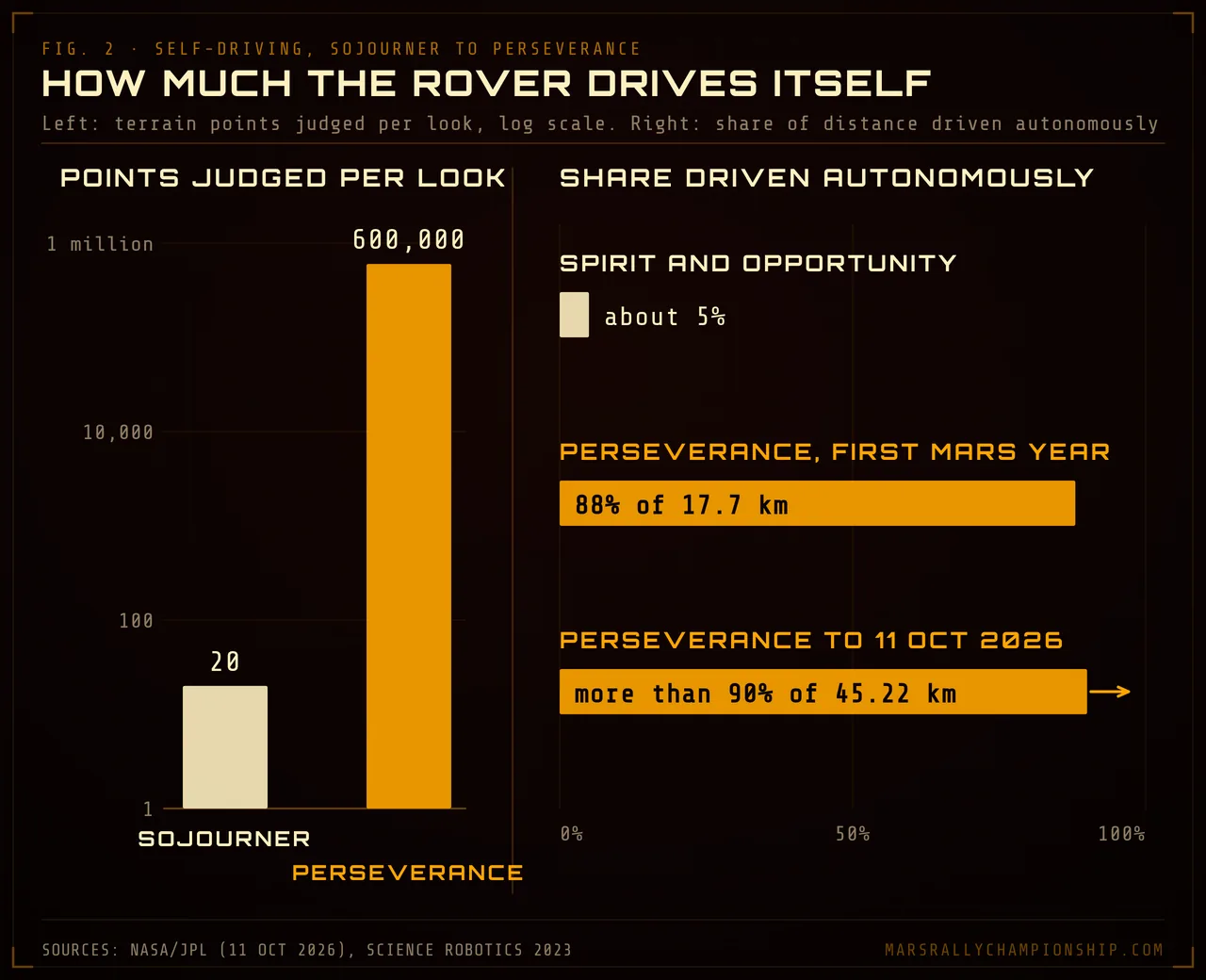
Diagram: Sojourner judged 20 points per look and Spirit and Opportunity drove about 5% autonomously; Perseverance judges 600,000 and drives over 90% that way.
What's next: AI-planned routes and a rover that finds itself
Two changes arrived between December 2025 and February 2026.
AI-planned waypoints. On 8 and 10 December 2025 (sols 1,707 and 1,709) Perseverance drove 210 m and 246 m on routes planned by AI, the first such drives on another world. Vision-language models read the high-resolution camera images from NASA's Mars Reconnaissance Orbiter and terrain-slope maps, picked out bedrock, outcrops, boulder fields and sand ripples, and produced a continuous path with waypoints. Humans still chose the destinations, and this was two demonstration drives, not a change in who is in charge. JPL's account of the drives says the work was led from its Rover Operations Center with Anthropic, using Claude models.
Mars Global Localization. Until 2026, after a drive the rover sent a 360-degree panorama, mapping experts matched it to orbital shots, and they sent back its position. That could take a day or more, and NASA says the distance Perseverance could drive without instructions had been largely limited by its uncertainty about where it was. Since its first operational use on 2 February 2026, and again on 16 February, the rover compares its own panorama with onboard orbital maps in about two minutes, to within about 25 cm. It runs on the Helicopter Base Station's commercial processor, more than 100 times faster than the rover's two main computers, which are based on 1997 hardware. See NASA's announcement.
Maimone says the newest software teaches Perseverance "to steer less and roll more". One limit remains: glare in the navigation cameras is why the team parks by mid-afternoon when driving toward the Sun.
Driving a Mars rover live: what a game keeps and what it drops
Mars Rally Championship is the opposite arrangement. It is a free 3D rally game in the browser, with no download and no account, and you drive a fictional pressurized 3,000 kg rally rover under Mars gravity of 3.72 m/s². It is not a NASA rover, and its terrain is sculpted to Martian morphologies, not surveyed.
Perseverance runs a sequence written a sol earlier. In the game, your inputs reach the physics every 1/60 of a second. The nearest thing to a rover planner is the co-driver: its calls are generated from the gate geometry and spoken 8 seconds ahead at your speed, and a strip on the HUD shows the next call, the live distance and an advised speed. Rally pace notes explained covers how they work, and driving on Mars online compares how much you steer in other Mars driving games.
The scale gap is easy to work out on Stage 4, Down the Mountain, which is 1,689 m long and set at sunset. At Perseverance's rated speed of 4.2 cm/s the stage would take about 11 hours. At JPL's projected AutoNav pace of 120 m an hour it would take about 14. At the 412 m record sol it is about four sols of driving. The stage's gold par of 1:45.5 works out to about 16 m/s.
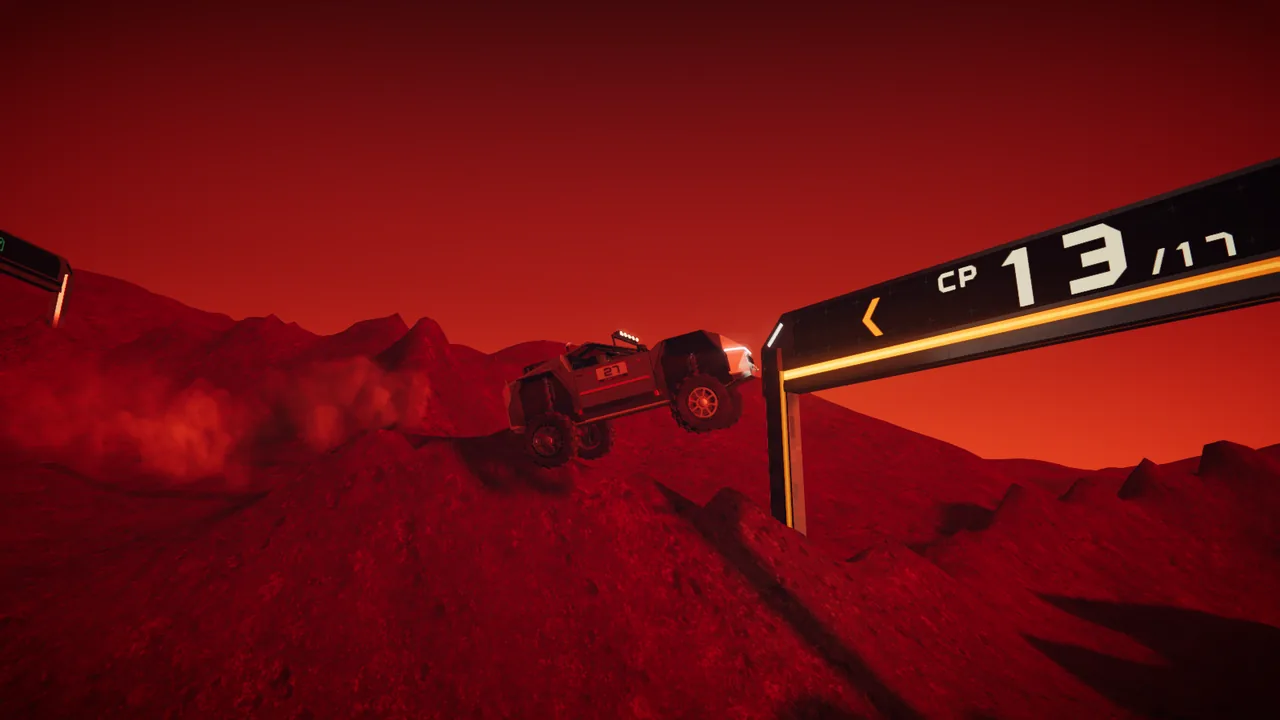
In-game screenshot: a replay of a run through Stage 4's 16 m gates 12 and 13, rebuilt from its recorded inputs.
One more echo of the real thing: every board run is a tape of recorded inputs, and the server re-simulates it before the time posts. It is a recorded sequence replayed and checked after the drive, where NASA checks its sequence before.