There is no internet on Mars in the everyday sense. Rovers talk to Earth through a relay network of orbiters and NASA's Deep Space Network, and each signal takes about 3 to 22 minutes one way, so 6 to 45 minutes there and back. Email-style, store-and-forward traffic works; a video call or a live game does not. Mars Rally Championship, a free browser rally game, makes a handy example: its live race rooms would fail from Mars, while its ghost races, which replay recordings, would not.
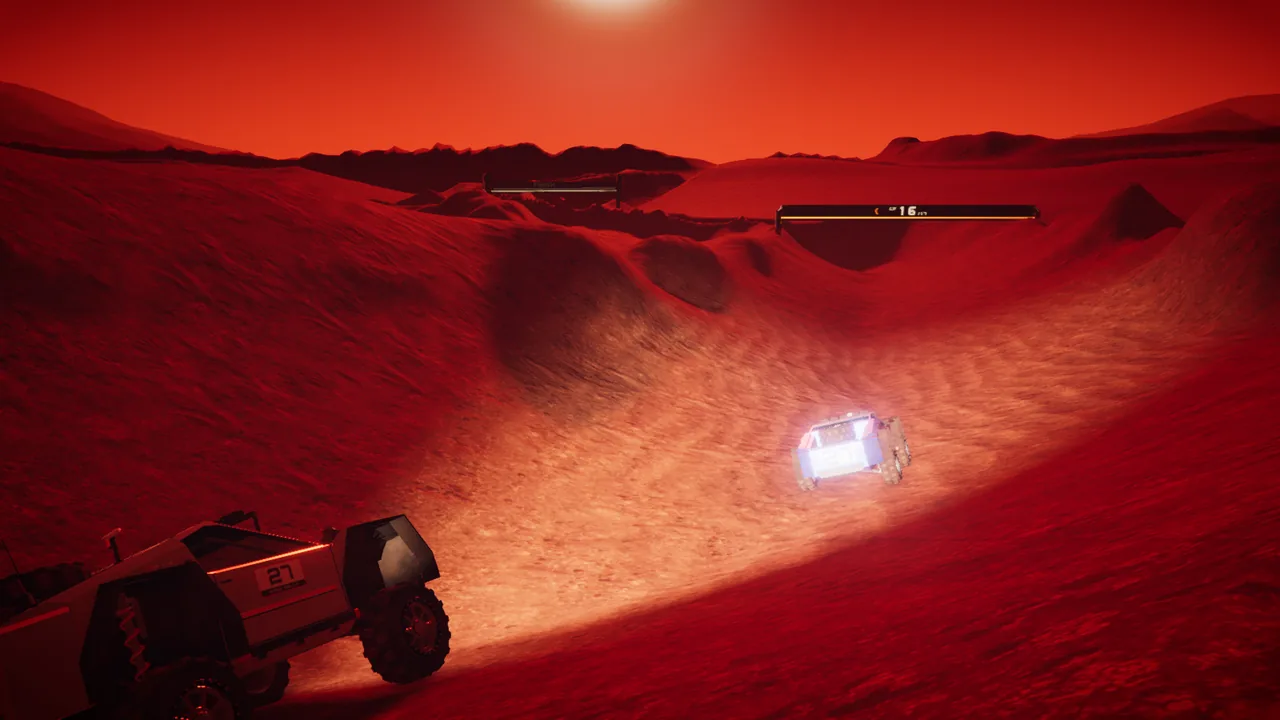
In-game screenshot: a recorded run's ghost a few lengths ahead on Stage 4's descent at sunset; a ghost needs no live link to the pilot who set it.
This post is a snapshot of the network as NASA describes it. Last checked: November 2026, against NASA, JPL and ESA pages, with the sources linked where they matter.
Is there internet on Mars?
There is no internet on Mars: rovers reach Earth through NASA's Deep Space Network, mostly by handing data to orbiters overhead at up to 2 megabits per second, and every signal takes about 3 to 22 minutes each way.
What does exist is the Mars Relay Network, an international constellation of NASA and ESA orbiters. Its members are Mars Odyssey, Mars Express (kept as a backup), the Mars Reconnaissance Orbiter, and ESA's ExoMars Trace Gas Orbiter. A fifth, NASA's MAVEN, was last heard on 6 December 2025 after passing behind Mars, and NASA declared the mission ended on 3 June 2026. So the network is down to four orbiters, and only three of them relayed rover data in February to May 2026.
On Earth, the other end is the Deep Space Network: three groups of antennas about 120 degrees apart, in California, Spain and Australia. NASA's page says every image seen from the surface of Mars since 2004 has come through the relay network.
Why relay at all? A rover can talk straight to Earth, but it is slow, and the rovers lack a line of sight to Earth for about 12 hours a day because Mars rotates. An orbiter passing overhead can take a big batch at a high rate, then send it home when its own antenna points at Earth. The Mars Reconnaissance Orbiter can even point at Earth while it talks to a rover. For the human side of that routine, see how NASA drives Mars rovers and the short relay paragraph in what a space rover is.
How long does a signal take between Earth and Mars?
A signal takes about 3 minutes at closest approach and about 22 minutes at the farthest. NASA puts the distance between 54.6 million km (33.9 million miles, about 3 minutes of light time) and 400.2 million km (248.7 million miles, about 22.4 minutes). At the average distance of about 225 million km, one way is roughly 12.5 minutes.
Double that for a question and its answer: 6 minutes at best, about 25 on average, about 45 at worst. For comparison, the Moon is about 378,000 km away, a light delay of 1.3 seconds each way. Mars is not the Moon with a longer cable; it is a different kind of problem.
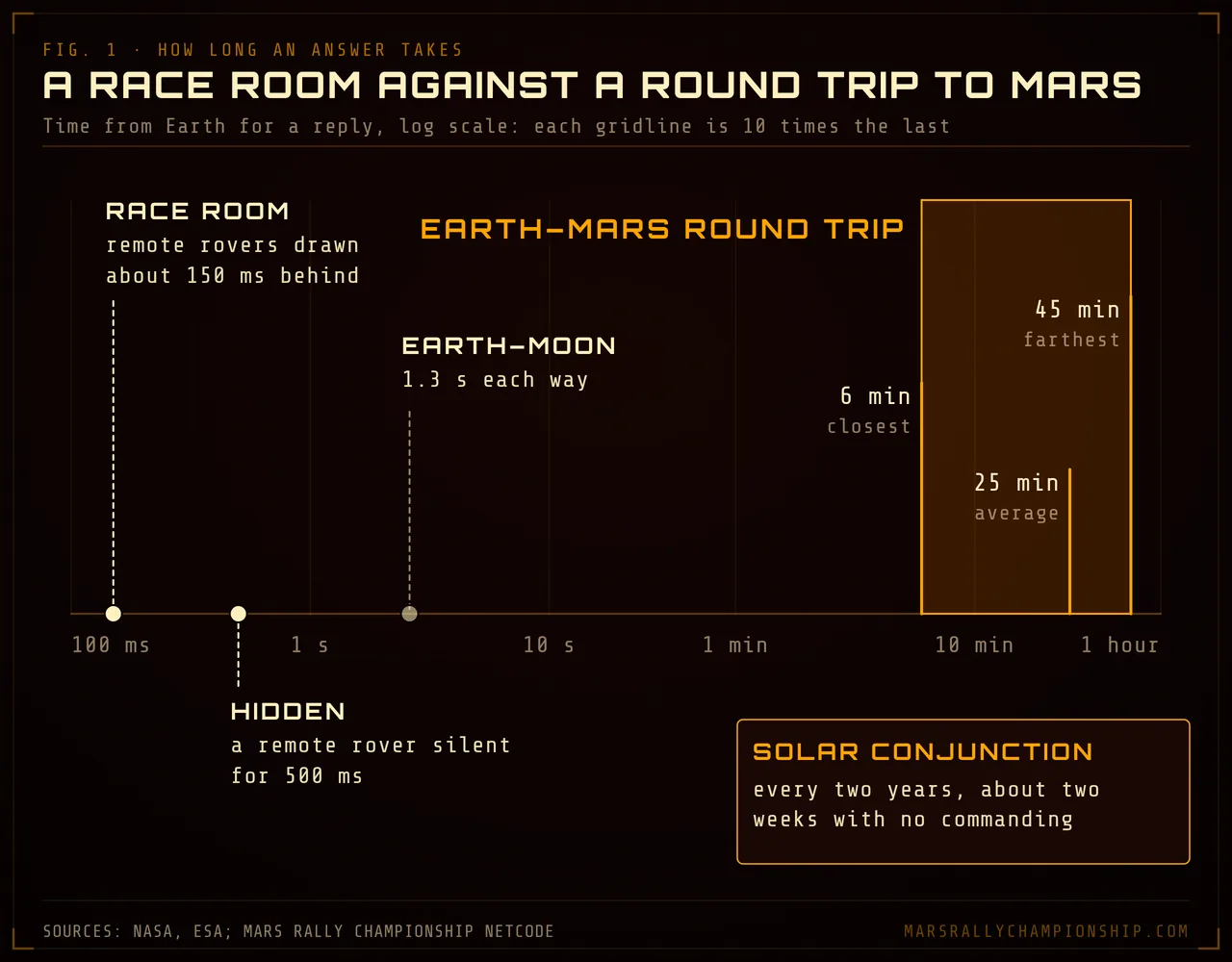
Diagram: a live race room works in tenths of a second; a round trip to Mars takes 6 to 45 minutes.
You cannot engineer this away. ESA's Mars Express team wrote that the delay "can't be improved by a faster computer or a more powerful radio", because it obeys the speed of light. ESA's Claire Parfitt put it more bluntly to Science News: "It's not a problem to be solved. It's just a problem." The only thing a mission can do is design around it, which is why rover drives are planned a day ahead rather than steered; the real-time "joy-sticking" of a rover is impossible, as JPL put it in January 2026.
There is a second, scheduled gap. Every two years Mars passes behind the Sun as seen from Earth, an event called solar conjunction. Ionized gas from the Sun's corona can corrupt signals, so missions stop sending commands. In November 2023 NASA paused commanding from 11 to 25 November, with about two days of no contact at all, and the orbiters relayed the pending data afterwards. The latest conjunction ran over the turn of 2025 into January 2026.
How fast is the internet on Mars?
Nothing on Mars is fast by home standards, but the relay link is respectable. A rover talks to an orbiter over UHF at up to 2 megabits per second. Perseverance's direct link to Earth is far slower: 160 bits per second one way and 500 the other to and from a 34 m Deep Space Network dish, and 800 and 3,000 bits per second to and from the 70 m dish.
The orbiters have the better link home. For the Mars Reconnaissance Orbiter, JPL's engineering monograph gives at least 500 kilobits per second at the maximum distance of 400 million km, and rates as high as 6 megabits per second at the closest ranges. In its early years it averaged 0.5 to 4 megabits per second depending on distance.
The number that matters for a rover is volume per day. NASA publishes how much rover data each orbiter relays; MAVEN's share went to zero after it fell silent.
| Orbiter (agency, arrived) | Height above Mars | Passes a day (used for relay) | Average relayed through 2025 | Average Feb–May 2026 |
|---|---|---|---|---|
| Mars Odyssey (NASA, 2001) | 385–450 km | 2–4 (0–1) | 170.4 Mb/day | 107.3 Mb/day |
| Mars Express (ESA, 2003) | 298–10,107 km | 1–3 (0) | Backup orbiter | Backup orbiter |
| Mars Reconnaissance Orbiter (NASA, 2005) | 255–320 km | 2–4 (1–3) | 447.5 Mb/day | 850.6 Mb/day |
| MAVEN (NASA, 2013) | 200–4,500 km | 2–4 | 897.5 Mb/day | 0 (silent since Dec 2025) |
| Trace Gas Orbiter (ESA, 2016) | 400 km | 2–4 (2–4) | 1,562.7 Mb/day | 2,228.1 Mb/day |
Mb means megabits. Add the three orbiters that relayed in February to May 2026 (107.3, 850.6 and 2,228.1) and you get about 3,186 megabits a day, roughly 400 megabytes, shared by Curiosity and Perseverance. At the 2 Mbps relay rate that is about 27 minutes of link time. ESA's Trace Gas Orbiter now carries most of it; NASA's page notes it sends, on average, the most relay data per day.
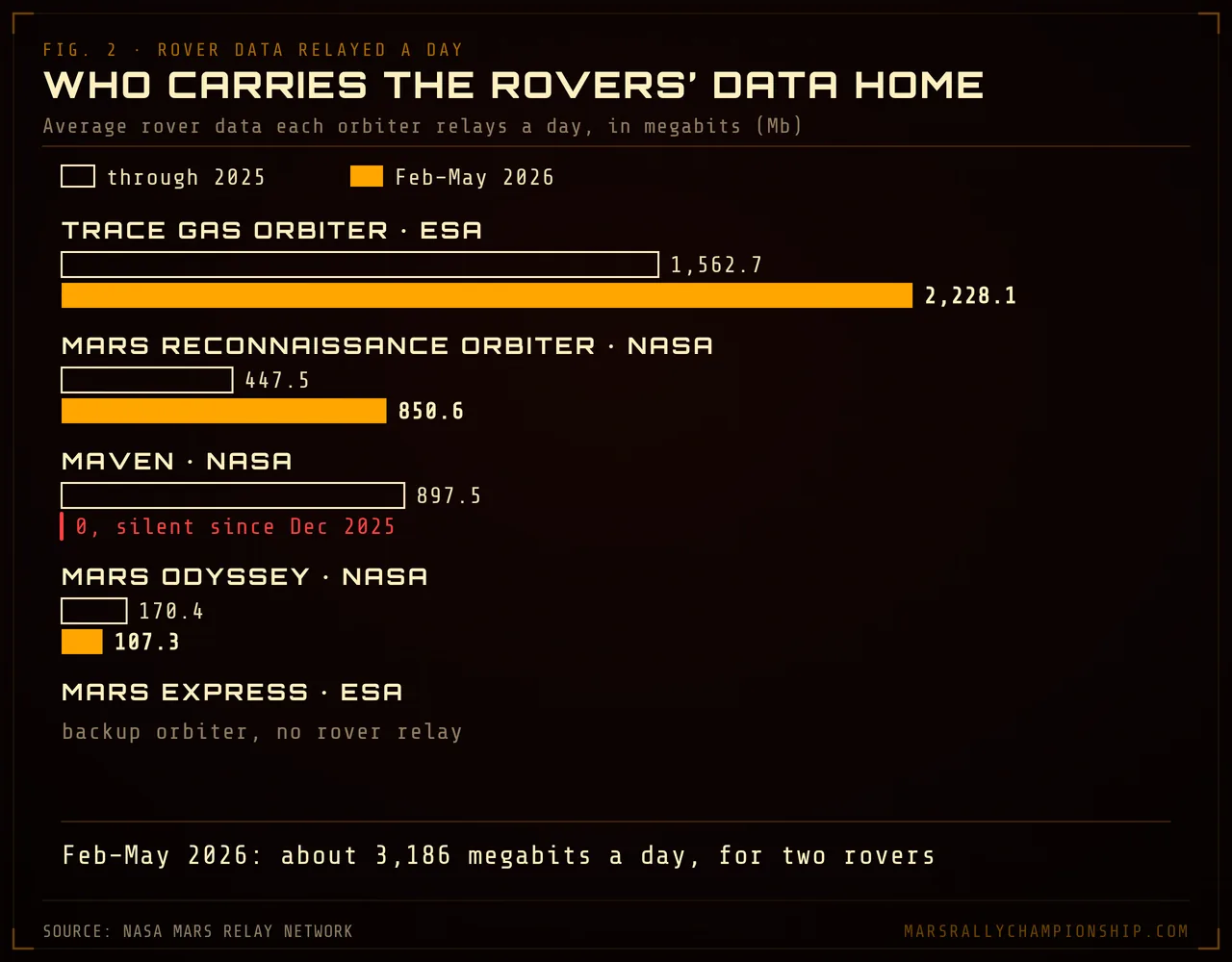
Diagram: ESA's Trace Gas Orbiter now relays most rover data; MAVEN's share fell to zero after it went silent in December 2025.
Put that next to your phone: about 400 megabytes a day is what the whole relay fleet carries for two rovers together. This is also why live video from Mars stays rare.
What would make Mars feel more connected?
Three things are in motion, and none of them touches the delay.
The first is software. NASA's Delay/Disruption Tolerant Networking stores data at each node until the next one is reachable, "similar to how emails are saved in outboxes". NASA says that with the completion of its multi-center DTN Project in January 2026, DTN is now an operational service in both the Near Space Network and the Deep Space Network. It is the right model for a place where links come and go, because it assumes the other end is not there right now.
The second is lasers. JPL's Deep Space Optical Communications demo, flown on the Psyche spacecraft, streamed ultra-high-definition video from 31 million km on 11 December 2023 at its 267 Mbps maximum, which JPL compares to household broadband. On 3 December 2024 it returned data from 494 million km, farther than Earth and Mars ever get apart. It ended on 2 September 2025 having received 13.6 terabits in total.
The third is hardware. On 1 September 2026 NASA selected Blue Origin to design, build, launch and operate a Mars Telecommunications Network: a firm-fixed-price contract worth up to about $700 million, with the orbiter due no later than 31 December 2028 and the network expected to be operational at Mars by 2030. NASA's release does not give its data rate or design, so neither does this post. Researchers have also proposed far larger ideas; Science News reported a 2023 TU Berlin paper for 81 low-orbit satellites with local cloud storage. That is a proposal, not a plan.
Faster links mean more data a day. A person on Mars would still wait 6 to 45 minutes for any answer from Earth.
Could you play online games from Mars?
Not live ones. This is a thought experiment; nobody has played from Mars, and nothing here claims otherwise. But it shows cleanly which online things survive the delay.
Mars Rally Championship's online races are live. A room holds up to 8 pilots, each pilot's rover sends its position 15 times a second, and the other pilots' rovers are drawn about 150 milliseconds behind so the motion looks smooth. If a remote rover goes silent for 500 milliseconds, it is hidden. With a round trip of at least six minutes, every rival would vanish within half a second of the start, and a rival's position would be minutes stale before it arrived. (On Earth, a dropped connection does not end a race: the run carries on offline and still posts at the finish.) The longer design story is in the netcode write-up.
Asynchronous play is different. A ghost is a 30-frames-per-second recording of a finished run: position, rotation, speed, steering, brake and rpm. It needs no live link to the pilot who set it. A leaderboard run is an input tape of a few kilobytes, the controls recorded once per 60 Hz step, which the server re-simulates before it posts the time. A few kilobytes is tiny next to a day's relay budget of roughly 400 megabytes. Mailing a tape home and waiting for the verdict, like email in an outbox, is exactly what store-and-forward is good at.
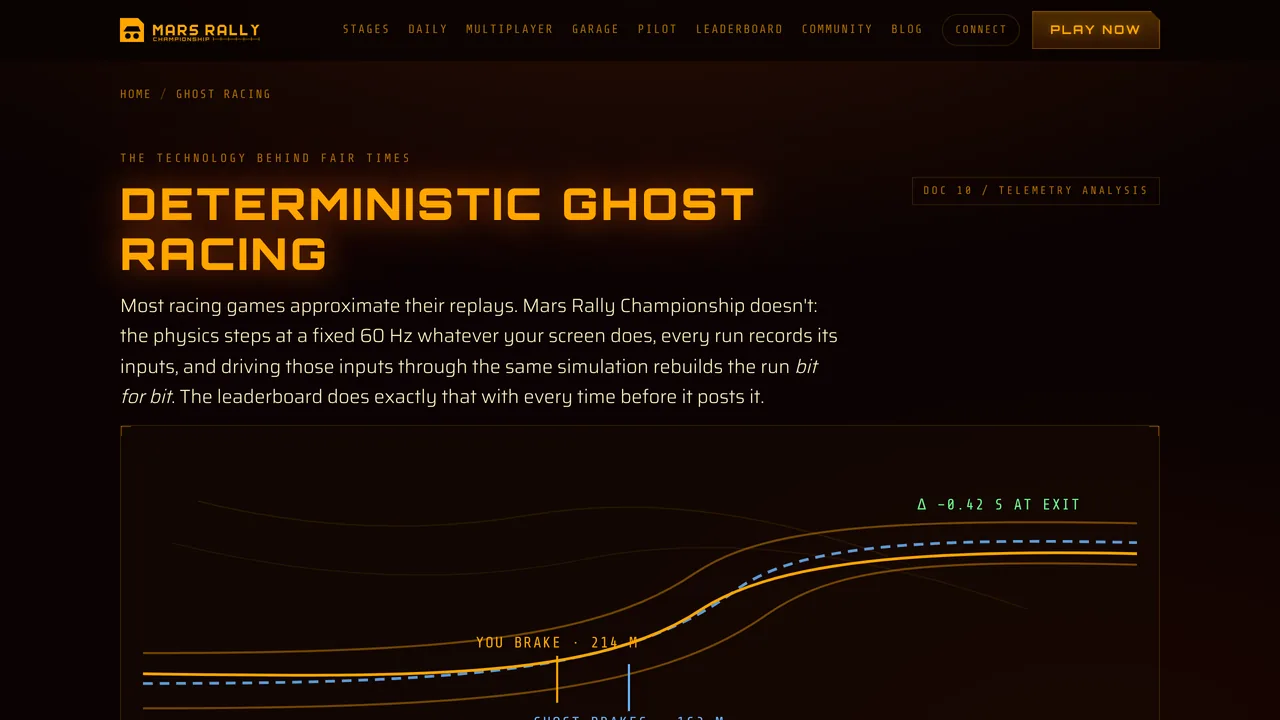
Screenshot: the site's ghost racing page; every run is rebuilt from its recorded inputs, so racing it needs no live connection.
So the rule of thumb for any online thing on Mars is simple. If it needs the other side to answer within a second, it fails. If it can be recorded, sent and judged later, it works, just late. Ghost racing is that second kind, which is why ghost-racing games are a better fit for a delayed world than live lobbies. Chess by mail, shared documents and email would work the same way; voice and video calls would not.
Where to try this
You can race a recording yourself, from Earth, with no download:
- Drive Stage 4, Down the Mountain and race a ghost on the descent.
- Open the Stage 4 leaderboard and press REPLAY or RACE on any row.
- Read about ghost racing and how the game uses recordings.
- Compare ghost-racing games from other makers.
- See how NASA drives Mars rovers when the radio is this slow.