A Mars dust devil is a spinning column of warm air that lifts dust off the ground: a whirlwind roughly 2 to 600 metres wide, not a storm. It forms when sunlit ground heats the air above it, and it usually lasts a few minutes. A dust storm is a much larger system that can cover a region or most of the planet and last weeks. Mars Rally Championship, a free browser rally game, has a dust storm mode, but no dust devils.
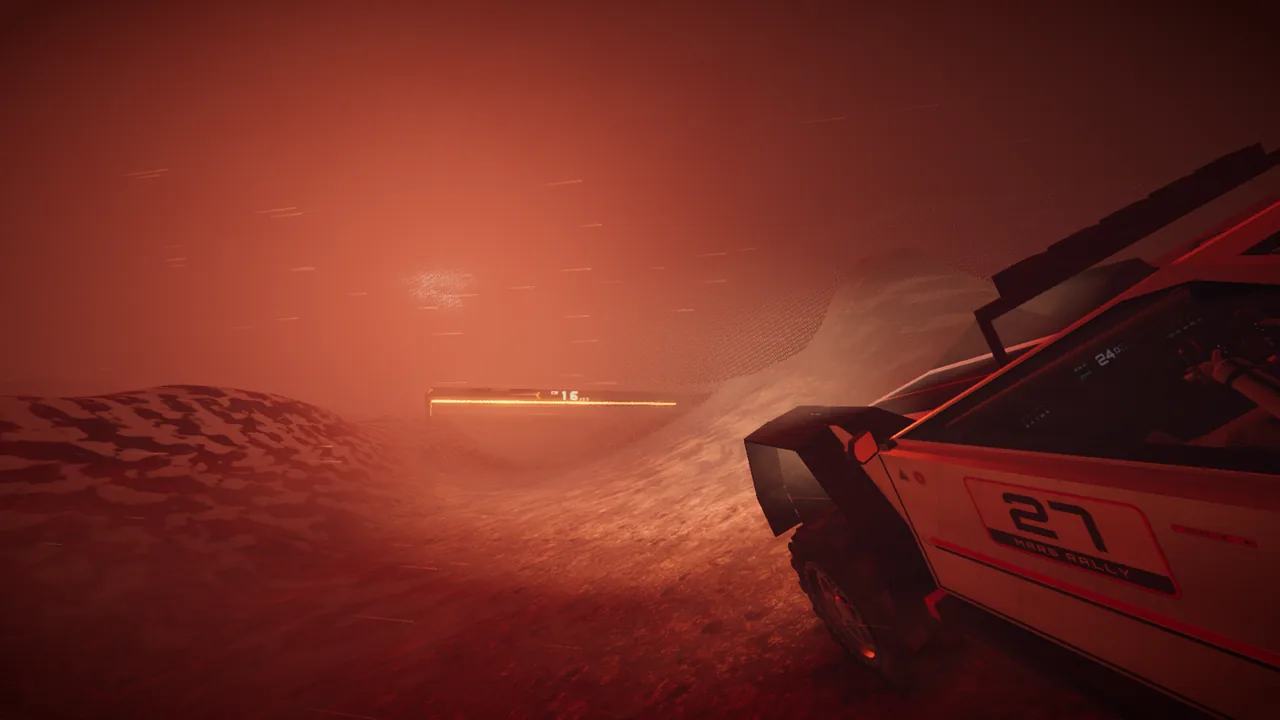
In-game screenshot: Stage 4, Down the Mountain, in the storm variant at sunset: red-brown haze swallows the ridge, and the next gate still glows through it.
Last checked: November 2026. Real-Mars numbers come from NASA, JPL, ESA or peer-reviewed papers; uncertain figures are flagged.
How do dust devils form on Mars?
A Mars dust devil starts with a hot patch of ground. As JPL describes it, air heated by the ground rises through the cooler air above. Other air slides along the surface to replace it, and that inflowing air begins to rotate. When it rises into the column it speeds up, like a spinning ice skater pulling in their arms. The rushing air picks up dust, and the dust makes the vortex visible.
The sun is the engine, so timing follows the sun. ESA notes that dust devils are most common in each hemisphere's spring and summer and peak between about 11:00 and 14:00 local solar time. At least four whirlwinds pass Perseverance on a typical Martian day.
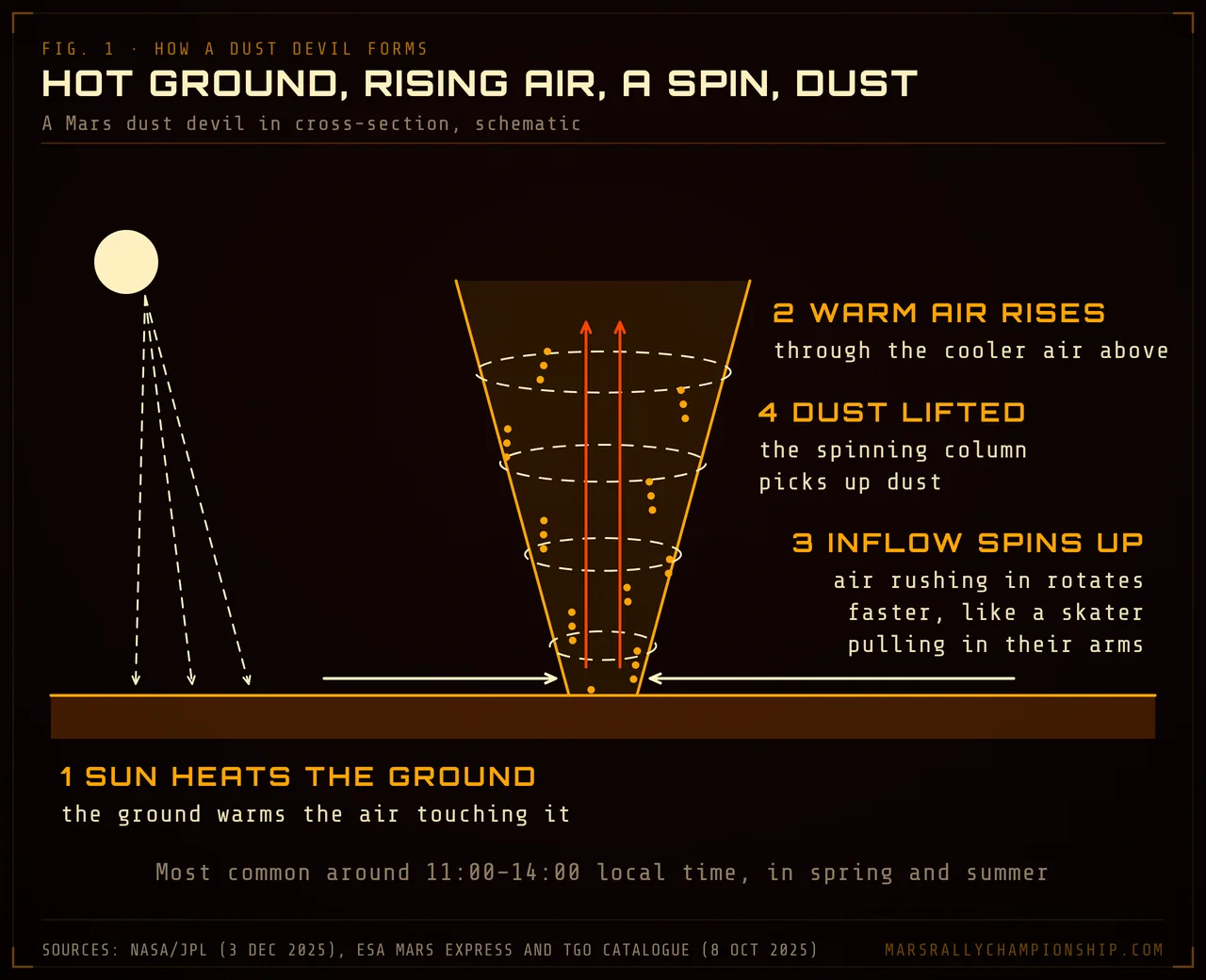
Diagram: hot ground, rising air, inflow that spins up as it is drawn in, and lifted dust, the sequence JPL describes for a Martian dust devil.
The same process runs on Earth. The difference is the air: Mars's atmosphere is about 1 percent as dense as Earth's. Our thin air and no downforce post covers what that does to a vehicle.
How big and how fast do Martian dust devils get?
Most are small, and a few are enormous. From the ground at Gusev Crater, Spirit measured 2 to 276 m across, most of them 10 to 20 m. From orbit, ESA's catalogue of 1,039 dust devils (found by a neural network in Mars Express and ExoMars TGO images) spans roughly 18 to 578 m, with a mean of 82 m. Orbiters cannot see the small ones.
Three cases make it concrete:
- Perseverance, sol 215 (27 September 2021): about 25 m wide, at least 118 m tall, moving at about 5 m/s.
- Perseverance, 25 January 2025, Witch Hazel Hill: a dust devil about 65 m wide eating one about 5 m wide, seen from roughly 1 km.
- Amazonis Planitia, 14 March 2012: a plume about 20 km high and about 70 m wide, seen from orbit.
For scale, the US National Weather Service says typical Earth dust devils are 10 to 300 feet wide with an average height of 500 to 1,000 feet. Mars's can grow so tall because, per an orbital-camera caption for the Amazonis image, a column of Martian atmosphere has less than 1 percent of the mass of an Earth column.
Speed is the other surprise. Tracking dust devils between image channels, researchers measured wind speeds up to 44 m/s (158 km/h), faster than any rover has measured, and found they move about 2.5 times faster than Earth's, whose recorded peak is 15 m/s. Yet ESA adds that a human would barely notice a 100 km/h wind on Mars. Speed is not force.
What does a Mars dust devil sound like?
A Mars dust devil sounds like two pulses of low wind with a hush between them, and sometimes a crackle. The first recording came on 27 September 2021 (sol 215) from the SuperCam microphone on Perseverance, as a dust devil passed over the rover. The paper in Nature Communications describes a 167-second recording with two bursts of low-frequency sound of 2 to 3 seconds each, at 20 to 60 Hz, around a very quiet stretch of about 3 seconds: the calm core. The microphone also logged 308 grain impacts.
In 2025 the same microphone gave a second layer. Per JPL's report on a Nature paper, SuperCam has recorded 55 electrical events since sol 215. Sixteen came as dust devils passed directly over the rover, and 35 came with the fronts of regional dust storms. The sounds are sparks and mini-sonic booms; in a 12 October 2024 recording, three crackles sit between the dust devil's front and trailing walls.
The cause is friction. Grains rub together and build up charge, like socks on carpet before a doorknob spark; JPL says that is about the discharge a Martian dust devil might produce. Mars's thin atmosphere needs far less charge to make a spark than Earth's.
The release says charged air could make oxidizing compounds such as chlorates and perchlorates, and could help explain why Martian methane vanishes quickly. That "could" marks an open question. It also notes that no electrostatic damage has been reported in decades of surface operations.
What do dust devils leave behind?
A dust devil leaves a track. The rotating air strips a thin layer of light dust and exposes darker ground, so orbital images show dark lines across the plains. They fade as dust falls back. Not every track is dark: streaks in Syria Planum are lighter than the plains around them.
Spirit photographed its first active dust devil on sol 421 (10 March 2005) and saw 533 in a full season. One sol before that image, its solar power rose by about 50 percent as dust came off the panels, and NASA asked whether a passing dust devil had helped. Such cleaning events were likely gusts and possibly dust devils; NASA never confirmed a dust devil for a single one.
NASA's Katie Stack Morgan says dust devils are responsible for about half the dust in the Martian atmosphere. Published estimates range from a tenth of what regional storms supply to as much as 75 percent of the total, so treat "about half" as a working figure.
Dust devil vs dust storm: what's the difference?
A dust devil is a small, short-lived vortex driven by a column of heated air, while a dust storm is a large system of wind-lifted dust that can last weeks. NASA describes the split this way: sunlight drives rising plumes of air on local scales, making dust devils, and the horizontal flow of winds on regional scales.
| Type | What it is | Typical size | How long | What drives it | Effect on a solar rover |
|---|---|---|---|---|---|
| Dust devil | A spinning column of heated air | About 2 to 600 m wide, up to about 20 km tall | Minutes (NASA: about 10) | Ground heated by the sun | Dust settles on panels; some cleaning events were likely dust devils or gusts |
| Local storm | A storm smaller or shorter than a regional one | Below the regional threshold | Not confirmed | Wind lifting dust | Not confirmed |
| Regional storm | Continent-sized dust cloud | At least 1.6 million km², per one review | More than 2 days; NASA says weeks | Rising warm air and wind | Not confirmed |
| Planet-encircling storm | A series of local and regional storms that merge | 2018: 35 million km² by 12 June | 2018: first seen 30 May, decaying from 23 July | Local and regional storms | 2018: Opportunity's last contact was 10 June; mission declared over 13 February 2019 |
Regional storms happen most years. Planet-encircling ones come every few Mars years (roughly 5 to 8 Earth years), per NASA. The 2018 storm was first detected on 30 May 2018, had an estimated tau of 10.8 on 10 June (tau measures how opaque the air is), and was officially planet-encircling by 19 June. Our Mars dust storms deep dive takes the storm side from there.
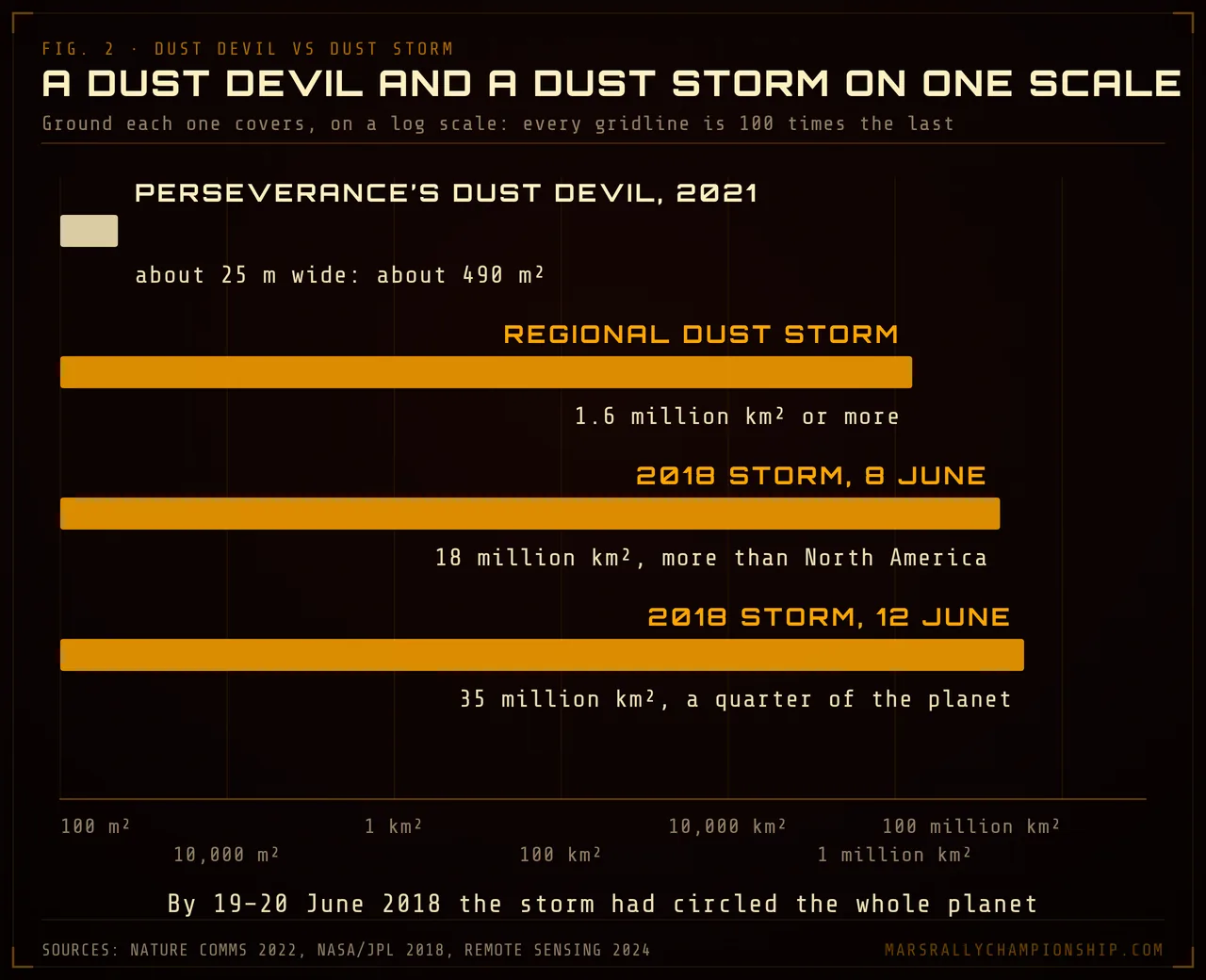
Diagram: Perseverance's 25 m dust devil against a regional storm and the 2018 storm, which covered a quarter of Mars by 12 June and then circled it.
Do dust devils cause the big storms? A 2008 study found significant evidence that they do not, though a dissenting view exists.
Why big dust storms switch dust devils off
A big dust storm shuts dust devils down. When Curiosity watched the 2018 storm from Gale Crater, Guzewich and colleagues found that dust devils and convective vortices ceased entirely from sol 2082 to 2106, and the first imaged dust devil did not return until sol 2137, when opacity had dropped to 2.84.
The reason follows from how they form. Dusty air shades the ground, so it stops being much hotter than the air above it. The paper reports about an 80 percent drop in sensible heat flux at the storm's height. With no strong heating from below, no column of air rises to spin up.
Drive through a dust storm in Mars Rally Championship
Mars Rally Championship has storm boards, not dust devils. There is no whirlwind, vortex or twister anywhere in the game. What it has is a dust storm you drive through on any of its four open stages: The Eight, The Long Run, The Opener and Down the Mountain.
Since 6 November 2026 the storm is a moving dust haze. About 95% of the view is gone by roughly 100 metres, a heavy brown haze, not a whiteout, and the gate you are driving to still shines through. Billows stream past on the wind, sand drifts low along the ground, and the sun dims to a glow with soft shadows. A WIND arrow on the HUD shows which way it pushes.
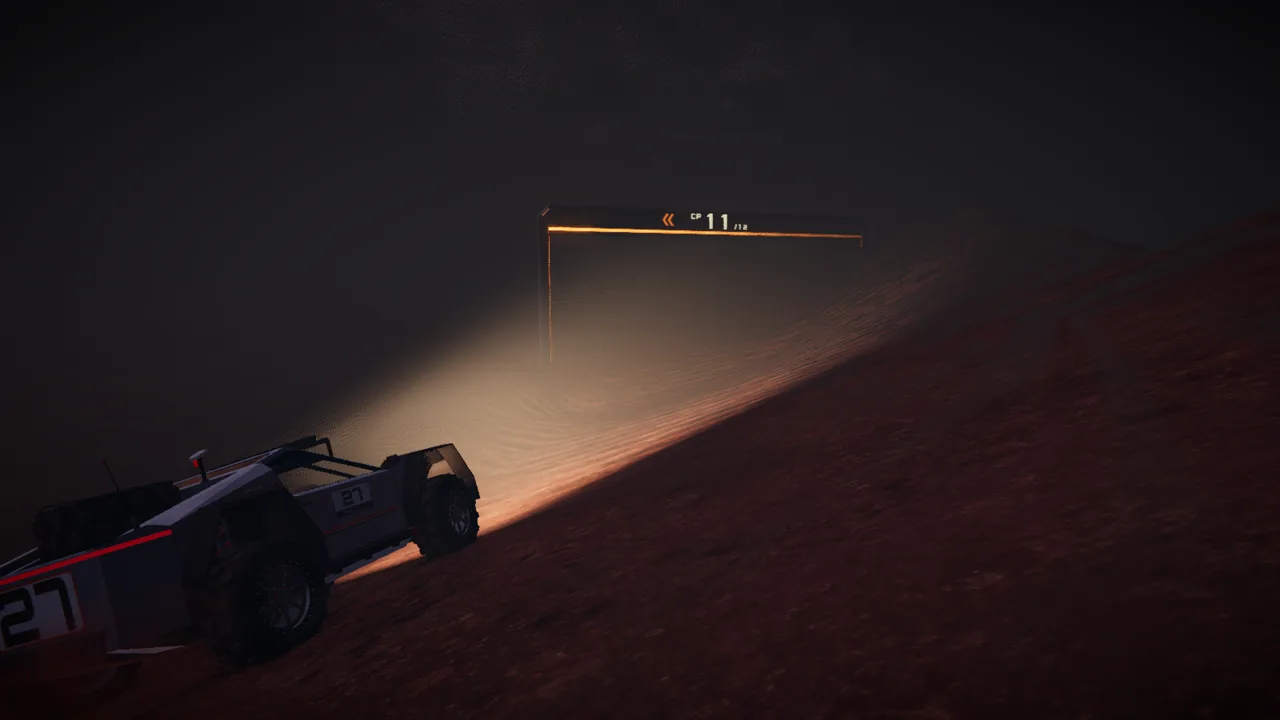
In-game screenshot: Stage 1, The Eight, at night in the storm: the headlights light up the dust itself, and the CP 11 gate glows through the dark.
The storm is at full strength from the start line through the countdown to the finish. At night the headlights cut beams through the dust.
Since 1 November 2026 the storm also pushes the rover: a steady 0.7 m/s² gusting to 2.0 m/s², roughly a quarter to two-thirds of the tires' grip on regolith. Dust slicks grip to 0.88 of clean air, and battery drain rises 50%. This is deliberately exaggerated. Real Martian air at those wind speeds would push this rover about 0.003 m/s², which nobody would feel; that fits ESA's remark that a human would barely notice 100 km/h.
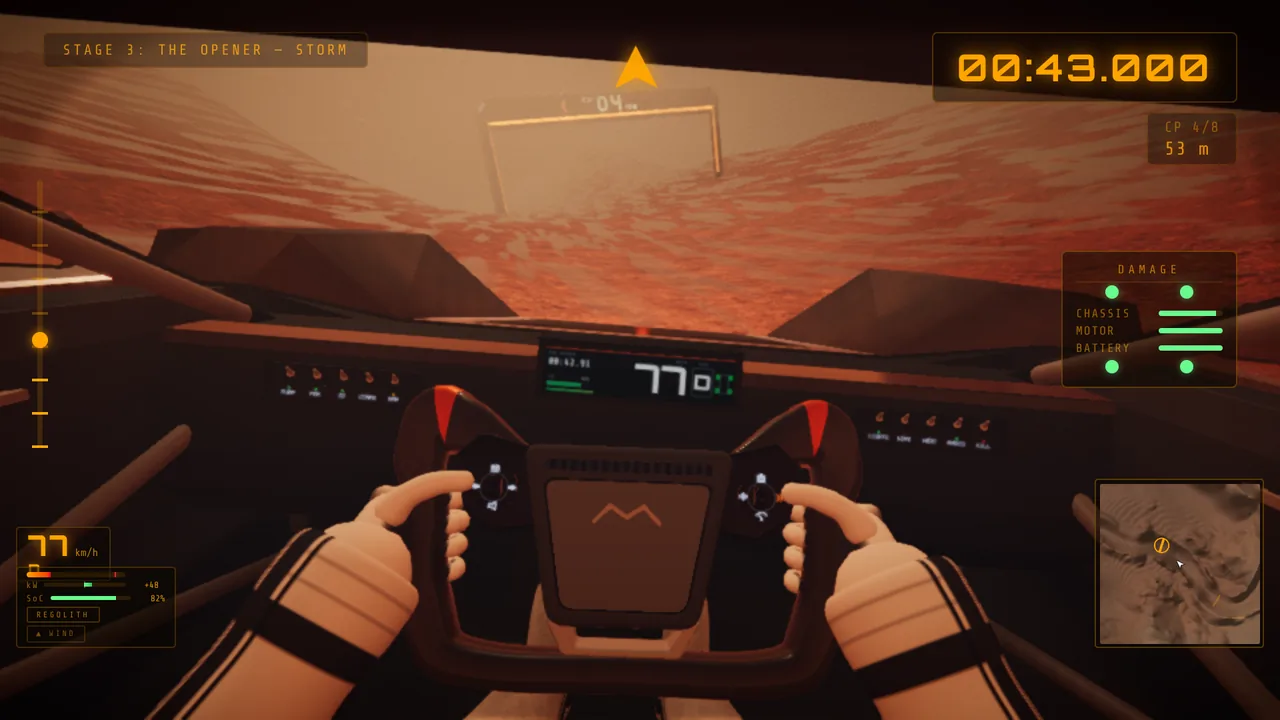
In-game screenshot: the helmet view on Stage 3, The Opener, in the storm, with the WIND chip on the HUD showing which way the gusts push.
Every racer on a board gets the identical storm, seeded per board, and the server re-simulates every run before it posts, storm runs included. Storm runs have their own boards and personal bests and earn no medals. To start one, pick STAGE N › STORM from the menu, or open Stage 2 in storm mode or Stage 4 at sunset in storm mode. The Stage 2 boards show who has driven it. No download, no account.
Where to try this
- Drive Stage 3 in the storm, the stage of the record in the video, free in the browser.
- How Mars dust storms work, the large-scale side.
- Footage from Mars, real rover imagery including dust devils.
- Why Mars sunsets are blue, what dust does to light.
Source for the catalogue: ESA's dancing dust devils article.