A space rover is a vehicle that moves across the surface of another world, carrying instruments or, on three Apollo missions, astronauts. Moving is what makes it a rover: a lander stays where it touched down, and an orbiter circles overhead. Most rovers are robots, steered by teams on Earth and by their own software, and they run on sunlight, plutonium or batteries. The first rovers worked on the Moon in 1970, on Mars in 1997 and on an asteroid in 2018. Mars Rally Championship, a free browser rally game, lets you drive a fictional crewed one.
Crossword help: "Explorer on Mars" (5 letters) is usually ROVER. "Exploratory vehicles on the red planet" (10 letters), from the Los Angeles Times puzzle of 1 December 2025, is MARS ROVERS.
What is a space rover, exactly?
A rover in space is defined by one ability: it moves itself across the ground of a world other than Earth. Merriam-Webster's definition, "a vehicle for exploring the surface of an extraterrestrial body", says nothing about wheels, size or crew.
That separates it from its neighbours on a mission:
- A lander touches down and stays put, as NASA's Viking landers and InSight did on Mars.
- An orbiter circles overhead, mapping from above and relaying radio traffic for the machines below.
- A rover usually arrives on a lander and then leaves it: Sojourner rolled down a ramp from Mars Pathfinder in 1997, and Pragyan drove off India's Vikram lander in 2023.
Wheels are usual, not required. Japan's two MINERVA-II1 rovers, confirmed by JAXA as the first rovers on an asteroid when they reached Ryugu in September 2018, hop instead, because Ryugu's gravity is too weak for wheels. A single hop keeps one off the ground for up to about 15 minutes.
Almost every rover is a robot. The exceptions are the Lunar Roving Vehicles of Apollo 15, 16 and 17, four-wheeled electric cars built for about 13 km/h, which astronauts drove about 90 km across the Moon in 1971 and 1972. Some future crewed rovers are being designed as sealed cabins on wheels, as what a pressurized rover would look like explains.
What is a Mars rover?
A Mars rover is a rover working on Mars. Six have driven there: NASA's Sojourner, Spirit, Opportunity, Curiosity and Perseverance, and China's Zhurong. Curiosity and Perseverance were still driving in September 2026. How many rovers are on Mars lists all eight that reached the surface, with their landing sites, distances and what silenced each one.
How do space rovers work?
Every rover has to solve four problems: power, driving, talking to Earth and doing science. Its distance from Earth shapes every answer.
Power: sunlight, plutonium or a battery
Most rovers have run on sunlight: Sojourner, Spirit, Opportunity and Zhurong on Mars, and the Lunokhods, Yutu, Yutu-2 and Pragyan on the Moon. The dark is the weakness. A lunar night lasts about two Earth weeks, so a solar Moon rover shuts down and waits for sunrise, and Pragyan never woke from its first. On Mars the threat is dust: a planet-wide storm cut off Opportunity's power in 2018.
Curiosity and Perseverance carry a radioisotope generator instead. It turns the heat of decaying plutonium-238 into about 110 watts at the start of a mission, day and night, with rechargeable batteries for the peaks. The Apollo rovers ran on batteries that were never recharged.
Driving: planned on Earth, finished by the rover
The Moon is about 1.3 light-seconds from Earth, close enough for the Soviet Union to drive its Lunokhods almost live. Two five-person crews, each a commander, driver, navigator, engineer and radio operator, took two-hour turns, steering through the Soviet deep-space antenna at Yevpatoria, in Crimea, from still television pictures, with a signal round trip of about 2.5 seconds.
Mars is between about 3 and 22 light-minutes away, so nobody drives a Mars rover live. Engineers plan each day's drive on Earth and uplink it as one command sequence, and the rover carries it out alone, judging the ground with stereo cameras and stopping when something looks wrong. Perseverance maps the terrain and picks its own path while its wheels turn, which is why it covers ground faster than any Mars rover before it; how fast Mars rovers go has the numbers.
Beneath all five NASA Mars rovers sits the same rocker-bogie suspension: six wheels on a springless linkage that keeps each one loaded on broken ground.
Talking to Earth: often through a relay
A Mars rover's antenna and power supply are small, so most of its data goes home through an orbiter overhead, which has more of both. Spirit and Opportunity returned 98% of their science and engineering data that way, and today the Mars Relay Network, a set of NASA and ESA orbiters, does it for Curiosity and Perseverance. A rover on the Moon's near side has Earth in view, but on the far side a relay is the only way home: Yutu-2 can never see Earth, so China placed a relay satellite, Queqiao, beyond the Moon.
What are space rovers used for?
Space rovers exist to carry instruments to the rocks and soil that matter and read them in place. Perseverance has seven, including zoom cameras, a laser that vaporises rock from a distance to read its chemistry, and a ground-penetrating radar. It also drills rock cores and seals them in tubes for a possible return to Earth.
Every rover that has moved on another world
By our count, 19 rovers have driven, rolled or hopped across another world under their own power as of September 2026: eleven on the Moon, six on Mars and two on the asteroid Ryugu. By world, in landing order:
| World | Rover | Agency | Landed | Crewed or robotic | Distance covered |
|---|---|---|---|---|---|
| Moon | Lunokhod 1 | Soviet Union | 1970 | Robotic, driven live from Earth | 10.54 km |
| Moon | Apollo 15 Lunar Roving Vehicle | NASA | 1971 | Crewed, two astronauts | ≈28 km |
| Moon | Apollo 16 Lunar Roving Vehicle | NASA | 1972 | Crewed, two astronauts | ≈27 km |
| Moon | Apollo 17 Lunar Roving Vehicle | NASA | 1972 | Crewed, two astronauts | ≈36 km |
| Moon | Lunokhod 2 | Soviet Union | 1973 | Robotic, driven live from Earth | ≈39 km |
| Moon | Yutu | CNSA (China) | 2013 | Robotic | 114.8 m |
| Moon | Yutu-2 | CNSA (China) | 2019 | Robotic | 1,613 m (reported Sep 2024) |
| Moon | Pragyan | ISRO (India) | 2023 | Robotic | 101.4 m |
| Moon | LEV-1 and LEV-2 (SORA-Q) | JAXA (Japan) | 2024 | Robotic; LEV-1 hops | — |
| Moon | Chang'e 6 mini rover | CNSA (China) | 2024 | Robotic | — |
| Mars | Sojourner | NASA | 1997 | Robotic | ≈100 m |
| Mars | Spirit | NASA | 2004 | Robotic | 7.73 km |
| Mars | Opportunity | NASA | 2004 | Robotic | 45.16 km |
| Mars | Curiosity | NASA | 2012 | Robotic | 37.43 km (14 Jul 2026), still driving |
| Mars | Perseverance | NASA | 2021 | Robotic | 44.98 km (24 Aug 2026), still driving |
| Mars | Zhurong | CNSA (China) | 2021 | Robotic | 1,921 m |
| Asteroid Ryugu | MINERVA-II1 Rover-1A and Rover-1B | JAXA (Japan) | 2018 | Robotic hoppers | — |
A dash means no published total could be found. Perseverance's last published reading left it 180 metres short of Opportunity's 45.16 km, the farthest any vehicle has driven on another world, so the record may already have changed hands. Rovers that arrived but never moved are not counted, such as two Soviet PrOP-Ms on Mars in 1971 and the MAPP and Yaoki rovers on Intuitive Machines' Athena lander, which tipped over on landing in March 2025. MASCOT, which hopped on Ryugu in 2018, is left out too: its builders call it a lander.
Rovers on the Moon: five countries since 1970
The first rover on another world, Lunokhod 1, was an eight-wheeled Soviet robot. It landed in the Sea of Rains on 17 November 1970, worked for eleven lunar days against a design life of three, drove 10.54 km and returned about 20,000 pictures, according to NASA's record of the mission. Lunokhod 2 drove about 39 km in 1973, farther than any Apollo rover, and held the record for driving on another world until Opportunity passed it in July 2014.
China's Yutu stopped driving 42 days after its December 2013 landing, at 114.8 metres, but returned data for 31 months. Yutu-2 arrived with Chang'e 4, the first landing on the Moon's far side, in January 2019, and became the longest-lived rover on the Moon. Chinese media put its total at 1,613 metres in September 2024, but images from NASA's Lunar Reconnaissance Orbiter suggest it has not moved since March 2024.
India's Pragyan landed near the south pole in August 2023 and drove 101.4 metres. The newest arrivals are the smallest. Japan's SLIM lander released two just before it touched down in January 2024: LEV-1, which hops, and LEV-2, or SORA-Q, a 228-gram ball that opens into a wheeled rover and photographed SLIM where it had tipped over. In June 2024 a Chinese mini rover of about 5 kg left the Chang'e 6 lander on the far side, chose its own vantage point and photographed the lander.
Which rovers are next?
Idefix, a rover built by Germany's DLR and France's CNES, rides on Japan's Martian Moons eXploration mission, which JAXA plans to launch on 20 October 2026, Japan time. It is due to land in 2029 on Phobos, the larger of Mars's two moons.
NASA's VIPER, an ice-hunting Moon rover, was cancelled in July 2024 with its assembly finished. In September 2025 NASA chose Blue Origin to land it at the lunar south pole in late 2027, but the delivery is an option NASA will exercise only after reviewing the results of the Blue Moon lander's first mission.
China's Chang'e 7, carrying a rover and a small hopping probe to the lunar south pole, was on its launch pad when China postponed it on 23 August 2026, saying it could not launch in its planned window this year. Astrobotic's Griffin lander, due to launch in late 2026, carries Astrolab's FLIP rover there too. For Mars, Europe's Rosalind Franklin is next, with launch no earlier than late 2028 and landing planned for 2030.
What kind of rover is in Mars Rally Championship?
The rover in Mars Rally Championship is fictional and crewed: a 3,000 kg electric rally rover, about three times the mass of Perseverance, with a 5.0 m body on four knobby tyres and a 240 km/h speed limit, driven by a pilot in a pressurized suit. The default HELMET camera puts you at the pilot's eyes.
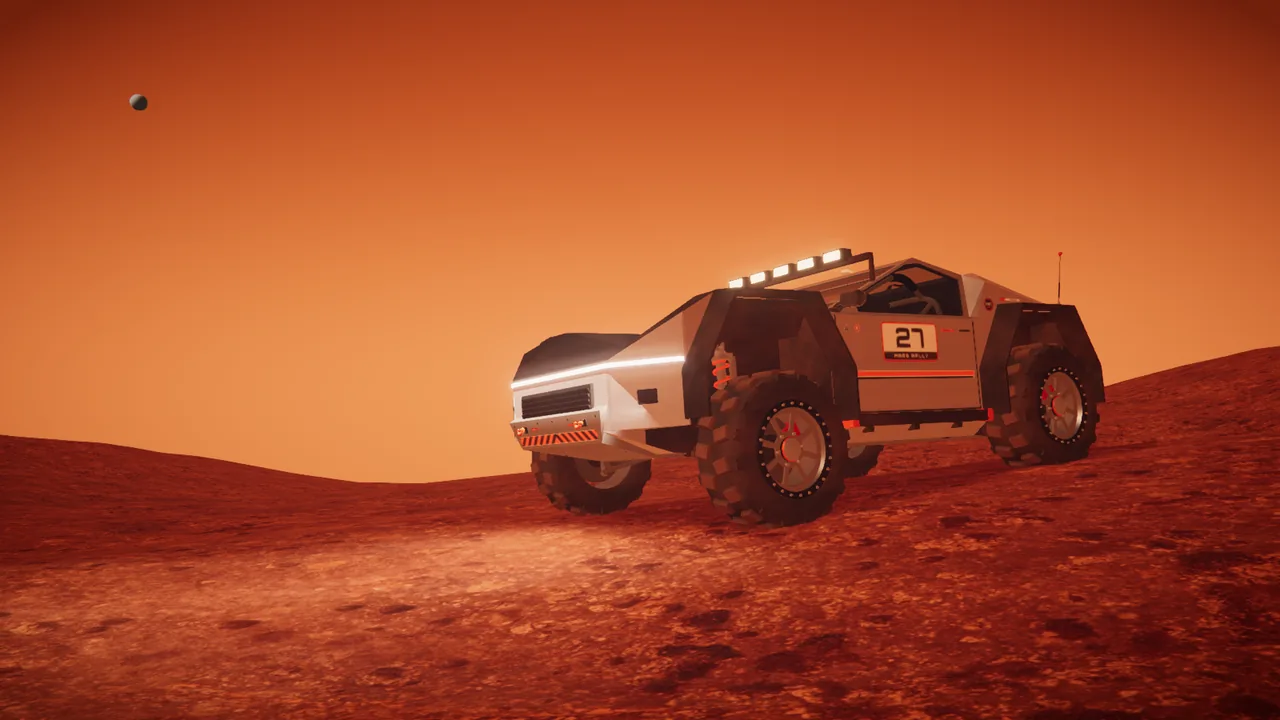
In-game screenshot: the Mars Rally Championship rover, a fictional four-wheeled crewed rally machine, on terrain sculpted to Martian shapes rather than a real landing site.
What it keeps from the real rovers is their planet: 3.72 m/s² of gravity, air at 0.020 kg/m³ and loose regolith, so it needs about 125 metres to stop from 100 km/h. What it leaves out is most of this page: there is no signal delay, because you drive it live, and no self-driving, relay orbiter or science instrument. Its power comes from a 90 kWh battery, not a generator making about 110 watts, though one real hazard survives: a dust storm raises battery drain by 50%. It has four sprung wheels where NASA's Mars rovers have six on a rocker-bogie, and its terrain is sculpted to Martian morphologies, not copied from a landing site.
Its nearest real relative is the crewed, electric, four-wheeled Apollo Lunar Roving Vehicle. Whether anything closer to a car has reached Mars is the question behind is there a car on Mars.
Where to try this
- Free roam has no timer and no checkpoints, so you can simply drive, and C cycles through the rover's 15 cameras.
- Mars rover size comparison measures every Mars rover, and the game's, against a car and a person.
- The history of the Mars rover tells the Mars half of this story in order.
Mars Rally Championship is free in a browser tab, with no download and no account, on a laptop or a phone in landscape, and up to eight pilots can race the same stage live.