Rally pace notes are a shorthand description of a stage, written during reconnaissance and read aloud by the co-driver so the driver knows what is coming before they can see it. A call names the distance to the corner, the direction it turns, and its severity on a numbered scale — most commonly 1 to 6, where 1 is a hairpin and 6 is barely a bend — plus modifiers such as crest, tightens, or don't cut. Mars Rally Championship, a free browser rally game, derives the core of each call, the direction and the number, automatically from each stage's checkpoint geometry.
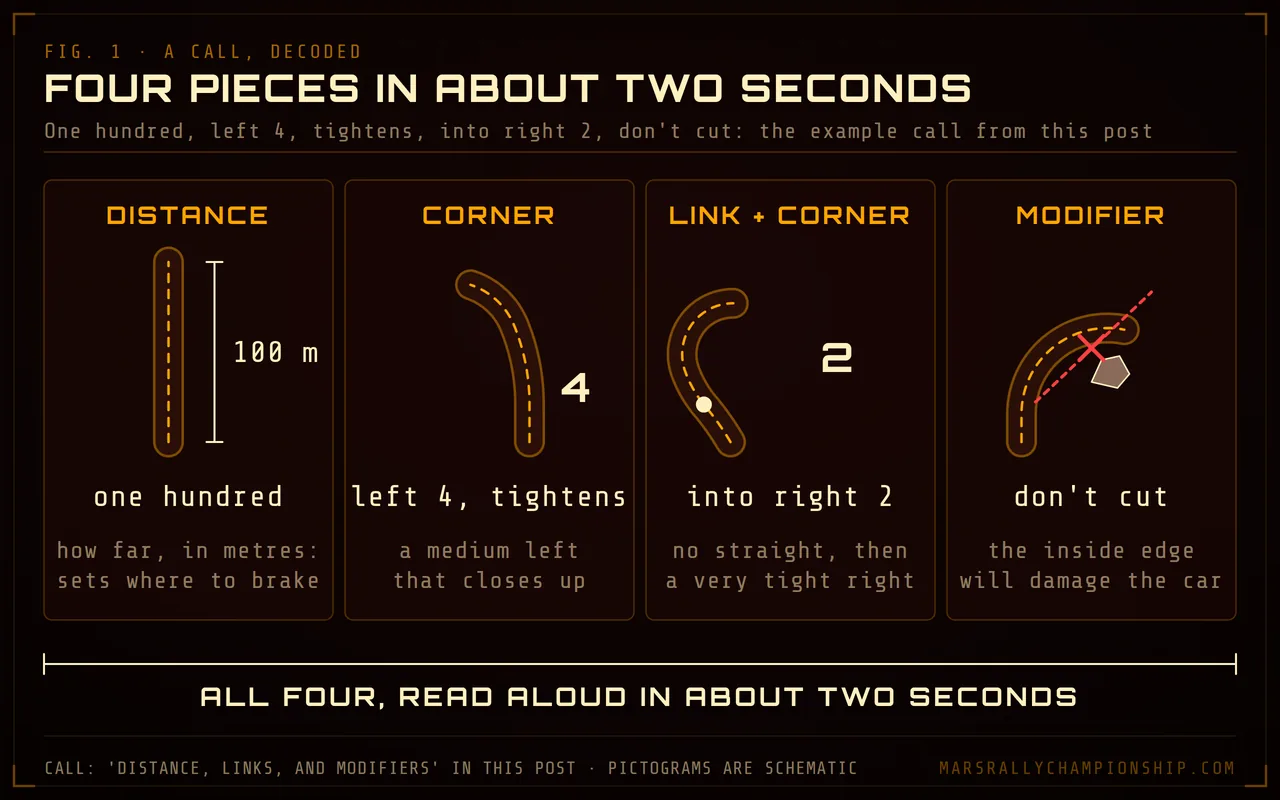
Diagram: one call carries distance, direction, severity, a link and a warning, spoken in about two seconds in the order the car meets the road.
Why the co-driver reads the road out loud
A rally stage is a closed public road that the crew drives once, at speed, in one direction. There is no practice lap and no second attempt. What the crew gets instead is recce: one or two passes at legal speed, hours or days before the start, with the driver dictating and the co-driver writing.
The book that comes out of recce is not a description of scenery. It is a compressed, ordered list of everything that changes the driver's inputs, corner by corner, with the distance between each one. Two crews can write the same stage very differently and both be right: notes are tuned to how that driver wants information delivered.
On the stage the co-driver rarely looks up. They read at a pace matched to the car's speed, staying one or two calls ahead of what the windscreen shows. That gap is the entire point of the system. By the time a blind crest resolves into a tight left, the braking should already be done. Reading is only part of the seat: the time card, the road book and the SOS sign are covered in what a rally co-driver does.
What the numbers 1 to 6 mean
In the most widely used modern system, corner severity runs from 1 to 6. The number grades how sharply the road deflects: 0 degrees is dead straight, 180 degrees doubles back on itself. A 1 is the tightest corner on the stage. A 6 is a kink you take without lifting.
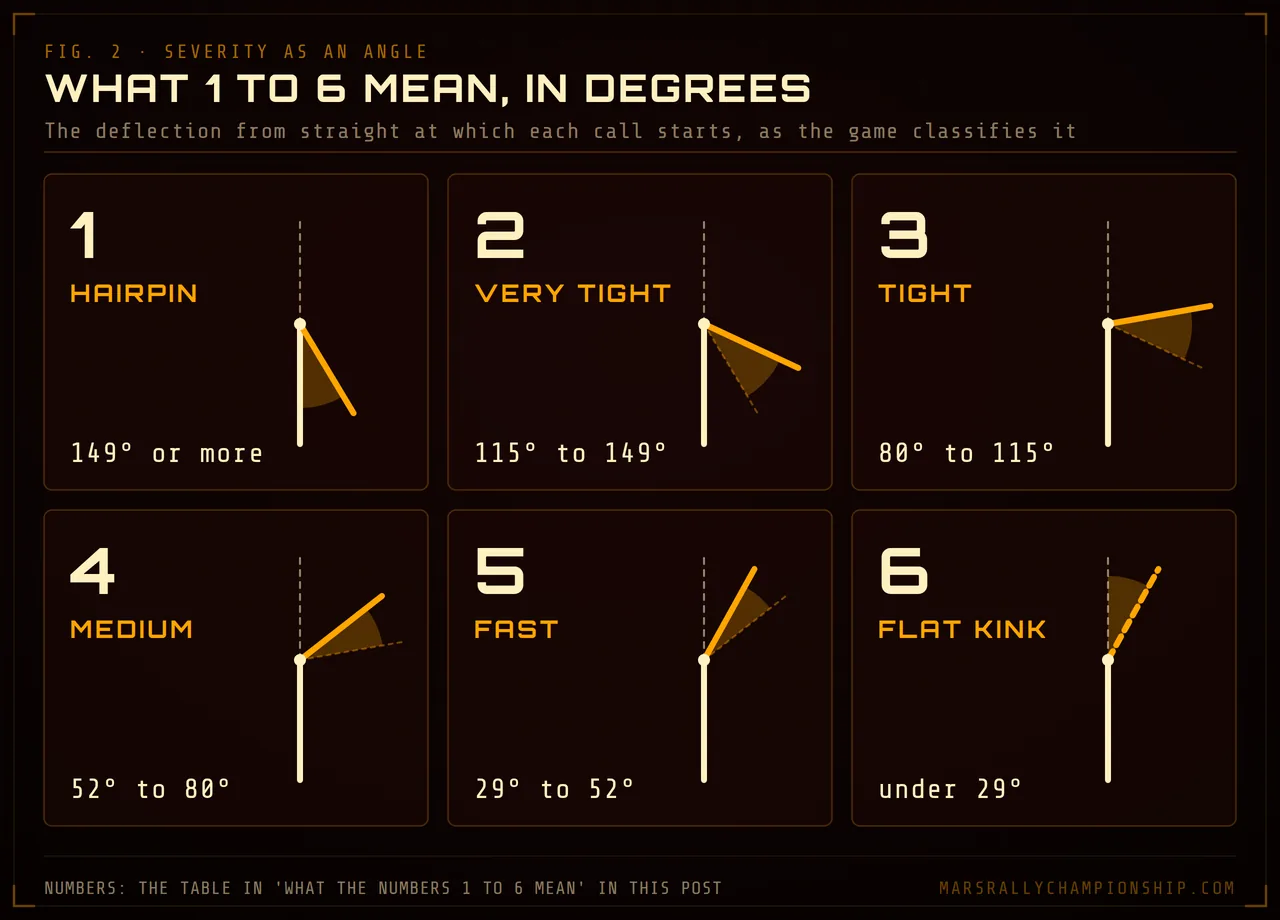
Diagram: the game grades a corner by how far the road deflects from straight: 149 degrees or more is a 1, under 29 degrees a flat 6.
Mars Rally Championship uses that scale directly, with fixed angle thresholds, so the numbers below are the exact boundaries the game classifies against.
| Call | Deflection from straight | What it means | Throttle |
|---|---|---|---|
| 1 | 149° or more | Hairpin. The road nearly doubles back. | Full braking, lowest gear, crawl to the apex before any power |
| 2 | 114.6° or more | Very tight. Sharper than a street corner. | Hard braking well before turn-in, power only past the apex |
| 3 | 80.2° or more | Tight, roughly a right angle. | Firm braking, one gear down, feed throttle from the apex out |
| 4 | 51.6° or more | Medium. Committed but not slow. | Brush of brake or a long lift, back to throttle at turn-in |
| 5 | 28.6° or more | Fast. A shape more than a corner. | Short lift, or nothing if the surface is good |
| 6 | Under 28.6° | Flat kink. Barely a corner. | Stay on it and hold your line |
The number describes geometry, not an instruction. A 3 on loose regolith with a wall of rock on the exit is a different corner from a 3 on hardpack with room to run wide, which is why the modifiers matter as much as the digit.
Distance, links, and modifiers
A complete call has three parts: how far away the corner is, which way it goes, and how tight it is. In practice you hear something closer to "one hundred, left 4, tightens, into right 2, don't cut". Read that back slowly and it is four separate pieces of information delivered in about two seconds.
The modifiers you hear most often
Crest and jump describe what the ground does rather than the road. A crest unloads the suspension at the worst moment; a jump takes the wheels off it entirely. Into links two corners with no meaningful straight between them, so the second call arrives while you are still cornering. Tightens and opens warn that the radius changes mid-corner, which is the most common cause of a corner being taken too fast. Long means the corner holds its radius for far longer than the number alone suggests. Don't cut marks an inside edge that will damage the car or throw it off line. Caution is the co-driver's blanket flag for something genuinely dangerous. The full vocabulary, from keep in and keep out to over crest and double caution, is decoded term by term, with example calls, in the rally pace notes glossary.
Distances are called in metres and are what let the driver place the braking point. On Earth a call at 100 metres is generous. On Mars it is not, for reasons covered in braking distance on Mars versus Earth.
Why some crews count the other way
This is the detail that confuses people watching onboard footage. The 1-to-6 direction is a convention, not a standard. In the most common system, lower numbers mean tighter corners: 1 is a hairpin, 6 is flat. Other crews run the scale inverted, so 1 is the fastest corner and 6 is the hairpin. A third group skips numbers for the extremes and uses words — hairpin, square, acute — with numbers only in between. Scales that run to 9 or 10 exist too.
None is more correct than the others; what matters is that the crew agrees and never changes it mid-season. If a call on an onboard seems wildly wrong for the corner that follows, the crew is almost certainly counting the other way. Check a hairpin early in the clip and you will know within one call which system you are hearing.
How Mars Rally Championship derives its notes from geometry
Real pace notes are written by hand, over two recce passes, by people who will drive the stage. Mars Rally Championship takes the other route: with stages still being authored, a hand-written book would go stale every time a route moved, so the co-driver notes are derived from the stage's checkpoint line at load time.
The derivation is worth understanding, because it explains what the notes get right and what they leave out. At each interior checkpoint the game measures the angle between the segment arriving and the segment leaving, then looks that angle up in the severity table above. The sign of the 2D cross product between the two segments gives left or right. The result is a call like "right three" or "left five".
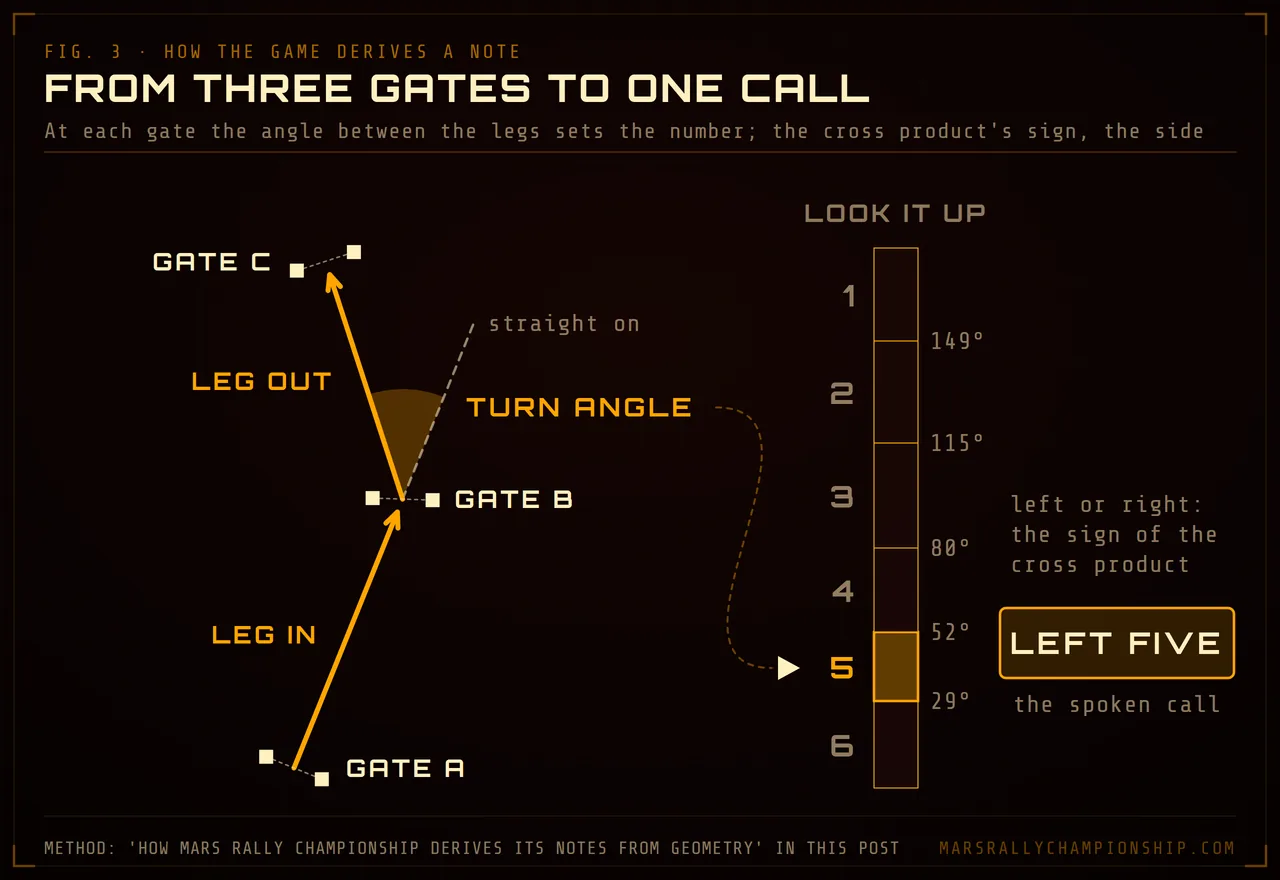
Diagram: one angle and one sign per gate is all the geometry gives, which is why the notes know nothing about crests or road edges.
Two calls are fixed. Every run opens with "stage starts, straight N meters", where N is the distance from the start gate to the first corner it calls, and every run ends with "into finish, caution" — the same into link a human co-driver would use to say the finish arrives without a break.
Stage 3, "The Opener" runs 1,164 metres through eight checkpoints, which gives the deriver an opener, six interior corner calls, and the finish warning. That is far sparser than a real rally stage, where notes run continuously. It is also honest about its limits: the geometry gives direction and severity, but there is no crest, no tightens, no don't cut, because a checkpoint line carries no elevation profile and no road edges. For those, the corner-by-corner human version lives in the Stage 1 fastest line guide. Stage 2, The Long Run, shows the gap more sharply: both of its fives sit on crests the notes cannot see, and the Stage 2 racing line guide walks through them gate by gate.
Why the call comes eight seconds out
The lookahead — how far ahead of the car the next note fires — is set to 8.0 seconds at current speed, clamped between 25 and 260 metres so it neither shouts at walking pace nor calls a corner from the far side of the stage.
That number started at 4.5 seconds, which is a sensible Earth value, and it was wrong. Mars gravity is 3.72 m/s², 38% of Earth's, and the total grip budget on regolith — friction plus soil cohesion — works out to roughly 3.1 m/s². Braking from 100 km/h takes about 125 metres and about 9 seconds. A call 4.5 seconds ahead arrived after the braking point had already gone past. Eight seconds puts the note in front of the braking zone at speed, which is what a co-driver is for.
Driving to the call, not to the corner
The habit that separates fast stage drivers from quick lap drivers is acting on the note rather than on what the eyes report. If the co-driver says "left 2" and the road still looks open, the braking starts now. Trusting the book feels wrong for a few runs, then becomes the only way to carry speed into blind sections.
Two smaller habits help. Count distances rather than corners: distance sets your braking point, the number only sets target speed. And listen for links — a call with into in front of it means no reset between the two corners, so your exit from the first is the entry to the second.
The co-driver speaks through the browser's own speech synthesis, so there is no audio download and no voice pack to install. The same call also sits in a strip at the top of the HUD — "RIGHT 4 · 120 M · ▼ 45" — with its live distance and an advised speed worked out from Mars grip and the corner's geometry, and a BRAKE cue lights while the stop down to that speed needs all the road that is left. If you would rather drive in silence, there is an on-off switch in settings; the strip stays, and nothing else about the run changes with the voice off.
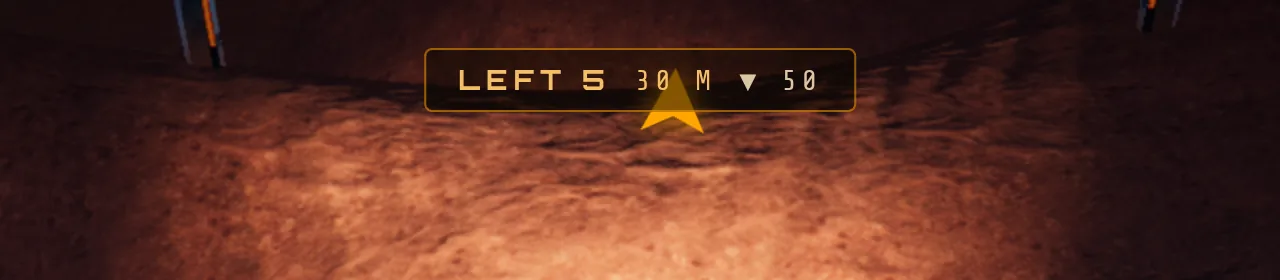
In-game screenshot: the strip shows the next call with a live distance and an advised speed from Mars grip, whether or not the voice is on.
Where to try this
Start with Stage 3, The Opener and run it twice: once with the co-driver on, listening for where each call lands relative to your braking, and once with it off to see how much of the stage you had actually memorised. The full stage list shows what is drivable today. If you want the broader technique work that sits underneath all of this, the guide to getting faster at rally driving games covers braking points, vision, and consistency.