The main difference between a lunar rover and a Mars rover is who drives: the Apollo Lunar Roving Vehicle carried two astronauts who steered it themselves for three days, while Mars rovers are robots that drive on their own for years, following plans sent from Earth a day at a time. The Apollo rover weighed 210 kg and ran at about 13 km/h. Perseverance weighs 1,025 kg and is rated at 152 m an hour. Mars Rally Championship, a free browser rally game, drives a fictional crewed rover under Mars gravity.
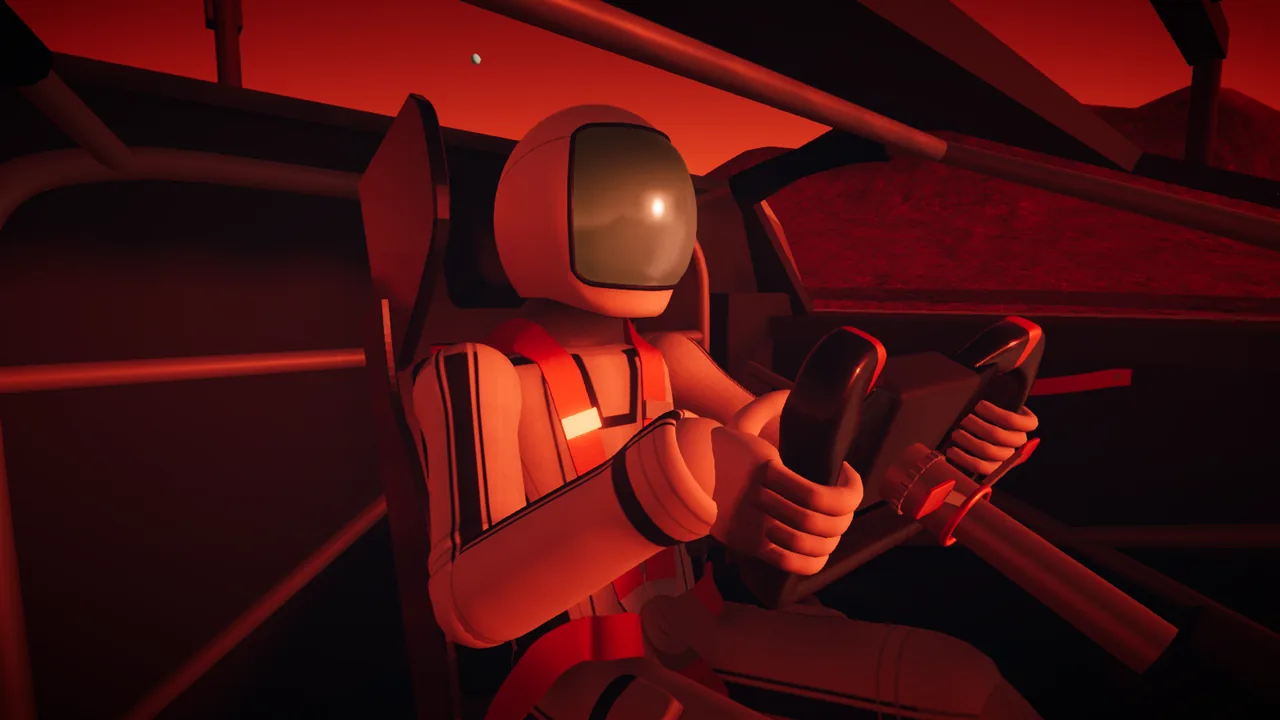
In-game screenshot: the suited pilot of Mars Rally Championship's fictional crewed rover at sunset on Stage 4; the Apollo rover is the only real crewed rover so far.
Methodology: NASA and JPL pages for every real-world figure, linked where they are used. Last checked: November 2026.
What is the difference between a lunar rover and a Mars rover?
Two different jobs produced two different machines. The Apollo Lunar Roving Vehicle, the LRV, was a light electric vehicle that astronauts drove on Apollo 15, 16 and 17. It was used on three traverses per mission, one a day, over a three-day stay. Apollo 15 made the first drive on 31 July 1971. Boeing built it, and NASA's NSSDC page says it was developed in 17 months.
A Mars rover is a robot built to survive and keep working with nobody nearby. Perseverance landed in Jezero Crater on 18 February 2021 and is still driving.
"Lunar rover" can also mean the robots. The Soviet Lunokhod 1 and 2 drove on the Moon in 1970 to 1973, and Lunokhod 2 covered 39 km. The comparison most people want, though, is Apollo's crewed rover against NASA's Mars rovers, so that is what this post sets side by side. The Lunokhod story has its own write-up in what is a space rover, and the LRVs get a short mention in is there a car on Mars: they are the only cars anyone has driven on another world.
Lunar rover vs Mars rover, side by side
The Apollo Lunar Roving Vehicle and Perseverance, NASA's newest Mars rover, compared.
| Apollo Lunar Roving Vehicle | Perseverance (Mars 2020) | |
|---|---|---|
| Driver | Two astronauts on board, hand controller | Planners on Earth a sol ahead; AutoNav steers between waypoints |
| In service | Apollo 15, 16 and 17, 1971–1972; three days each | Since landing on 18 Feb 2021; extended to about the end of 2028 |
| Mass | 210 kg, plus up to 490 kg of crew and cargo | 1,025 kg |
| Size | 3.1 m long, 2.3 m wheelbase, 1.14 m high | 3 m long, 2.7 m wide, 2.2 m tall |
| Wheels | Four, 81.8 cm, woven steel mesh with titanium chevrons | Six, 52.5 cm, aluminium with 48 grousers |
| Suspension | Double wishbones, torsion bars, dampers | Rocker-bogie |
| Power | Two 36 V silver-zinc batteries, not rechargeable | Radioisotope generator, about 110 W at launch |
| Top speed | About 13 km/h; 18 km/h record (Apollo 17) | 152 m an hour (4.2 cm/s) on flat, hard ground |
| Distance | 27.8, 26.7 and 35.9 km per mission | 45.22 km by 11 Oct 2026, the off-world record |
| Gravity | 1.62 m/s² | 3.72 m/s² |
| Signal to Earth | About 1.3 seconds each way | About 3 to 22 minutes each way |
Three gaps stand out. The LRV had a crew and Perseverance has none. The LRV at about 13 km/h is more than 80 times faster than Perseverance at 0.152 km/h. And the LRV worked for three days per mission where Perseverance has worked for more than five years.
Moon gravity vs Mars gravity: what it does to a rover
The Moon pulls at 1.62 m/s², about 0.165 of Earth's gravity. Mars pulls at 3.72 m/s², 38% of Earth's (NASA's Mars fact sheet rounds the mean to 3.73). For a vehicle, gravity sets how hard the wheels press on the ground, and that sets grip.
A fully loaded LRV, 210 kg plus 490 kg of crew and cargo, is 700 kg. On the Moon it presses down with 1,134 newtons, the weight of about 116 kg on Earth. Perseverance's 1,025 kg weighs on Mars what about 389 kg weighs at home. A light vehicle with little weight on its wheels has little grip to brake and turn with. For what the same physics does to a fast vehicle, see how Mars gravity changes rally driving.
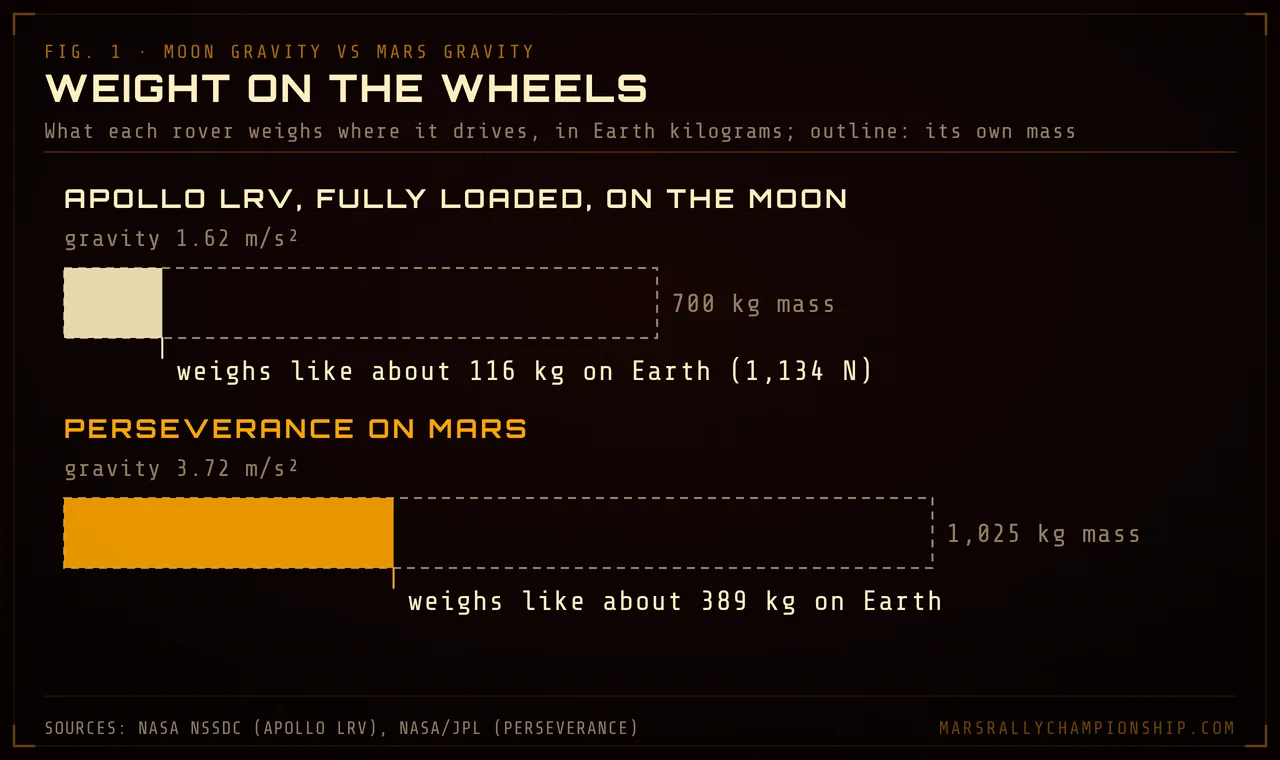
Diagram: a fully loaded Apollo rover pressed on the Moon about as hard as 116 kg does on Earth; Perseverance weighs on Mars what 389 kg weighs at home.
The rest of the environment differs too. The Moon has essentially no air: night surface pressure is about 3×10⁻¹⁵ bar. Mars has a thin one, 6.36 mbar on average. A lunar day-night cycle lasts 29.53 Earth days, and equatorial temperatures swing from 95 K to 390 K. A Mars sol lasts 24.66 hours. A NASA Ames analysis from 2017 adds that with no air on the Moon, there is no scattered light to fill shadows, which complicates driving near the poles.
Wheels and suspension: woven steel against machined aluminium
The LRV had four wheels, each a spun aluminium hub with an 81.8 cm tire of zinc-coated woven steel strands, 23 cm wide. Titanium chevrons covered 50% of the contact area, and a 64.8 cm inner frame acted as a bump stop. Double wishbones with torsion bars and a damper carried each wheel, ground clearance fully loaded was 36 cm, and both the front and rear wheels steered, for a 3.1 m turning radius.
Perseverance has six aluminium wheels of 52.5 cm with 48 grousers, each with its own motor. The front and rear pairs have steering motors, so the rover can turn in place. A rocker-bogie suspension lets it climb obstacles as large as a wheel. The wheel and suspension details are covered in Mars rover wheels explained and rocker-bogie suspension explained.
Power and range: batteries for three days, plutonium for years
The LRV carried two 36-volt silver-zinc batteries that could not be recharged. Each wheel had a 0.25 hp DC motor, so the four together made 1 hp, about 0.75 kW. Thermal control was passive.
Range was set by safety, not the batteries alone: astronauts had to be able to walk back to the lunar module if the rover failed. The farthest any crew got from the module was 5.0 km on Apollo 15, 4.5 km on Apollo 16 and 7.6 km on Apollo 17. That rule is explained in crewed pressurized Mars rovers.
Perseverance carries a radioisotope generator that made about 110 W at launch, declining a few percent a year. It drives on less than 200 W. JPL says its first extended mission began in October 2026 and runs to roughly the end of 2028.
Who drives: an astronaut, Earth, or the rover itself
The LRV was driven by hand. A T-shaped controller sat between the two seats: push it forward to go, pull back to brake, move it left or right to steer, and use a switch with a pull back for reverse. A gyro and an odometer fed a computer that tracked the direction and distance back to the lunar module, and a Sun-shadow device gave a manual heading check.
Lunokhod was steered from Earth, by a team of controllers sending commands from television frames that arrived seconds apart. NASA's 2017 analysis found that even at lunar distance, light time plus communications overhead rules out true joystick driving.
On Mars the delay is 3 to 22 minutes each way, depending on where the planets are. Planners send a day's plan one sol ahead, and Perseverance's AutoNav system chooses a path between waypoints. JPL says it has driven more than 90% of the rover's distance. The full routine is in how NASA drives Mars rovers.
Speed and distance: 18 km/h against 152 metres an hour
NASA's test report put the LRV's top speed at 9 to 13 km/h depending on slope, and the design figure is about 13 km/h. On Apollo 17, driving downhill, the crew set a lunar speed record of 18 km/h. Over a full mission the speed was lower: Apollo 17 covered 35.9 km in 4 hours 26 minutes of driving, an average of about 8.1 km/h while moving. Apollo 15 covered 27.8 km in 3 hours 2 minutes, and Apollo 16 covered 26.7 km in 3 hours 26 minutes.
Perseverance is rated at 152 m an hour on flat, hard ground, just under 0.1 mph. On 11 October 2026, sol 2,006, it reached 45.22 km, passing Opportunity's 45.16 km. Opportunity needed 5,111 sols; Perseverance did it in five and a half years against almost 15. It had already passed Lunokhod 2's 39 km and Apollo 17's distance. At Apollo 17's moving average of 8.1 km/h, Perseverance's whole odometer would take about five and a half hours.
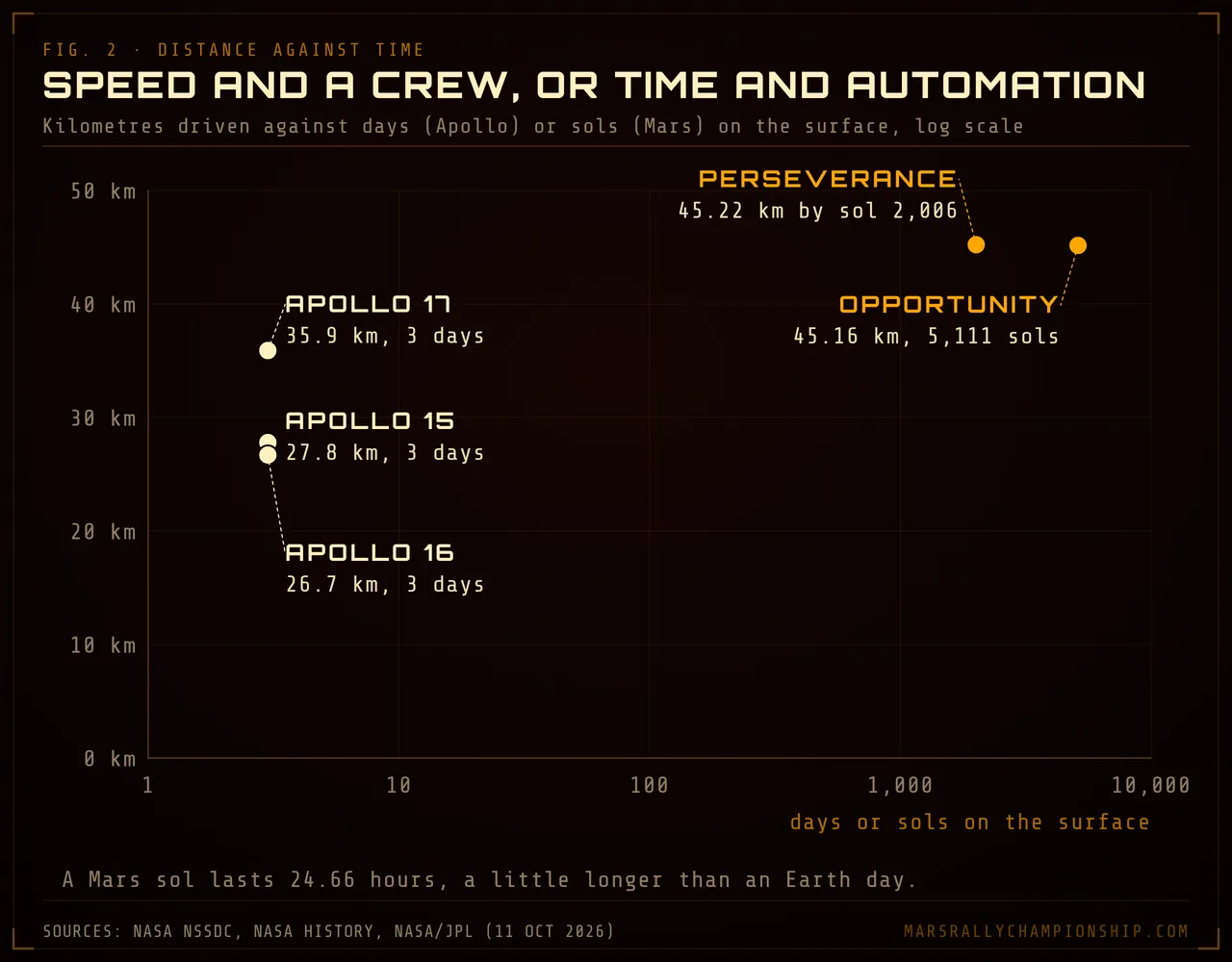
Diagram: the Apollo rovers covered 26.7 to 35.9 km in three days each; Perseverance needed 2,006 sols for 45.22 km, the record.
Mars rover speeds, including the best single-sol drives, are covered in how fast Mars rovers go. The point here is the shape of the comparison: the LRV bought distance with speed and a crew, and Perseverance buys it with time and automation.
What comes next on the Moon
On 26 May 2026 NASA ordered the first phase of its Lunar Terrain Vehicles: $219 million to Astrolab and $220 million to Lunar Outpost, with the aim of reaching the lunar surface by 2028. Astrolab's CLV-1 is a crewed rover of about 2,000 lb, rated at more than 6 mph on level ground. Lunar Outpost's Pegasus is built to operate for up to a year and to be driven manually, autonomously or by teleoperation, at more than 9 mph.
That second description is the Mars idea arriving on the Moon: a vehicle that a person can drive, and that also drives itself when nobody is aboard. For the Mars version of a crewed vehicle, see the designs in crewed pressurized Mars rovers.
A crewed rover on Mars, in a browser
Mars Rally Championship is a free 3D rally game that runs in the browser, with no download and no account. Its rover is fictional, and it is closer to the LRV idea than to Perseverance: crewed by a pilot in a pressurized suit, four wheels on long-travel suspension, battery-electric. The resemblance stops there. It weighs 3,000 kg, carries a 90 kWh battery and makes 312.5 kW at peak, against the LRV's four 0.25 hp motors. Its speed limit is about 240 km/h, roughly 13 times Apollo 17's 18 km/h record. It is a pickup-truck-sized rally rover, not a science rover, and nothing in it is a NASA design.
The physics is where Mars shows. Gravity is 3.72 m/s², and stopping from 100 km/h takes about 125 m, against about 52 m on Earth gravel with the same tires and soil.
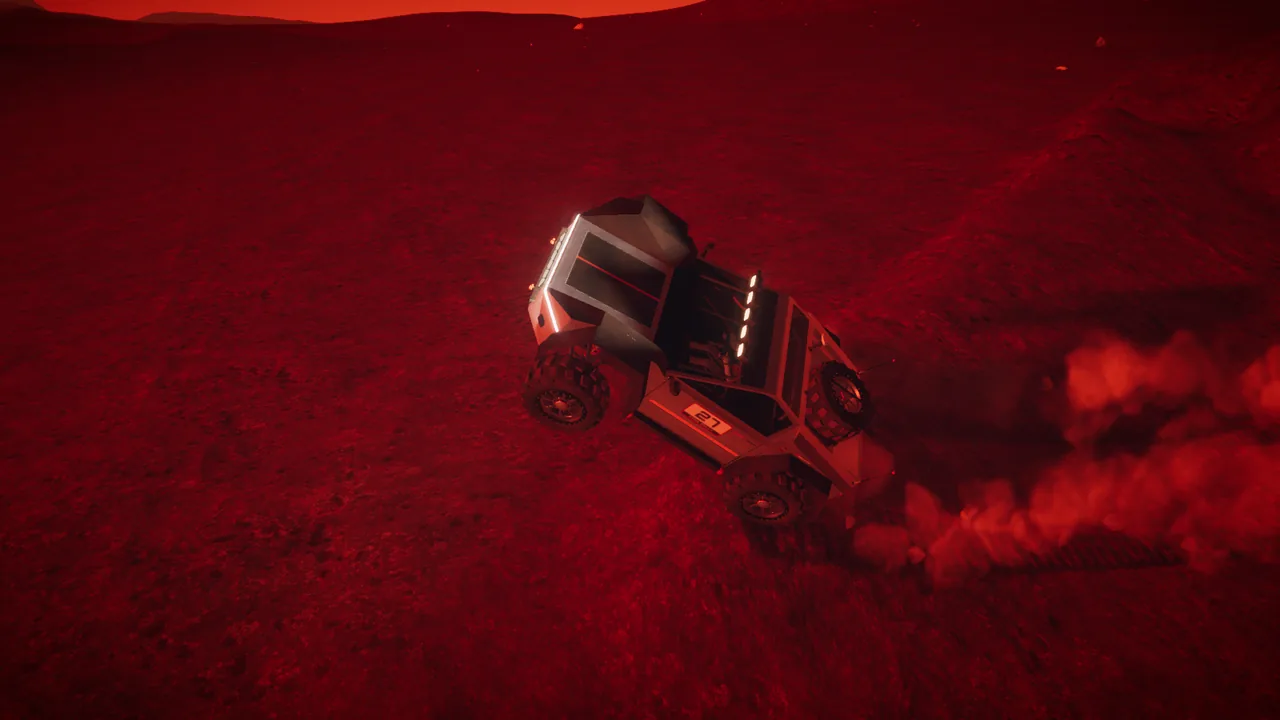
In-game screenshot: a 3,000 kg rally rover lifts two wheels leaving a crest on Stage 4's descent at sunset, under Mars's 3.72 m/s² gravity.
Stage 4, Down the Mountain, is the one to try for the feel of a heavy vehicle on a slope. It runs 1,689 m at sunset, and from gate 8 the ground falls 124 m in 850 m. The terrain is sculpted to Martian morphologies, not surveyed from a real place, so treat it as a driving model and not a map.