To get faster at racing games, stop trying to carry more speed and start protecting the speed you already have: brake earlier than feels right, use one control at a time, turn in early on a long arc, and read your ghost split by split instead of chasing it. Those habits transfer to any rally game. Mars Rally Championship, a free browser rally game, just makes them impossible to ignore — the entire grip budget is about 3.1 m/s², so a sloppy input costs you the whole next straight.
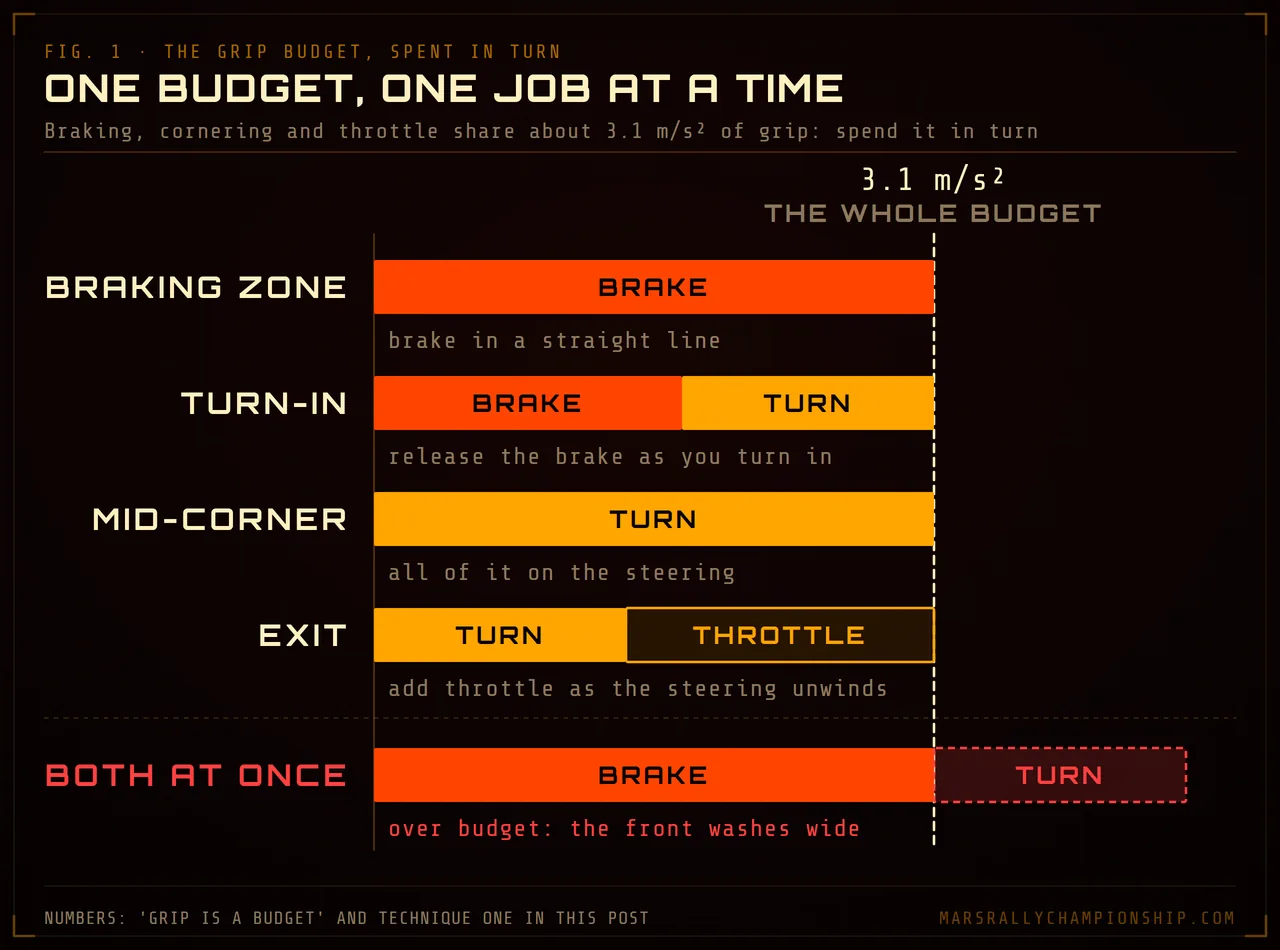
Diagram: brake, steering and throttle draw on one budget of about 3.1 m/s²; ask for two at once and the front washes wide.
Grip is a budget, and here it is about 3.1 m/s²
Every technique below is one rule wearing different clothes: a tire has a fixed amount of grip, and braking, cornering and accelerating all spend from the same account.
In Mars Rally Championship the number is unusually easy to see. Tire friction sits at µ 0.70 on dry basaltic regolith, gravity is 3.72 m/s² — 38% of Earth's — and the product, plus about 0.48 m/s² of regolith cohesion, is roughly 3.1 m/s² of acceleration in any direction. That is the whole budget: whatever the brakes take, the steering cannot have.
The budget also moves under you: hardpack lakebed multiplies grip by 1.15, cracked polygon ground by 0.75, so effective friction runs from about 0.53 to 0.81 and total grip from about 2.2 to 3.6 m/s². Nothing rescues you at speed either, because downforce is impossible in air at 0.020 kg/m³. The low-gravity technique primer covers how that changes the feel of the car; this post is about what to do with your hands.
Technique one: spend the budget on one thing at a time. Brake in a straight line, release the brake as you turn in, add throttle only as the steering unwinds. Overlapping any two of them is the most common reason a corner goes wrong. The one deliberate exception is the Scandinavian flick, which overloads the rear tires on purpose to swing a car round on loose ground; in this game's physics it only delays the turn, and the handbrake does the rotating instead.
Braking earns more time than anything else
Technique two: brake earlier than feels right, then earlier again
Stopping from 100 km/h takes about 125 metres and roughly 9 seconds. The same tires on Earth gravel would do it in about 52 metres. Every braking instinct from a tarmac racer is calibrated to a distance that no longer exists.
Practise it deliberately: pick a rock as a braking marker, run the corner, note the overshoot, move the marker back twenty metres, run it again. Repeat until you are braking too early and having to wait. That is the correct feeling; trim from there.
The co-driver is tuned around the same problem: calls fire on an 8.0-second lookahead, because an Earth-standard 4.5-second call arrived after the braking point. Rally pace notes explained covers the severity scale behind them.
Technique three: threshold-brake, never stomp
The anti-lock brakes hold each tire at the peak of its grip, so a straight-line stop spends the whole friction circle and the wheels never lock. Steer with the pedal held and the ABS shares the circle, so the rover turns while it slows — but every bit of brake is cornering grip you do not have, and a full pedal leaves the corner the least. On a keyboard or a touchscreen the brake is all or nothing, so do the heavy braking in a straight line and ease off as you turn in; a gamepad trigger can be feathered, which is where threshold braking lives. On a keyboard, holding ↑ and ↓ together into a turn makes a medium brake the keys otherwise lack; left-foot braking in rally games measures it against the brake alone and a plain lift.
Squeeze to firm, hold, then bleed pressure off as you add steering lock. Braking and steering trade against each other; they never stack.
Corner geometry: early, wide, greedy about the exit
Technique four: long, low arcs instead of late apexes
At 100 km/h the minimum corner radius is about 250 metres. That is an enormous arc, far wider than most players' mental model of a corner, and the brake-deep, late-apex line from tarmac games does not fit inside it.
Turn in absurdly early. Use all the width available, be pointing down the exit long before the corner is finished, and treat the apex as something you drift past rather than attack. Stage 3, The Opener is the cleanest place to feel it: 1,164 metres of timed line through 8 checkpoints whose 30-metre radii are generous on purpose. Choose a line through them; do not thread them.
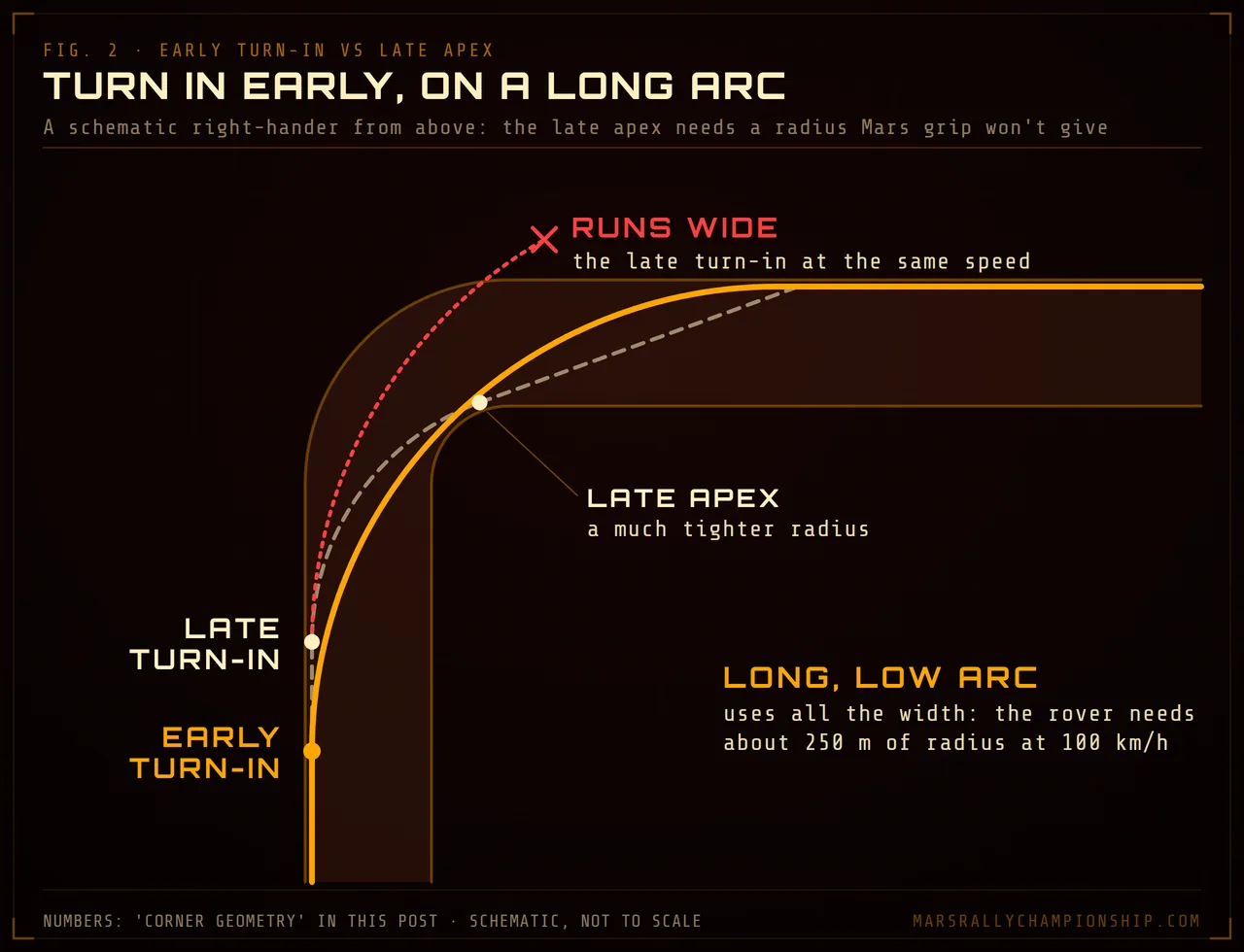
Diagram: at 100 km/h the rover needs about 250 m of radius, so the line that uses all the width works and the late apex does not.
Technique five: protect exit speed above everything
Acceleration is traction-limited rather than power-limited, and 0–100 km/h takes roughly 11 seconds. Braking from 100 km/h takes about 9. The car sheds speed almost as slowly as it gains it, and gaining it back takes longer still.
That is the argument for exit speed. One km/h scrubbed at the exit is carried, unrecovered, down the whole following straight, and a full 0–100 km/h costs eleven seconds of clean traction to earn back. Entry speed is a vanity metric. Exit speed is the lap time.
Flight, landing, and gear selection
Technique six: take less air
Airborne tires do nothing at all — no braking, no steering, no throttle, just ballistic flight and whatever attitude you left the ground with. With gravity at 3.72 m/s² instead of 9.81, you hang there roughly 2.6 times as long as the same launch would on Earth.
Skim crests instead of launching off them. A small lift before the rise, enough to keep the wheels loaded, costs a fraction of a second and buys back seconds of steering authority.
Technique seven: land settled
Feed a little throttle just before touchdown. It settles the rear and gets the drive wheels turning near ground speed, so they bite instead of skidding.
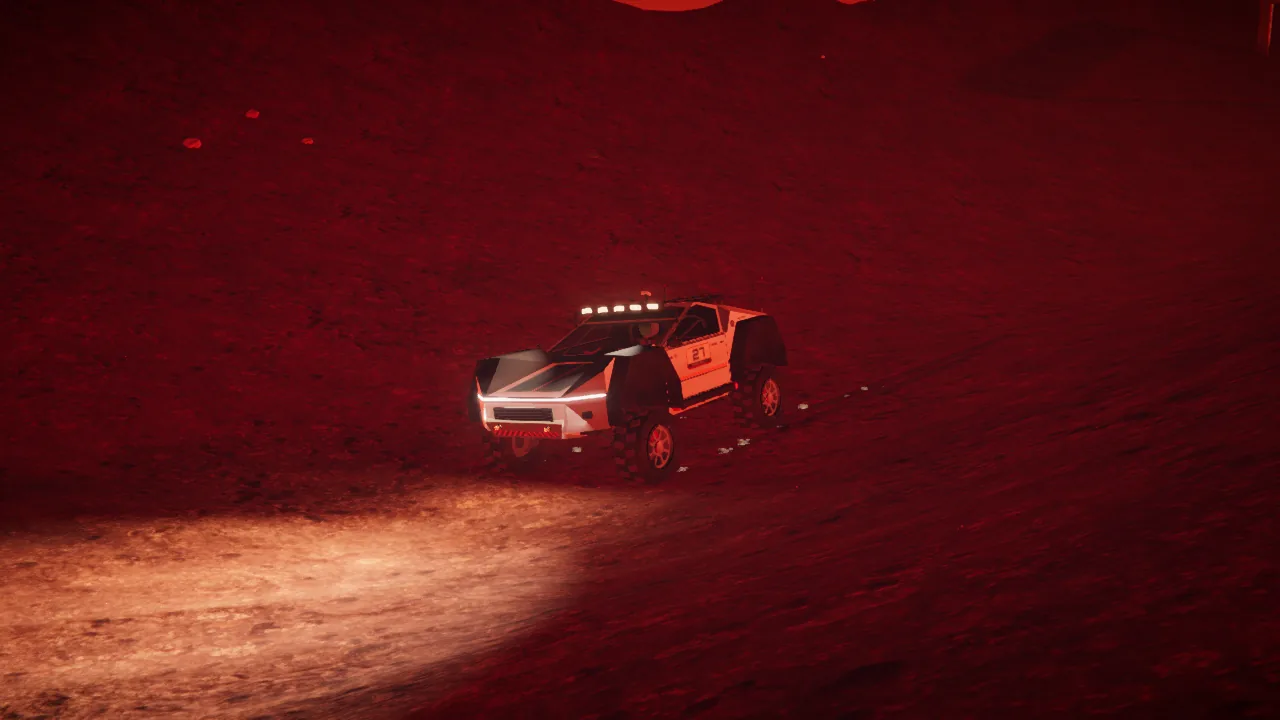
In-game screenshot: a flat, square landing with a little throttle in, so the drive wheels meet the ground already turning.
This matters more here than on Earth because low gravity corrects attitude poorly: a vehicle that is tilting keeps tilting. The rollover tip angle is about 52°, and past it no amount of steering saves you. Land flat and square.
Technique eight: use the right gear range
Three ranges, three different tools. L (13:1) for climbing and slow technical sections, where you want torque at the wheel. D (9:1) for most stage running — your default. H (7:1) for long open runs. Shifting is manual and cheap, so drop to L before a climb rather than partway up it.
Technique nine: read your ghost, do not just race it
Racing a ghost teaches almost nothing. It tells you that you are behind, which you already knew, and tempts you into overdriving.
Reading one is different. Runs replay bit-exact from their recorded inputs, and the translucent rover beside you is your own best run, corner for corner. Compare split by split, find the one section where the gap actually opens, and work on that alone. Ghost racing covers the mechanics; the rival field option, off by default, puts the top three leaderboard ghosts on track at once — three solutions to one corner, side by side.
The nine techniques and what each mistake costs
| # | Technique | The number behind it | What getting it wrong costs |
|---|---|---|---|
| 1 | One input at a time | Grip budget ≈3.1 m/s² | Two inputs spend one budget twice; the front washes wide |
| 2 | Brake earlier than feels right | 125 m from 100 km/h | Arrive hot, scrub speed through the whole corner |
| 3 | Threshold-brake, never stomp | ABS shares one circle — brake and steering draw on the same grip | A full pedal into the turn still turns, but wide |
| 4 | Early turn-in, long low arc | Min radius ≈250 m at 100 km/h | A late apex you cannot make becomes understeer |
| 5 | Protect exit speed | 0–100 km/h takes ≈11 s | Each km/h dropped at exit is paid for down the straight |
| 6 | Take less air | Hang time ≈2.6× Earth's | Airborne tires brake, steer and drive nothing |
| 7 | Land settled | Tip angle ≈52° | A tilted landing keeps tilting; past 52° it is a rollover |
| 8 | Right gear range | L 13:1 · D 9:1 · H 7:1 | Bogging on the climbs, or out of gear on the straights |
| 9 | Read the ghost, do not chase it | Bit-exact replays, top-3 rival field | Chasing hides the leak, rewards overdriving |
A clean run is a fast run
Damage is not cosmetic — it changes how the car handles for the rest of the stage, which makes tidiness a technique rather than a virtue. Suspension is tracked per corner, and destroyed suspension multiplies grip by 0.40 — well under half your budget. Uneven damage is worse than square damage: an imbalance pulls the steering by up to about 4.5°, which you hold against for every remaining corner. Tires lose 18 HP per direct strike, and that is where tire damage comes from: sliding wears them at under 5 HP a minute even fully sideways, so it is the rocks, not the drifts, that wear them out.
There is a repair zone at the start of each stage: 8 metres of radius, 20 HP per second, and you must be stopped. In the Mars Cup damage carries between stages, so a scruffy opening stage is a slow closing one.
Where to practise this
Mars Rally Championship is free, runs in the browser with no download and no account, and works on a phone or a school Chromebook. Twenty minutes, in this order: five braking from 100 km/h to a stop and watching where you end up, five walking a braking marker backwards into one corner, five entering slower than feels right and checking the exit speed, five reading a ghost instead of racing it. To practise the same way elsewhere, our time trial racing games guide compares games on instant restart, medals, ghosts and leaderboards.
- The Proving Ground tutorial — nineteen lessons drilling the 125-metre braking distance, the gears, the handbrake pivot and catching a slide.
- Free roam — no timer, no checkpoints, unlimited repetitions of one corner.
- Stage 3, The Opener — a 1,164-metre benchmark, gold at 1:12.8, author at 1:04.0.
- The Opener's fastest line guide — these techniques, call by call.
- Ghost racing and the leaderboard — where you learn which corner is costing you.