Footage from Mars is real, but none of it is live. Every clip was recorded by a spacecraft and sent home afterwards, mostly as still frames played in sequence. The best known is Perseverance's landing, filmed on 18 February 2021 from the parachute opening to touchdown. Rovers have also filmed dust devils, the Ingenuity helicopter and Phobos crossing the Sun, and Perseverance's microphones have recorded wind, laser clicks and rotor hum. Mars Rally Championship, a free browser rally game, renders any of its leaderboard runs to video: game footage, not Mars.
What real footage from Mars exists?
Real footage from Mars covers landings, flights, weather, the sky and sound, most of it still frames played in sequence.
Dust devils, whirlwinds that lift the same fine dust as a Martian dust storm, are the classic weather footage: Spirit caught them crossing Gusev Crater in 2005, and Curiosity and Perseverance have filmed many since.
The sky gets filmed too: on 2 April 2022 Perseverance recorded Phobos crossing the face of the Sun, one of the transits described in what Phobos and Deimos look like from the surface of Mars. On 2 July 2026 the rover caught Earth, a single point of light, slipping behind Phobos in nine images. Sunsets are mostly stills: Curiosity's 2015 sequence is four frames over 6 minutes 51 seconds.
The recordings worth knowing, oldest first:
| Recording | Spacecraft | When | What it shows | Published by |
|---|---|---|---|---|
| Dust devil movies | Spirit (NASA) | 2005 | Whirlwinds crossing Gusev Crater | NASA, JPL |
| Descent video | Curiosity (NASA) | August 2012 | The heat shield falling away, the ground rushing up | NASA, JPL |
| Landing video | Perseverance (NASA) | 18 February 2021 | The parachute opening about 11 km up, the sky crane, touchdown | NASA, JPL |
| Microphone recordings | Perseverance (NASA) | From 20 February 2021 | Wind, laser snaps, wheels on rock, Ingenuity's rotor hum, a dust devil | NASA, JPL |
| Ingenuity's first flight | Ingenuity, filmed by Perseverance (NASA) | 19 April 2021 | Takeoff, a 30-second hover at 3 m, landing | NASA, JPL |
| Phobos transit | Perseverance (NASA) | 2 April 2022 | Phobos crossing the face of the Sun | NASA, JPL |
| Mars Webcam livestream | Mars Express (ESA) | 2 June 2023 | An hour of images from orbit, one about every 50 seconds | ESA |
| A day on Mars | Curiosity (NASA) | 8 November 2023 | 12 hours in 25 frames, the rover's shadow moving like a sundial's | NASA, JPL |
NASA and JPL post their Mars rover videos on their websites and YouTube channels, and Curiosity and Perseverance, both still working as of September 2026, keep sending new frames.
The Perseverance landing video, from parachute to touchdown
Perseverance filmed its own landing from more angles than any Mars lander before it. Cameras on the backshell looked up at the parachute, one on the descent stage looked down at the rover, and two on the rover looked up at the descent stage and down at the ground. NASA released the landing video and the first audio from Mars together on 22 February 2021, four days after touchdown in Jezero Crater.
It opens about 11 kilometres up as the parachute snaps open at supersonic speed. The heat shield drops away, the crater floor swings into view, and in the last seconds the descent stage lowers the rover on cables through its own rocket-blown dust, cuts them and flies off. The parachute's panels spell "Dare Mighty Things" in binary code, which viewers decoded within hours.
Curiosity had filmed its descent in August 2012, but its Mars Descent Imager looked only down. Views of a landing from outside are stills: the Mars Reconnaissance Orbiter's high-resolution camera photographed Phoenix in 2008, Curiosity in 2012 and Perseverance in 2021 hanging under their parachutes.
Ingenuity flight videos: the first powered flights on another planet
Ingenuity was filmed from the ground, and it filmed from the air. On 19 April 2021 NASA's helicopter made the first powered, controlled flight on another planet, climbing to 3 metres, hovering for 30 seconds and landing, while Perseverance recorded it with Mastcam-Z from a nearby overlook. The helicopter's own downward-looking navigation camera caught its shadow on that first flight.
Built for up to five test flights over 30 days, Ingenuity flew 72 times in almost three years, more than two hours in the air in all. Its last flight, on 18 January 2024, damaged at least one rotor blade, and a colour image it took afterwards shows the damaged blade's shadow. NASA's Ingenuity mission page collects its images and videos.
What does Mars sound like?
Mars sounds faint: thin wind, clicks and hums, much quieter than the same events on Earth. Perseverance carries the first two microphones to record there, one on the SuperCam instrument atop its mast and one on its body for the landing. The wind "sounds" NASA's InSight lander released in December 2018 were seismometer and air-pressure readings, not a microphone recording.
The landing microphone heard nothing usable on the way down, but on 20 February 2021 it recorded a minute of sound with a gust of Martian wind in it, and in March 2021 about 16 minutes of the rover driving, its metal wheels banging and scraping over rock.
SuperCam's microphone hears the snap of its laser striking rock, which says something about the rock's hardness. It also caught Ingenuity's rotors humming 80 metres away on the helicopter's fourth flight, on 30 April 2021, and in September 2021 a dust devil passing over the rover, published in 2022 as the first recording of one.
Mars has two speeds of sound
Sound crosses Mars's thin carbon dioxide at about 240 metres per second, against about 343 in Earth's air at 20 °C, and above about 240 hertz it travels roughly 10 metres per second faster. The finding, published in Nature in April 2022, comes down to how carbon dioxide molecules behave at very low pressure: far enough from a sound, you would hear its high notes fractionally before its low ones.
Is there live video from Mars?
No. Nothing has ever been streamed live from the surface of Mars, and three limits keep it that way.
Distance. A radio signal takes about 3 to 22 minutes each way, so even a perfect stream would arrive minutes old.
Bandwidth. A rover sends most of its data through orbiters passing overhead, such as NASA's Mars Reconnaissance Orbiter and ESA's Trace Gas Orbiter in the Mars Relay Network. A relay link carries up to about 2 megabits per second while an orbiter is in view, a few minutes at a time. A steady high-definition stream needs several megabits per second, all the time.
Power. Perseverance runs on a radioisotope generator that made about 110 watts when new, so every minute of video competes with the science. Mars footage is rationed: short clips, low frame rates, sent when there is room. What a space rover is covers how rovers juggle power, driving and radio.
The nearest thing to live pictures came from orbit. On 2 June 2023 ESA streamed Mars Express's Visual Monitoring Camera, nicknamed the Mars Webcam, for about an hour: a new image about every 50 seconds, each about 18 minutes old on arrival.
How to tell real Mars footage from a render
Real footage from Mars traces back to a named spacecraft, a date or sol and a credit such as NASA/JPL-Caltech or ESA, and Perseverance's and Curiosity's raw frames are public on NASA's raw-image pages. Three checks catch most fakes:
- The camera. Surface footage comes from cameras on a rover or lander. Apart from landers filming their own descent, the only footage from the Martian air is Ingenuity's, so a smooth drone shot skimming the dunes is an animation, however real the terrain under it.
- The sky. A Martian daytime sky is butterscotch; a blue one usually means white-balanced processing or a fake. Real sunsets do turn blue around the Sun, but the blue sunset that went viral in February 2026 carried Google's AI watermark, as why sunsets on Mars are blue explains alongside the real ones since 1976.
- The sound. Real Mars audio is faint wind and mechanical clicks. A howling gale was added on Earth.
Processed is not the same as fake: clips sold as 4K Mars footage are often real rover frames upscaled, smoothed or panned across on Earth. NASA's own landing animations, made before Curiosity and Perseverance arrived, also get reposted as the real thing.
Mars Rally Championship makes game footage, not Mars footage
Mars Rally Championship makes videos too, and every frame is a game render. Each run is recorded as an input tape of a few kilobytes, the controls 60 times a second, and replaying it through the same simulation rebuilds the run bit for bit. That is how the server checks every leaderboard time, and how any board run can be watched from REPLAY on the leaderboard.
A replay offers 17 cameras, from the broadcast-style TRACKSIDE, the default, to DRONE, ORBIT and HELMET, the pilot's own eyes. P opens photo mode: the replay freezes, the interface steps aside, and S saves the frame as a PNG.
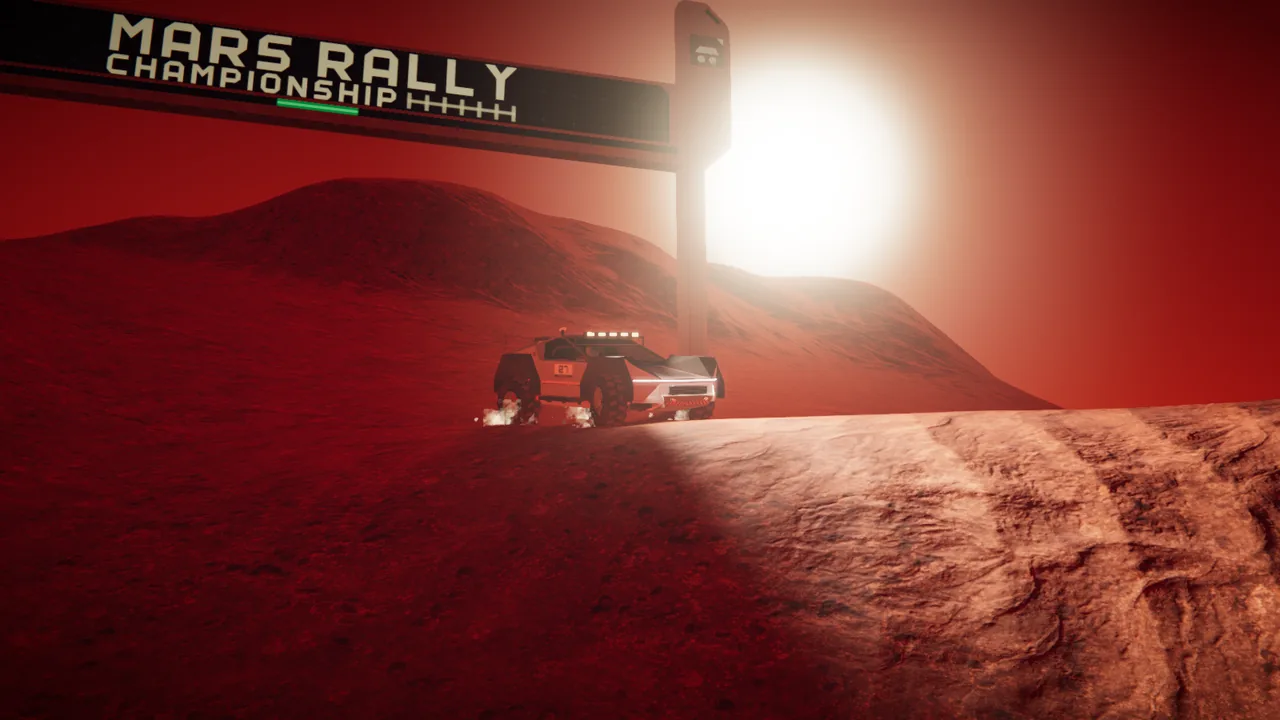
In-game screenshot: a replay frozen in photo mode with the interface hidden; a render of sculpted terrain, not a frame from Mars.
V, or the VIDEO button, turns the replay into a file: the whole run or its last 30 seconds, from any of those cameras. Where the browser supports WebCodecs, it is rendered frame by frame, never screen-recorded, at 1920×1080 or vertical 1080×1920 and 30 or 60 frames per second, with engine, tyre, wind and impact sounds synthesised to match. A 30 fps MP4 runs at about 8 megabits per second, four times the fastest relay link from the Martian surface.
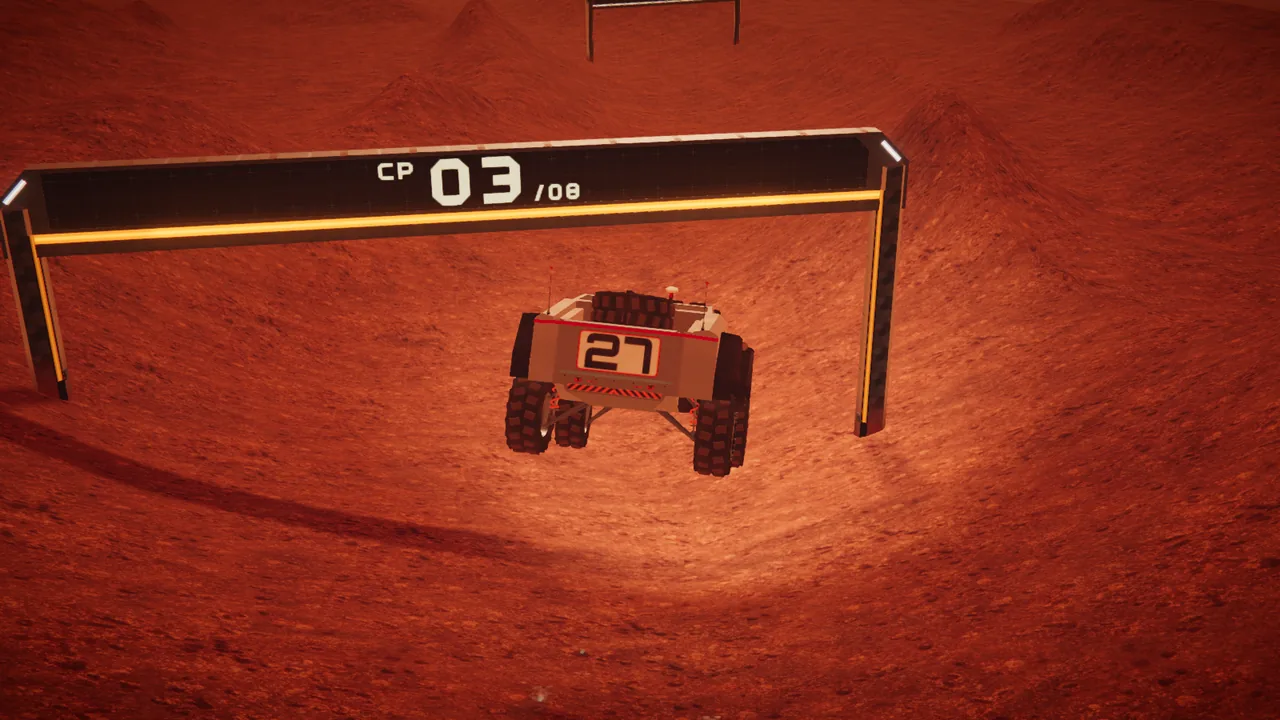
In-game screenshot: a leaderboard run seen through one of the 17 replay cameras; every angle is rebuilt from the run's recorded inputs, not filmed on Mars.
What the game does not simulate is most of this page: no signal delay, no rationed frames, and nothing in the sound for Mars's thin carbon dioxide or its 240 m/s speed of sound. The game's dust storms even howl, which by the test above marks its soundtrack as made on Earth. The rover is fictional, and the terrain is sculpted to Martian morphologies, not copied from any real place.
Where to try this
- Stage 2, The Long Run: 2,306 metres and 12 gates; finish, then render the run from the results screen.
- A car race on Mars: why the first one would be a rally, and why no footage of it exists.
- How many rovers are on Mars: all eight that reached the surface, and the two still sending pictures.
Mars Rally Championship is free, runs in a browser tab with no download and no account, works on a laptop, a school Chromebook or a phone in landscape, and races up to eight pilots live.