The best low-gravity games each change one part of how things move. Mars Rally Championship, a free browser rally game listed first because it is ours, runs real Mars gravity, 0.38 g, under a rover that needs about 125 metres to stop from 100 km/h. After it: BeamNG.drive lets you set the gravity yourself, Super Mario Odyssey's Moon Kingdom stretches its jumps, Kerbal Space Program lets you land on the Mun at 1.63 m/s², and Lone Echo, Hardspace: Shipbreaker and Prey's spacewalks take gravity away entirely.
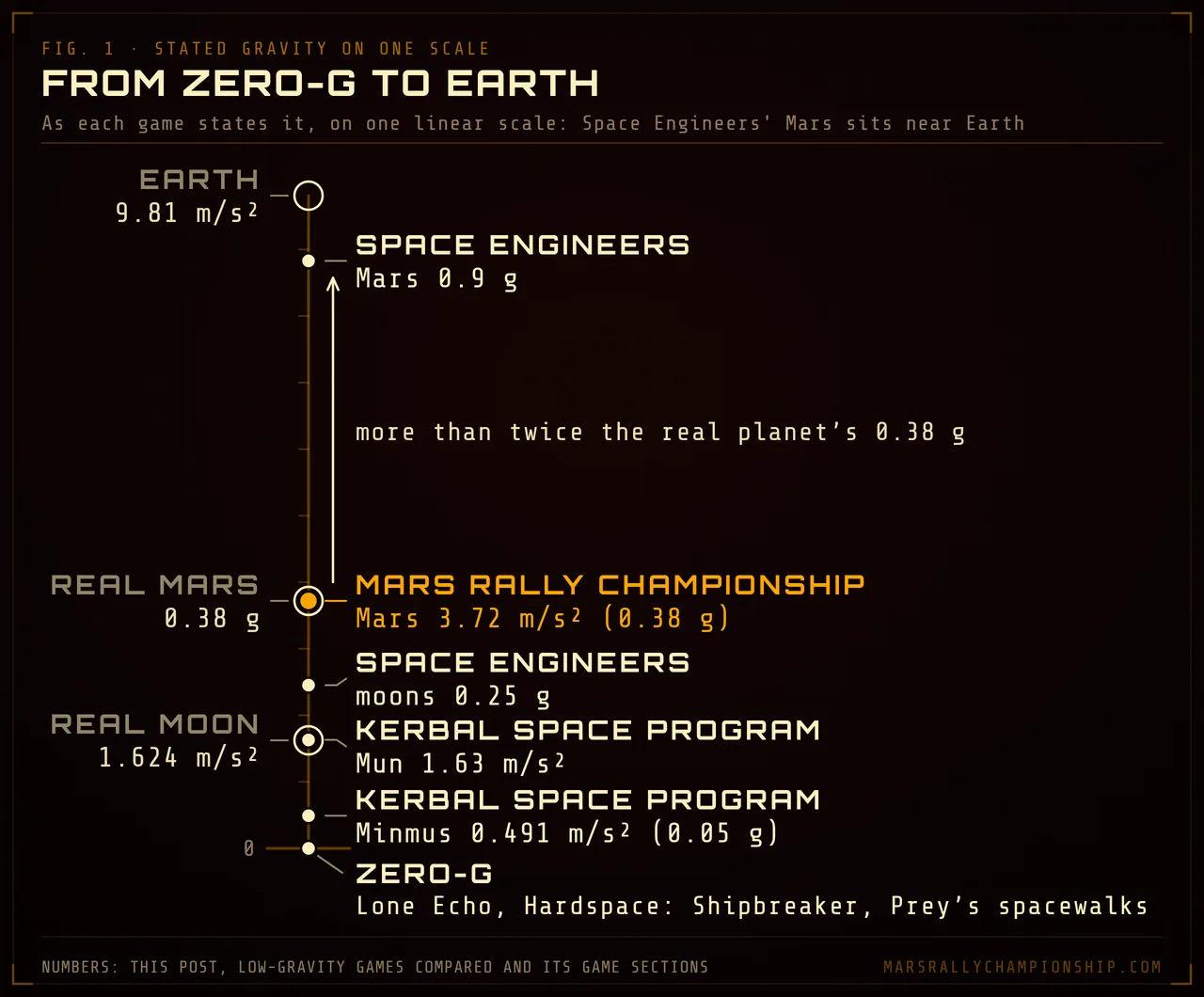
Diagram: stated gravity from zero-g to Earth's 9.81 m/s²; Mars Rally Championship runs the real 0.38 g, while Space Engineers' Mars, at 0.9 g, sits near Earth.
What low gravity actually changes when you play
Gravity is the force that brings everything back to the ground, so turning it down changes three things in a game: how long you stay in the air, how hard your tyres can push, and, at zero, whether anything stops you at all. Most games below lean on one of the three; the landing games add a fourth, the fuel it takes to come down gently and leave again.
Hang time. For the same take-off speed, a jump's height and its time in the air both scale inversely with gravity: halve the pull and you rise twice as high and stay up twice as long. That is the floaty feel of a moon level. The Earth, Mars and Moon multiples are worked through in how high you could jump on Mars.
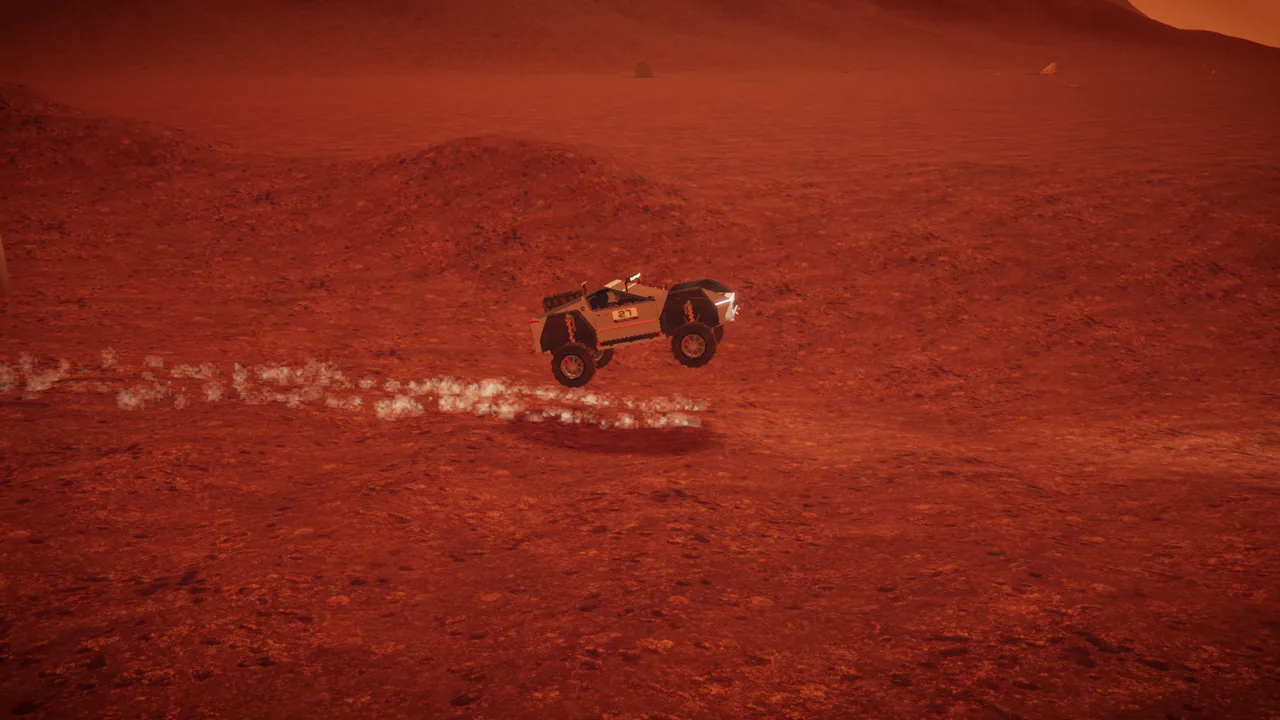
In-game screenshot: the rover off a crest on Stage 2, its shadow well clear of the wheels; at 0.38 g the flight lasts long enough to plan the landing.
Grip and stopping. A tyre's grip is friction times the load pressing it into the ground, and that load is weight. Lower gravity cuts the grip but leaves the vehicle's mass, and so its momentum, untouched. In Mars Rally Championship, Mars gravity of 3.72 m/s² leaves the rover about 3.1 m/s² of grip, soil cohesion included, to share between braking, steering and throttle; the same tyres on Earth gravel would have about 7.35 m/s². Any honest low-gravity driving game is a game about stopping distances.
Momentum in zero-g. With no weight there is no friction from weight either, so a push lasts until something pushes back. Inertia is the same on every world. A zero-g game is a game about stopping too, except that the brakes are a handhold, a wall or a thruster.
Vehicles also roll over more easily, because less gravity pulls a tipped car back onto its wheels.
Low-gravity games compared
The gravity column gives a number only where the game's developer or official wiki states one; a figure worked back from a jump arc would be a guess. Mars Rally Championship is first because it is ours; the rest are grouped by what low gravity changes in them: wheels, jumps, zero-g, then landings.
| Game | Gravity, as stated | Where you meet it | What it changes in play |
|---|---|---|---|
| Mars Rally Championship Play | 0.38 g (3.72 m/s²) | Everywhere: both stages, free roam, the tutorial | About 125 m to stop from 100 km/h, 3.1 m/s² of grip, long airtime |
| BeamNG.drive | The value you set | The Environment menu, mid-session | Handling at whatever gravity you choose |
| Rocket League | Low, one of four settings | Mutators in exhibition and private matches; the Moonball preset | Longer air time, easier aerials, a slower game |
| Super Mario Odyssey | Lighter on the Moon; no figure | The Moon Kingdom, Dark Side and Darker Side, outdoors | Higher, farther jumps that fall more slowly |
| Starfield | Varies with each world's mass | Every planet and moon you land on | Jump and boost height, fall damage, combat |
| Lone Echo | Zero-g | A station orbiting Saturn | You move by grabbing and pushing off |
| Hardspace: Shipbreaker | Zero-g | The derelict ships you take apart | Salvage work with no up or down |
| Prey (2017) | Zero-g on spacewalks | Outside the Talos I station | Thrusters, full 3D movement, an oxygen supply to watch |
| Lunar Lander (Atari, 1979) | Not stated | The descent to the Moon | Thrust against the fall before the fuel runs out |
| Kerbal Space Program | Mun 1.63 m/s²; Minmus 0.491 m/s² (0.05 g) | The Mun and Minmus | Landing and leaving get easier as gravity drops |
| Space Engineers | Moons 0.25 g; Mars 0.9 g | Its moons and planets | Its Mars is near Earth weight; its moons are the light ones |
| Moonbase Alpha | Not stated | A lunar south-pole outpost in 2032 | Not described; a team repair job for up to six |
Two of those figures are worth a second look. Space Engineers' Mars, at 0.9 g, is more than twice the real planet's 0.38 g. Kerbal Space Program's Mun, at 1.63 m/s², is about the real Moon's 1.624 m/s², as its own wiki points out.
Mars Rally Championship: 0.38 g on four tyres, not zero-g
Our game, listed first for that reason. This is Mars Rally Championship's own site; everything below it is grouped by what low gravity changes and judged on its merits.
Mars Rally Championship is a free 3D rally game that runs in a browser tab with no download, no install and no account, on a keyboard, a gamepad or a phone's touchscreen. It is not a zero-g game. It runs Mars gravity, 3.72 m/s² or 0.38 g, under a 3,000 kg pressurized rover, and that single number is the whole handling story.
Here low gravity means less grip, not a free ride. The four tyres have about 3.1 m/s² to spend, so a stop from 100 km/h takes about 125 metres and 9 seconds, roughly 2.4 times the distance on Earth gravel with the same tyres. Turn-in is capped at the grip the tyres hold, about 6° a second at 100 km/h, and the tightest corner you can hold at that speed has a radius of about 250 metres. The air, at 0.020 kg/m³, is about 1.6% as dense as Earth's, so no wing and no amount of speed adds downforce.
Crests are where 0.38 g shows. Off the same lip at the same speed, the rover flies farther and hangs longer than an Earth car would, and while it is airborne the tyres cannot steer, brake or drive, so fast pilots plan their airtime instead of collecting it. The game counts it anyway: the LOW GRAVITY achievement wants 30 seconds of airtime, unfinished runs included, and SUBORBITAL wants five minutes.
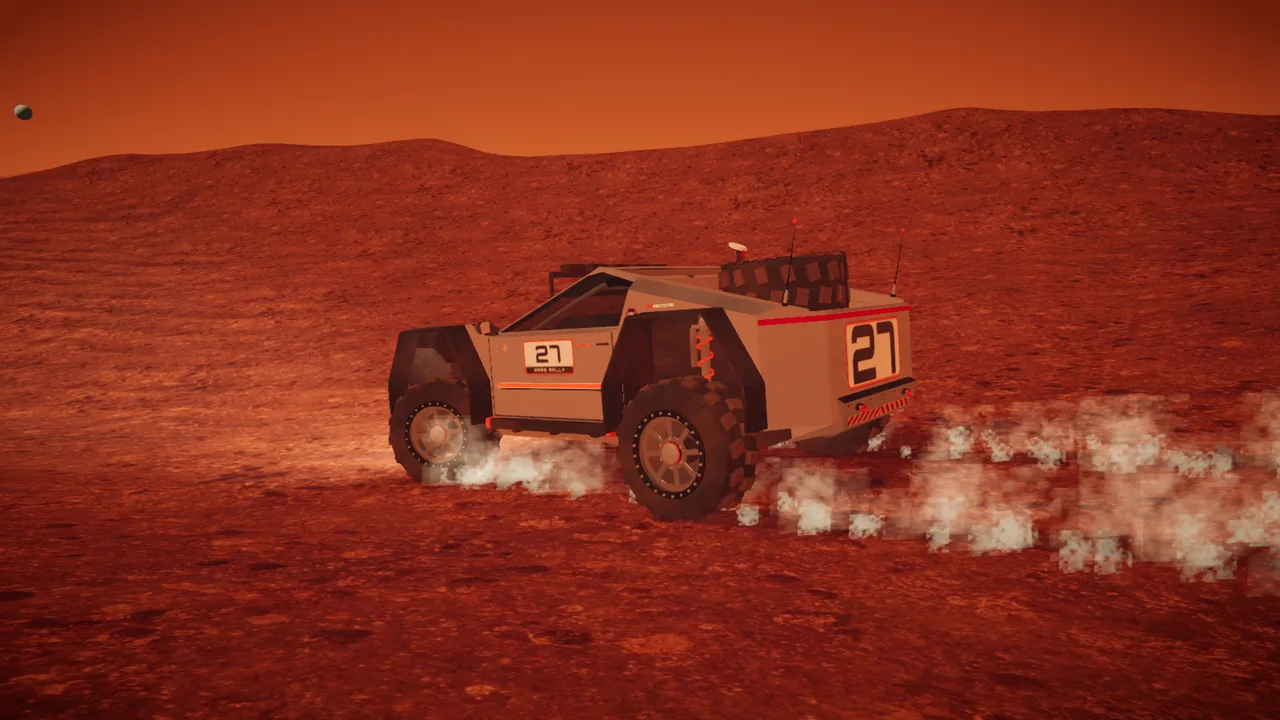
In-game screenshot: the same flight a second later, dust flying as the tyres come back down; until they touch, the rover cannot brake, steer or drive.
The limits are real. There are two stages, one rover and one handling model for everyone, with no upgrades. The terrain is sculpted to Martian morphologies rather than mapped from a real place, so a game built on surveyed ground beats it on geography. And if you want floaty fun, this is the wrong kind of low gravity: here it mostly makes driving harder, which the low-gravity driving primer teaches you to work with.
Play free — no downloadLow-gravity driving games where you set the gravity
Two well-known car games treat gravity as a setting you change rather than a place you visit.
BeamNG.drive
BeamNG.drive, the soft-body driving sandbox, lets you change world gravity while the game runs: open the Environment menu, set the value you want and carry on driving. BeamNG's gravity documentation pitches it for experiments and for testing handling in low or high gravity, and it is a separate thing from a car's centre of gravity. Set it to the Moon's figure and the same car brakes, corners and lands like another machine.
It is a paid PC game on Steam, still in early access, and our guide to BeamNG in a browser explains why you cannot play it in a tab. For comparing gravities on one car it beats everything here; it is a sandbox, so the stage and the stopwatch are yours to bring.
Rocket League's Moonball
Rocket League, the car-football game, has offered low gravity since its first mutators arrived in patch 1.08 in November 2015. In an exhibition or private match, the mutator settings put gravity at Default, Low, High or Super High, and the Moonball preset pairs low gravity with a large ball and fast-recharging boost; the patch notes described it as "low gravity action with a whole lot of boost".
Low gravity there is all about the air: longer flights, easier aerials and a slower game. It is the most playful low-gravity driving on this list.
Low-gravity jumping games: more air, slower falls
Games built around jumping use weak gravity the other way round from a rally game: more air is the reward, not the risk.
Super Mario Odyssey's Moon Kingdom
Super Mario Odyssey turns gravity down for its Moon. On the surface of the Moon Kingdom, and in the Dark Side and Darker Side, Mario jumps higher and farther, stays up longer and falls more slowly. The effect reaches the 2D sections but not the Underground Moon Caverns, where normal gravity returns and the floaty jumps stop rescuing you over pits. The game gives it no number; it is simply lighter.
It is the cleanest demonstration of hang time in any game here: the same jump button, the same plumber, much more air.
Starfield
Starfield, Bethesda Game Studios' space RPG, makes gravity a property of every world you land on. The pull on the player depends on the body's mass, and it changes how high you jump or boost, how much a fall hurts and how a fight plays out, so a small moon and a heavy planet move differently.
It came out on PC and Xbox Series X/S in September 2023, and the PlayStation Blog set its PS5 release for 7 April 2026.
Zero-g games: momentum you have to cancel yourself
Zero-g games take weight away entirely, which turns every movement problem into a stopping problem. In Lone Echo zero-g is the whole game; Hardspace: Shipbreaker makes it the workplace; Prey sends you outside the station into it.
Lone Echo
Lone Echo is the purest zero-g game here. Ready At Dawn's VR adventure, published by Oculus Studios for the Oculus Rift on 20 July 2017, puts you aboard a station orbiting Saturn, where you move by grabbing the structure and pushing off, one to one with your hands. The studio built a procedural hand-posing system so your fingers wrap around whatever you grab; in zero-g a handhold is both your accelerator and your brake.
Lone Echo II followed in 2021, and Meta closed Ready At Dawn in August 2024.
Hardspace: Shipbreaker
Hardspace: Shipbreaker makes zero-g a job. You are a ship breaker working for the Lynx Corporation, taking abandoned spacecraft apart in first person for their materials while labour relations at the company play out. Everything you cut loose floats, so the work is as much about moving mass with no weight as about cutting it. It came out on PC on 24 May 2022, and on PS5 and Xbox Series X/S on 20 September 2022.
Prey (2017)
Prey, Arkane Studios' 2017 game, takes you outside the Talos I station into zero-g. On a spacewalk you move in a spacesuit on thrusters, free in all three dimensions, while watching your oxygen, and if you drift too far beyond the station's rings, radiation starts to build. The GLOO Cannon's foam makes temporary platforms in gravity and in zero-g alike.
Moon gravity games: landing and exploring
Landing on the Moon was a computer game before it was an arcade cabinet. Jim Storer, a high school student, wrote Lunar in the FOCAL language on a DEC PDP-8 in the autumn of 1969; Atari's Lunar Lander arcade game followed in 1979, the company's first vector-graphics game. In every version you fall towards the Moon or another world and work the thrusters to land before the fuel runs out.
Kerbal Space Program
Kerbal Space Program is the moon gravity game for anyone who wants the numbers. Its official wiki gives the Mun a surface gravity of 1.63 m/s², about the real Moon's, and its smaller moon, Minmus, 0.491 m/s², or 0.05 g. Minmus takes more delta-v to reach, but its weaker pull makes landing and getting home again easier.
The original is a paid game on Steam. Its sequel, Kerbal Space Program 2, stalled in early access after its studio, Intercept Games, was shut down, and has gone years without an update.
Space Engineers
Space Engineers is the reminder to read a game's numbers before trusting its planet names. Its official wiki lists 1.0 g for the Earth-like planet, 0.25 g for its moons, which are only 19 km across, and 0.9 g for its Mars, a world with thin, unbreathable air. The real Mars pulls 0.38 g, so the low gravity in Space Engineers lives on its moons, not on its Mars.
Moonbase Alpha
Moonbase Alpha costs nothing. Released on Steam on 6 July 2010 and made by Army Game Studio and Virtual Heroes with NASA Learning Technologies, it puts a team of up to six, with six more watching, at a lunar south-pole outpost in 2032 after a meteor strike, racing an online leaderboard to repair it. Its descriptions cover the mission rather than the gravity, so the table says not stated.
Is there a zero gravity game you can play online?
In this guide, true zero-g means an install: Lone Echo, Hardspace: Shipbreaker or Prey. Echo VR, Ready At Dawn's online game, shut its servers on 1 August 2023.
Online, the games here offer low gravity rather than none. A Rocket League private match can run Moonball with friends, and Mars Rally Championship's online rooms put up to 8 pilots on one stage at 0.38 g, as translucent rovers with no collisions, from a link and with no download. Moonbase Alpha adds a free team repair job on the Moon for up to six.
Where to try this
Mars Rally Championship runs from a link, so trying 0.38 g takes one click. Free roam has no timer and no gates, which makes it the place to learn how long 0.38 g keeps a rover in the air. The Proving Ground tutorial runs nineteen lessons, one of them a jump. A first timed run belongs on Stage 2, The Long Run: 2,306 metres on far easier ground than Stage 1.
If you came for speed rather than float, the best space racing games sorts the hover and anti-gravity racers.