Mars surface gravity is 3.72 m/s², about 38% of Earth's 9.81 m/s². For the same take-off speed, jump height scales inversely with gravity, so you clear roughly 2.6 times what you clear on Earth. An average adult raises their center of mass 0.4 to 0.5 m in a standing jump; on Mars that becomes about 1.0 to 1.3 m — impressive, not superhuman. Hang time scales the same way: you are airborne about 2.6 times longer. Mars Rally Championship, a free browser rally game, runs that same 3.72 m/s² under a 3,000 kg rover.
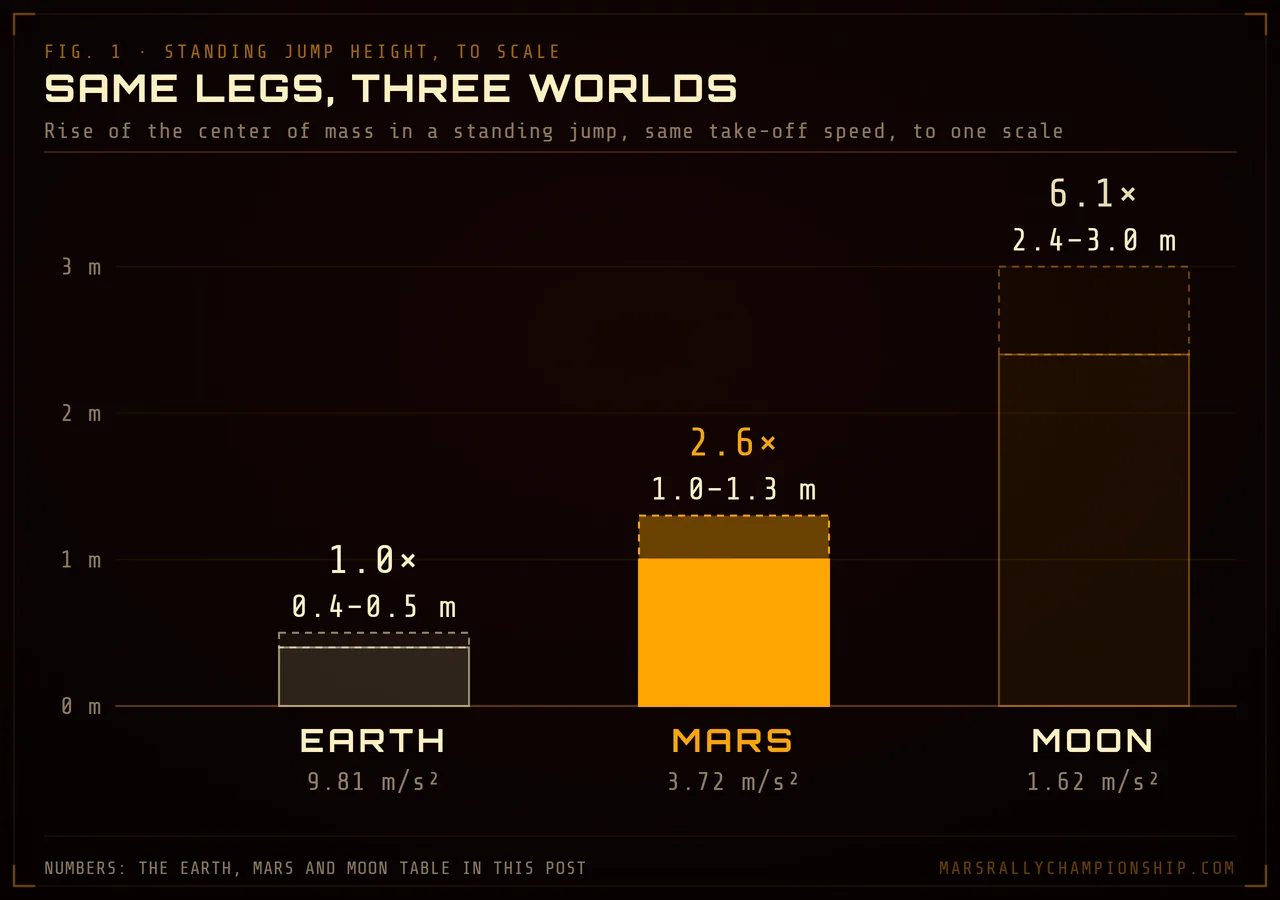
Diagram: the same pair of legs lifts you 0.4 to 0.5 m on Earth, 1.0 to 1.3 m on Mars and 2.4 to 3.0 m on the Moon.
The arithmetic, and the two assumptions underneath it
A jump is a projectile problem. You leave the ground at some vertical speed, gravity decelerates you, and you rise by (take-off speed)² ÷ (2 × gravity) before coming back down — the standard projectile-motion relationship. Nothing in that expression cares which planet you are standing on except gravity, so for an identical take-off speed the height is simply inversely proportional to it.
Earth's 9.81 m/s² divided by Mars's 3.72 m/s² is 2.64. Round that to 2.6 and it is the only number the rest of this post needs. NASA's Mars Fact Sheet puts Martian surface gravity between 3.69 m/s² at the equator and 3.73 m/s² at the poles; 3.72 sits inside that spread, and it is the figure the game's physics config uses.
Two assumptions are doing real work here. The first is that your take-off speed is unchanged — the same leg push, the same quarter-second of hip, knee and ankle extension. The second is that "jump height" means the rise of your center of mass, not the height of a bar you clear or the mark your fingertips reach on a wall. Mixing those up is where most jumping numbers go wrong before they ever leave Earth.
With both stated, the sum is dull. An average adult raises their center of mass 0.4 to 0.5 m in a standing vertical jump; multiply by 2.64 and you get 1.06 to 1.32 m. Call it 1.0 to 1.3 m.
That is where most Mars-jumping copy goes wrong in the other direction. A 2.6x multiplier sounds like it should put you over a house, and it does not: 1.3 m is the roofline of a small hatchback, or a garden fence you would still swing a leg over. It is a real change. It is not flight.
Thin air is not a loophole either. Mars's atmosphere has a density of about 0.020 kg/m³, roughly 1.6% of Earth's 1.225 kg/m³ — for a body-sized object at jumping speeds that rounds to nothing in both directions.
Earth, Mars and the Moon, with the same pair of legs
| World | Surface gravity | Jump height, same take-off speed | Hang time | What that means |
|---|---|---|---|---|
| Earth | 9.81 m/s² | 1.0x — 0.4 to 0.5 m | 1.0x — about 0.6 s | Up and down before you can think about it |
| Mars | 3.72 m/s² | 2.6x — about 1.0 to 1.3 m | 2.6x — about 1.6 s | Chest height, with time to look around at the top |
| Moon | 1.62 m/s² | 6.1x — about 2.4 to 3.0 m | 6.1x — about 3.7 s | Basketball-rim height, and a long way to fall |
Every hang-time figure above assumes the same 0.45 m Earth jump, with time aloft = 2 × (take-off speed) ÷ gravity. The Moon column is the useful control: at 1.62 m/s², the figure on NASA's Moon Fact Sheet, the multiplier is 6.1x, so the same jump should reach basketball-rim height and hold you up for nearly four seconds. Twelve people have had the chance to test that. None of them did.
Why a pressurized suit takes most of it back
The subtraction comes from two directions at once.
Joint mobility goes first. Take-off speed comes from extending three joints very fast — hip, then knee, then ankle, with the ankle supplying the final, quickest part of the push. A gas-pressurized suit resists all three, because bending a pressurized joint changes the volume of gas inside it and the gas pushes back. The ankle is the worst casualty.
Mass is the second problem, and low gravity does not solve it. A surface suit with life support weighs 38% as much on Mars as on Earth, but it has exactly the same inertia. Weight is what you have to overcome; inertia is what you have to accelerate. Mars discounts the first and leaves the second untouched, so the extra kilograms still cost take-off speed.
Then the height equation squares whatever is left. Lose a fifth of your take-off speed to a stiff ankle and a heavy backpack and you keep only 0.8² of your height — 64% of it. More than a third of the jump goes to a 20% loss.
Apollo settled this empirically. The theoretical lunar multiplier was 6.1x, and yet the record of what the crews actually did — preserved in NASA's Apollo Lunar Surface Journal transcripts and film — is loping, skipping and a low two-footed bunny hop, kept deliberately short. Partly the suits restricted their hips and ankles. Partly it was judgment: a fall from the top of a three-meter arc is serious when your life support is strapped to your back.
So 1.0 to 1.3 m is the shirt-sleeves number, the one that applies inside a pressurized habitat. Out on the surface in current hardware, expect meaningfully less, and expect to hop rather than leap.
Hang time is the number that actually changes how you move
Time aloft follows the same rule as height: it is 2 × (take-off speed) ÷ gravity, so it also scales by 2.6x. For the 0.45 m jump used above, that is about 0.6 s on Earth and about 1.6 s on Mars.
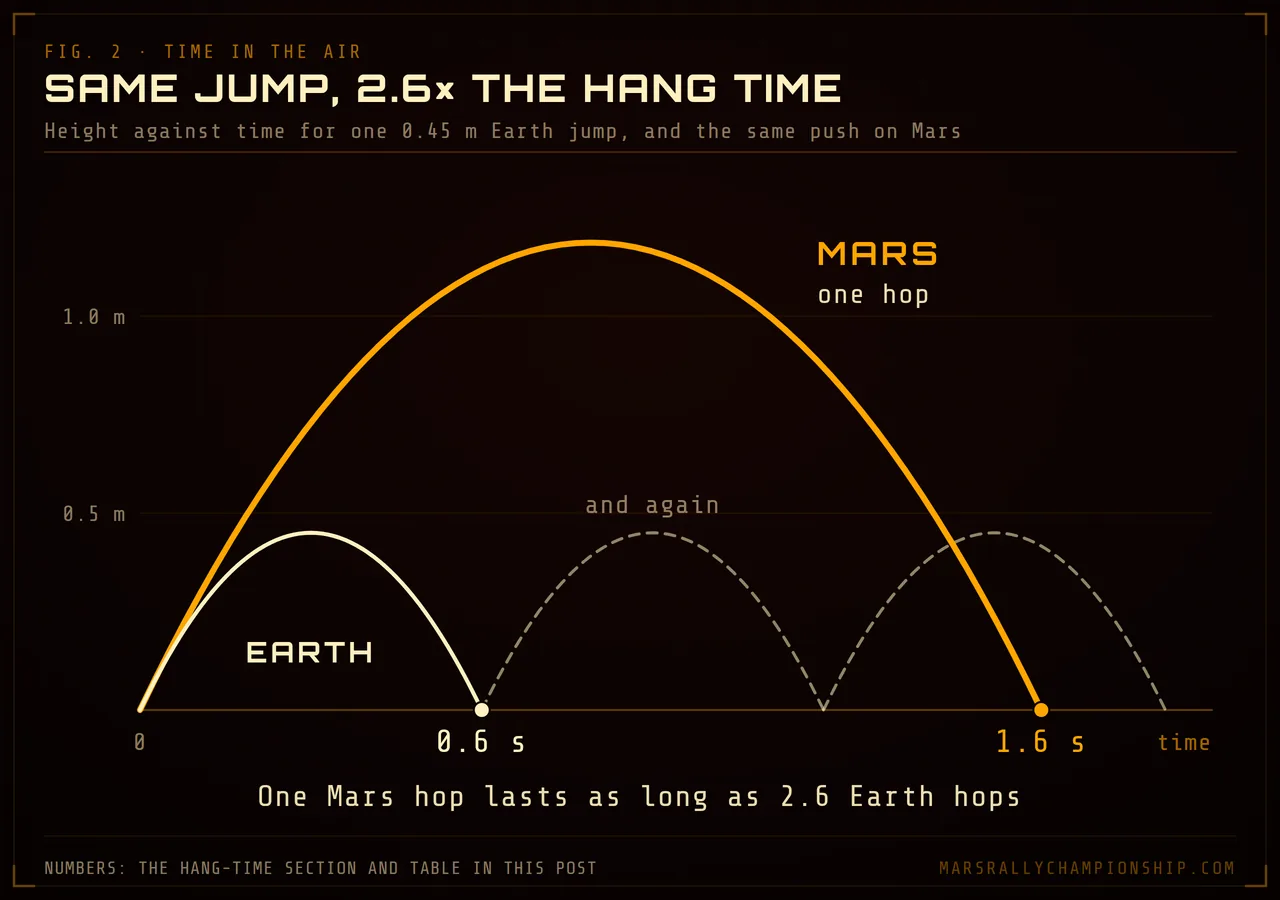
Diagram: one push, two worlds. The Earth hop lands after 0.6 s; the same push on Mars stays up 1.6 s, 2.6 times as long.
A second of extra airtime sounds trivial and is not. Walking is a series of controlled falls, and the fall sets your cadence. Stretch every fall by 2.6x and your comfortable step rate collapses, leaving two options: shuffle at the wrong rhythm, or lengthen the stride to match. Horizontal distance obeys the same relationship, so the same push carries you 2.6 times farther. Lengthening the stride is the cheap answer, and that is the lope, arrived at from physics rather than preference.
On Mars you would not soar. You would float, and floating is stranger than height.
What 2.6x hang time does to a rover
This is where the number stops being a curiosity. Take a crest at the same speed on Mars as on Earth and the vehicle flies about 2.6 times farther and stays up about 2.6 times longer — the same relationship applied to a 3,000 kg rover instead of an eighty-kilogram person. Aerodynamics do not damp it: at 240 km/h the drag deceleration in Martian air is about 0.02 m/s², and downforce, which scales with air density, is effectively unavailable at any speed. In free roam, which has no timer and no checkpoints, take the same crest at 60 and then 120 km/h and compare how long the wheels stay off the ground.
While you are airborne, the tires are doing nothing at all. No steering, no braking, no throttle — you are a ballistic object with a steering wheel in it. A crest that costs a third of a second of control on Earth costs the better part of a second on Mars, and you land further down the road than you planned, usually pointed slightly wrong.
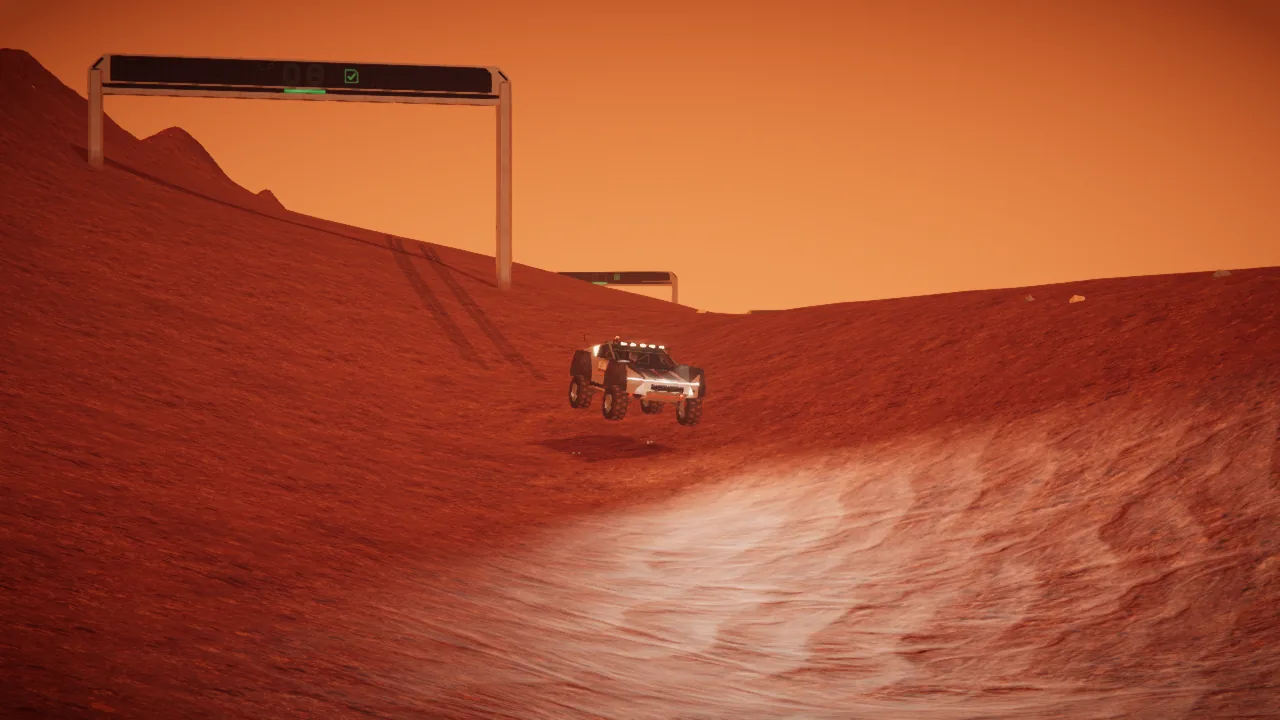
In-game screenshot: airborne over the drop after gate 7 on Stage 2. Until the tires touch down again they cannot steer, brake or drive.
That is expensive because grip is already scarce. The total grip budget is tire friction multiplied by gravity, plus a little soil cohesion that gravity does not touch: with a base coefficient of 0.70 that is about 3.1 m/s² on Mars against about 7.35 m/s² on Earth — the friction half weaker by the same factor of 2.6 that made your jump higher. Braking from 100 km/h takes roughly 125 m, about 2.4 times the 52 m the same tires would need on Earth gravel — braking distance on Mars is a problem of its own. Giving up a second of grip you cannot spare, for air you did not need, is how a stage time comes apart.
So the fast line is the low one. Quick drivers deliberately take less air: they skim crests instead of launching off them, lift or brush the brake just before the lip so the nose stays down, and keep the wheels within reach of the surface. The physics model cooperates — a soft-contact spring lets the suspension extend over a crest instead of the car snapping into the air. Then, just before touchdown, feed in a little throttle: it settles the rear and turns a landing into a corner entry rather than an interruption. The rest of that toolkit is in the low-gravity driving primer.
Low gravity also makes the rover easier to roll
Weak gravity cuts both ways on stability. The static tipping threshold is pure geometry — half-track 0.9 m against a center-of-gravity height of 0.7 m puts it at about 52° of lean — and that angle is the same on any world. What gravity sets is the force pulling a tilted vehicle back down, and on Mars that restoring effort is 38% of what you are used to. A curb strike, a rock, or a one-wheel landing after a long flight tips you further and rights you slower. Rolling is likelier not because the rover is top-heavy, but because so little is pulling it back.
Two achievements make this legible. LOW GRAVITY wants 30 seconds of career air time; SUBORBITAL wants five minutes. Both accumulate across every run, and watching those counters climb is the quickest way to notice how much of a Martian stage you spend off the ground.
Where to feel it
The tutorial is the shortest route to the sensation. The Proving Ground runs nineteen lessons, and two are built for exactly this: a blind crest that tells you to brake early, and a jump lesson with a kicker and a tabletop where the 0.38 g flight time is impossible to miss.
Stage 3, The Opener is the next step. Its 1,164 m timed line drops from 158 m to 93 m of elevation across eight checkpoints, and a descending route means crests — where the choice between two-tenths of airtime and two-tenths of grip gets made at speed.
Your air-time totals live on the pilot dossier alongside the rest of the achievement list; the achievements guide explains which ones reward playing badly on purpose. For the wider picture of what 3.72 m/s² feels like from the driver's seat, start with what it is like to drive on Mars. Other games lean on the same arithmetic, and the best low-gravity games sorts them by whether weak gravity buys you air, costs you grip or, at zero g, leaves you nothing to stop with.
All of it runs in a browser tab. Mars Rally Championship is free, needs no download and no account, and works on a phone or a school Chromebook as well as a desktop.