The race to Mars has no clear leader: as of September 2026, nobody has a crewed Mars mission built, funded and scheduled. SpaceX's Starship first reached orbit on 28 September, but the company has put the Moon first and skipped the late-2026 Mars window. NASA says astronauts could go as early as the 2030s; a 2021 Chinese roadmap names 2033. On sample return, China leads: Tianwen-3 is to bring Mars samples home around 2031. Until a crew lands, any Mars race you can enter is simulated, like Mars Rally Championship, a free browser rally game.
Is there really a space race to Mars?
Only loosely. The Mars race, as the contest is often called, is a set of stated ambitions: a few governments and SpaceX say they will put people on Mars. It is not the Moon race of the 1960s, when two governments paid for crewed programmes to beat each other there. No government has funded a crewed Mars landing with a date attached, and NASA and SpaceX are partners as much as rivals: NASA's next Moon landings depend on landers from SpaceX and Blue Origin.
What looks like a race is often the calendar. In July 2020 the UAE's Hope orbiter, China's Tianwen-1 and NASA's Perseverance launched within 11 days of one another, and all three reached Mars in February 2021. They shared a launch window, not a finish line.
The only scoreboard so far is robotic: just two countries have driven on Mars, the United States five times and China once, as how many rovers are on Mars sets out; the history of the Mars rover runs from the Soviet skis of 1971 to one-tonne Perseverance.
What would winning the race to Mars actually mean?
There are three finish lines, and they are not equally close.
The first crewed landing is the one most people mean. In one NASA concept, the two astronauts who land spend their whole 30-day stay in a pressurized rover, the vehicle described in what a crewed, pressurized Mars rover would look like.
The first sample returned from Mars was meant to be NASA's and ESA's, until Congress ended the NASA-led Mars Sample Return in January 2026 after its estimated cost reached about $11 billion. The tubes Perseverance has filled since 2021 have no funded ride home; China's Tianwen-3 is now the mission aimed at this prize.
The first heavy landing, many tonnes set down intact, is where SpaceX's plan starts. The heaviest rover landed so far, Perseverance, weighs about a tonne; SpaceX's website already prices Starship cargo to the Martian surface at $100 million a tonne.
Who will get to Mars first? The contenders as of September 2026
For a crew, nobody is scheduled; for samples, China is closest. Six programmes to watch:
| Contender | Programme | Next Mars step | Stated crewed-Mars date | Status, September 2026 |
|---|---|---|---|---|
| SpaceX | Starship | Refilling in orbit, then uncrewed cargo landings | Mars city work to start in 5–7 years (Musk, Feb 2026) | Reached orbit 28 Sep 2026; Moon first since Feb 2026 |
| NASA | Artemis (Moon); SR-1 Freedom | ESCAPADE reaches Mars Sep 2027; SR-1 Freedom launch planned Dec 2028 | "As early as the 2030s"; a 2026 study targets round trips by 2036 | Artemis II flew around the Moon, Apr 2026; Mars Sample Return cancelled, Jan 2026 |
| China (CNSA) | Tianwen-3 | Two launches late 2028; samples on Earth around 2031 | 2033, in a 2021 roadmap | In prototype development; crewed Moon landing targeted before 2030 |
| Japan (JAXA) | MMX | Launch 20 Oct 2026 (Japan time) to Phobos; samples on Earth 2031 | — | Declared ready for launch |
| Europe (ESA) | Rosalind Franklin rover | Launch no earlier than late 2028; landing 2030 | — | NASA approved its share, Apr 2026 |
| UAE | Hope orbiter; Mars 2117 | — | A settlement by 2117 | In Mars orbit since Feb 2021 |
A dash means nothing published. Every crewed date in the table is a statement, a study or a roadmap; none is a scheduled launch.
SpaceX's Mars mission: Starship reached orbit, Mars slipped
SpaceX is the only contender flight-testing a ship meant to land people on Mars, and until February 2026 it was aiming uncrewed Starships at the late-2026 window. On 8 February Elon Musk said SpaceX had shifted its focus to a "self-growing city" on the Moon, with work on a Mars city to start in five to seven years; days earlier, the Wall Street Journal had reported that SpaceX told investors it would try for Mars later. Part of Musk's case was the calendar: Mars is reachable only "when the planets align every 26 months", while "we can launch to the Moon every 10 days".
On 28 September 2026, Starship Flight 14 reached orbit for the first time and deployed 26 Starlink satellites; after a vacuum Raptor engine shut down early, SpaceX cut the flight from almost ten hours to about three and splashed it down in the Pacific. The step Mars depends on has not flown: pumping propellant from one Starship into another in orbit.
NASA's crewed Mars mission: the Moon first, a nuclear probe planned for 2028
Artemis II flew four astronauts around the Moon from 1 to 10 April 2026, the first crew to go there since 1972. The executive order on US space policy signed on 18 December 2025 sets a Moon return by 2028 and gives Mars no date.
For Mars, NASA says astronauts could go "as early as the 2030s". In May 2026 NASA Administrator Jared Isaacman announced a 60-day study of a nuclear or chemical spacecraft able to fly crews to Mars and back by 2036 without refuelling, the opposite of SpaceX's plan to refill Starships in orbit.
NASA's nearer-term Mars plan is robotic. Space Reactor-1 Freedom, planned to launch in December 2028, would be the first interplanetary spacecraft powered by a fission reactor. About a year after launch it is to release SkyFall, three Ingenuity-derived helicopters dropped in mid-air during descent, to map buried ice and scout landing sites for crews.
China's Mars mission: a sample return planned for 2028
China, whose first independent Mars mission, Tianwen-1, orbited, landed and drove in 2021, has the clearest path to the first sample return. Tianwen-3 is to launch in 2028 and bring at least 500 grams of Mars to Earth around 2031, according to the mission's chief scientist, Hou Zengqian. It needs two Long March 5 launches, and its lander is to drill up to two metres down.
China's crewed Mars dates come from a conference talk, not a funded programme. In June 2021 Wang Xiaojun, then head of the China Academy of Launch Vehicle Technology, presented crewed launches in 2033, 2035, 2037 and 2041, building toward a base. The crewed goal China has publicly committed to is a Moon landing before 2030.
Who else is heading to Mars
The late-2026 window SpaceX skipped is not empty. Japan's MMX is due to launch on 20 October 2026, Japan time, to bring at least 10 grams of Phobos, the larger Martian moon, to Earth in 2031. NASA's twin ESCAPADE orbiters swing past Earth in November 2026 on their way to Mars orbit in September 2027. Europe's Rosalind Franklin rover is to land at Oxia Planum in 2030, and India, which reached Mars orbit with Mangalyaan in 2014, has proposed a lander carrying a rover and a helicopter.
When will humans land on Mars?
Not before the 2030s, on any plan published as of September 2026. SpaceX's February statement puts the start of a Mars city in the early 2030s, NASA's study aims at crewed round trips by 2036, and China's roadmap starts at 2033.
Two milestones will say more than any announced year: whether Starship can refill in orbit, and whether Tianwen-3 leaves Earth in 2028.
Why is it so hard to send humans to Mars?
A launch window every 26 months
Earth and Mars line up for an efficient transfer about once every 26 months, and the trip takes six to nine months each way. Coming home runs on the same clock: a crew that waits on Mars for the next alignment stays about 500 days, some 487 sols, the Martian days explained in how long a day on Mars is. Leaving after a few weeks means a longer, costlier route home; NASA's recent concepts take it, for about two years in all.
Landing tonnes through air too thin to brake
NASA's human-mission studies assume landings that each deliver about 20 tonnes, nearly twenty times what the Curiosity landing delivered, and say the methods for slowing tens of tonnes in air this thin have not been demonstrated. The atmosphere is thick enough to need a heat shield and too thin for parachutes to finish the job, so the last of the speed has to come off on rocket engines.
Radiation, power and the ride home
Curiosity's radiation detector measured about 1.8 millisieverts a day inside its spacecraft on the way to Mars: about 0.66 sieverts for two 180-day legs, more than NASA's career limit of 600 millisieverts before a single day on the surface.
A dust storm can dim the Sun for months, which is how Opportunity went silent in 2018, as Mars dust storms explained sets out. For crews, NASA plans to prove fission power on the Moon, then take it to Mars.
The ride home needs propellant. NASA estimates that lifting four astronauts off Mars takes about 7 tonnes of fuel and 25 tonnes of oxygen. The only oxygen anyone has made on Mars is the 122 grams from Perseverance's MOXIE experiment, which ended in 2023. One launch home needs about 200,000 times as much.
The Mars race you can enter today
Mars Rally Championship is the simulated kind, and it is ours. In this free browser rally game, a pilot in a pressurized suit drives a 3,000 kg rally rover, race number 27, under Mars conditions: 3.72 m/s² of gravity, air at 0.020 kg/m³ and about 125 metres to stop from 100 km/h. That mass is nearly three times Perseverance's and about a seventh of what each crewed-mission landing is meant to deliver.
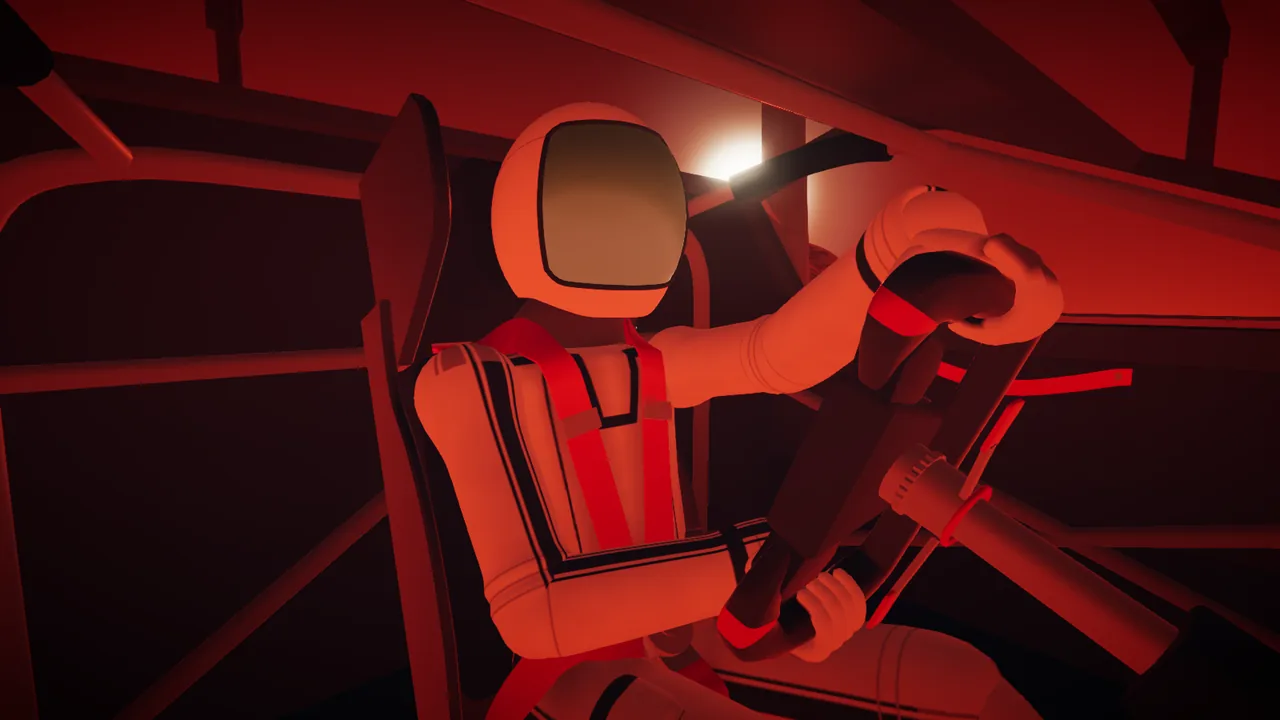
In-game screenshot: the ONBOARD camera, a rally-TV lens inside the cabin, looks back at the suited pilot at the carbon yoke, the only crew this Mars race carries.
The game skips the rest of this post: no launch window, no cruise, no radiation, no life support and no landing. The rover is fictional, and the terrain is sculpted to Martian morphologies rather than surveyed from a real landing site. The competition is real: two stages are open, and every leaderboard time is re-simulated from the run's recorded inputs before it is posted.
Where to try this
- Race up to eight pilots live on one stage, as translucent rovers with no collisions, each timed from their own start.
- How a car race on Mars would work: most likely as a rally, one sealed electric car at a time against the clock.
- Mars Rally Championship is free in a browser tab, with no download and no account, on a laptop, a school Chromebook or a phone held in landscape.