Mars dust storms are genuinely dangerous, but not in the way films show them. The Martian atmosphere is about 1.6% as dense as Earth's, so even a 100 km/h Martian wind pushes with roughly the force of a 13 km/h breeze at home — not enough to knock a person down or tip a rocket over. The real threat is the dust itself: talcum-fine, electrostatically clingy, abrasive, and dark enough to starve a solar panel. Mars Rally Championship, a free browser rally game, models a storm as a heavy brown haze that raises battery drain 50%.
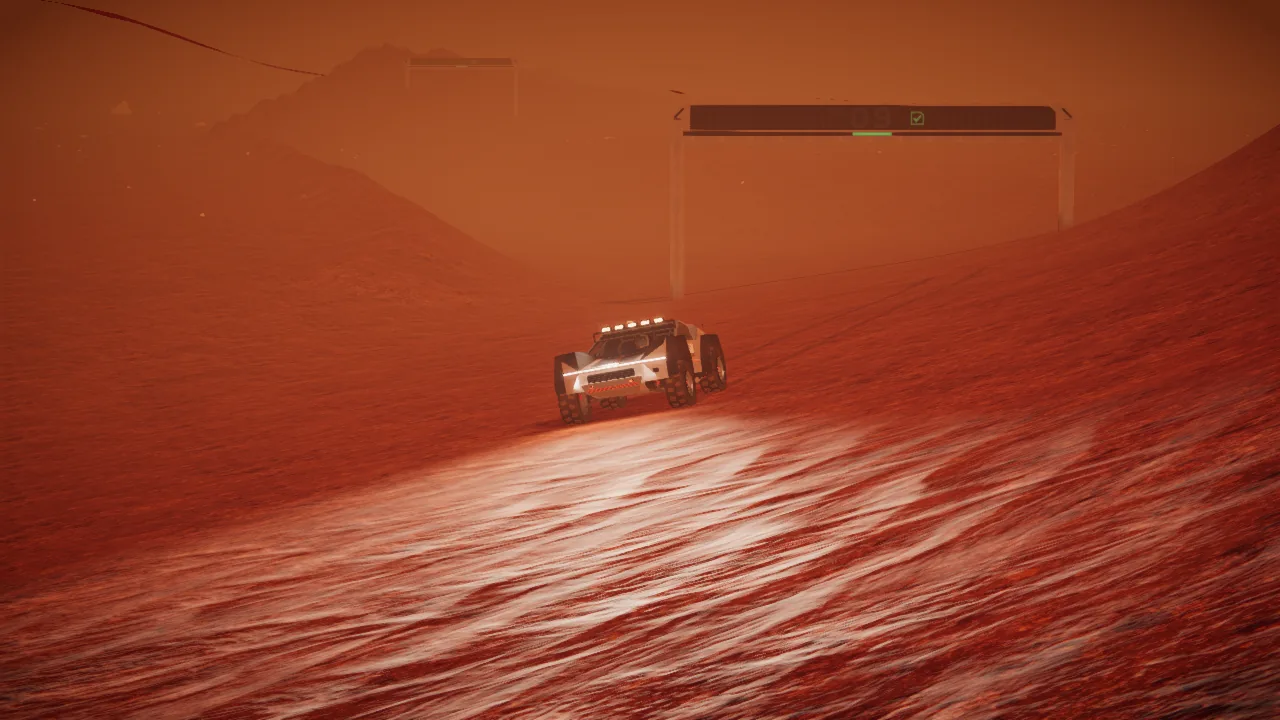
In-game screenshot: Stage 2 in the storm variant, which runs at full strength for the whole run: a heavy brown haze, the next gate still shining through.
The wind is real, and it is far too thin to push anything over
Wind force scales with air density, and that single fact corrects most of what people believe about Martian storms.
Dynamic pressure is half the air density times velocity squared. Martian air density is about 0.020 kg/m³ against Earth's 1.225 — roughly 1.6%. Put a 100 km/h Martian gale through that equation and it exerts about 8 pascals. The same wind speed on Earth exerts around 470. To feel 8 pascals at home you would stand in a 13 km/h breeze, the sort that moves a flag and nothing else. Martian wind near its measured peak is something an astronaut would notice on the suit fabric and then work through.
That is why the opening of The Martian is the one place the book knowingly breaks physics. Andy Weir has said as much in interviews: he needed a reason to leave a crew member behind, and no honest Martian weather event supplies one. A storm that topples an ascent vehicle cannot happen in air this thin.
The same density figure deletes aerodynamic grip for a vehicle, which is why a car on Mars has no downforce at any speed — worked through in Mars aerodynamics and why there is no downforce.
What thin air can still do is lift dust. Martian grains are only micrometres across, gravity is 38% of Earth's, and there is no rain to wash anything out of the sky. Once a storm has put dust up, it can stay suspended for weeks.
The dust is the dangerous part
Suspended dust, not wind speed, is what makes a Martian storm a mission risk. NASA's own explainer on Martian dust storms makes the same correction, and the reasons come down to three properties of the material.
It is extremely fine. Martian dust runs to a few micrometres per grain, closer to talcum powder or cigarette smoke than to beach sand. Particles that small follow the air rather than falling out of it, and they find any gap a seal leaves.
It is electrostatically clingy. Dry, wind-agitated grains pick up charge and stick to whatever they land on, including vertical surfaces and glass. Nothing brushes off cleanly, and there is no liquid water to rinse it away.
It is abrasive. The grains are basaltic and angular, never rounded by running water. They scour camera windows, degrade lens and mirror coatings, and work into bearings, gear teeth and hinges as a slow mechanical tax on every moving part.
Put those together and a storm attacks a rover on three fronts at once: it coats the solar arrays, it gets into the mechanisms, and — the part that actually kills missions — it absorbs and scatters sunlight before it reaches the ground.
The ledger does cut both ways. Gusts occasionally scrub panels clean, and these "cleaning events" repeatedly restored power to the Mars Exploration Rovers and bought them years of extra life. Wind on Mars is more often the solution than the problem.
Mars has a dust storm season, and it is southern summer
Mars runs a far more elliptical orbit than Earth: eccentricity around 0.093 against Earth's 0.017. At perihelion, the closest point, Mars receives roughly 40% more sunlight than at aphelion, and perihelion falls during southern hemisphere summer.
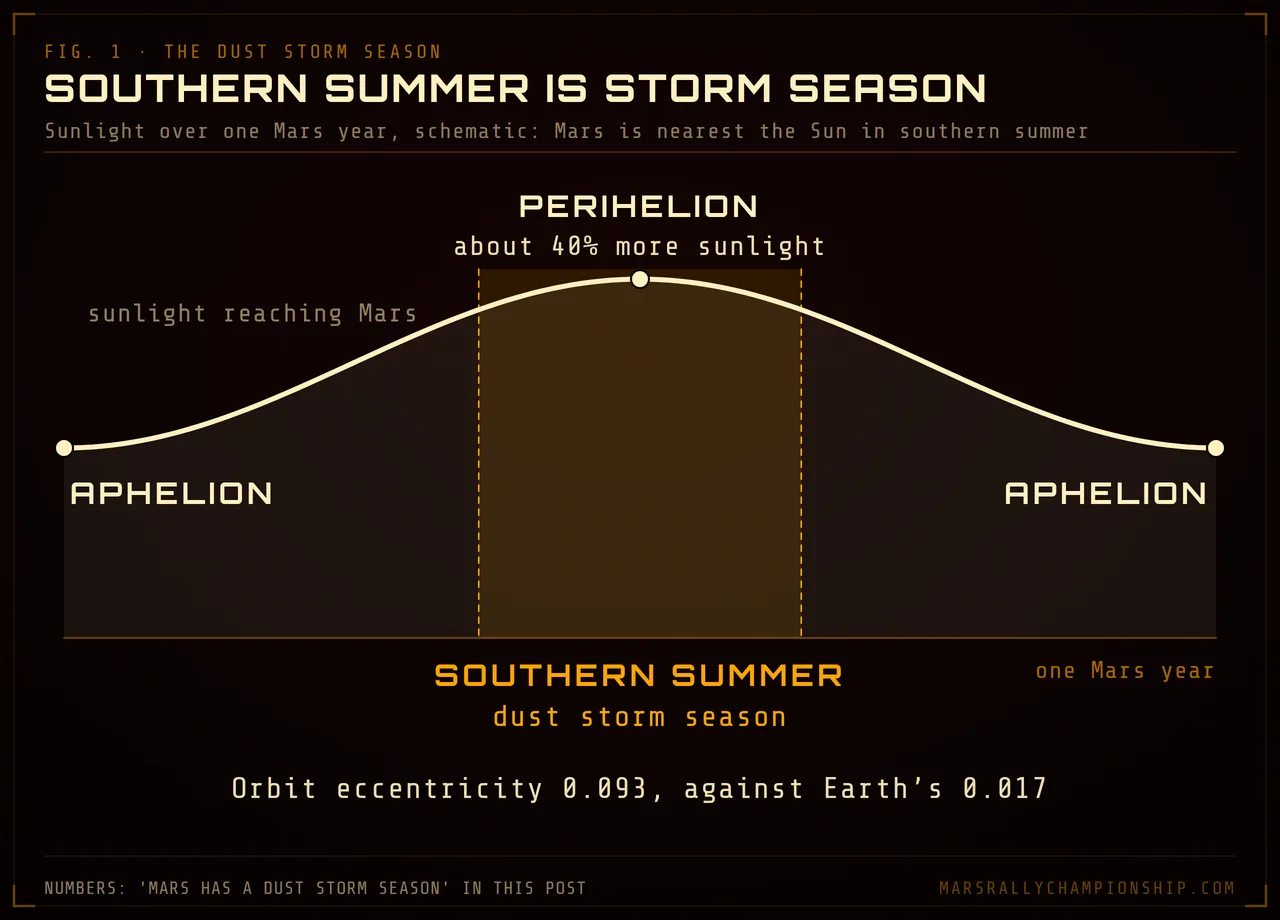
Diagram: Mars gets about 40% more sunlight at perihelion than at aphelion, and perihelion falls in southern summer, the dust storm season.
That extra sunlight starts a feedback loop. A warmer surface drives stronger convection, convection lifts dust, suspended dust absorbs sunlight and heats the air around it, heated air drives stronger winds, and stronger winds lift more dust. The loop runs until the season turns or the loose surface material near the storm is exhausted.
Most Mars years this produces local and regional storms and nothing more. Every three or four Mars years — five to eight Earth years — several regional storms merge and the haze wraps the entire planet. Astronomers call that a planet-encircling dust event. The word "global" describes the coverage, not the violence: it is a planet-wide haze, and the weather you would stand in at any given point inside it is unremarkable.
The three sizes of Mars dust storm
| Storm scale | Typical duration | What it does to sunlight | Consequence for a solar-powered rover |
|---|---|---|---|
| Local | Hours to a couple of days, tens to a few hundred km across | Modest dimming; the sun stays a defined disk | A slow day: charging drops, drive plans get trimmed |
| Regional | Days to a few weeks, spanning thousands of km | Sunlight cut sharply; sky darkens toward deep brown | Science suspended, power rationed, heaters prioritised |
| Planet-encircling | Weeks to months, the whole planet | Direct sunlight almost entirely blocked; daytime resembles deep dusk | Generation falls under the survival load — the rover sleeps, or does not wake |
A local storm is a bad afternoon. A planet-encircling event is an existential problem for anything that runs on sunlight, and ESA's Mars Express has watched several of them grow from orbit.
2018: the storm that ended Opportunity and left Curiosity working
The clearest case study on Mars is a controlled experiment nobody designed. In late May 2018 a regional storm began over Arabia Terra. Within roughly two weeks it had gone planet-encircling, and two working rovers were inside it.
Opportunity was parked in Perseverance Valley on the rim of Endeavour Crater, running on solar panels, more than 45 kilometres and fourteen years past a design life of 90 sols. The sky opacity above it was measured at a tau of about 10.8, the darkest ever recorded from the Martian surface. Its last transmission, on 10 June 2018, reported a falling battery and a darkening sky. NASA sent recovery commands for eight months and formally ended the mission on 13 February 2019, just short of fifteen years after landing. What region of Mars Opportunity explored follows the rover's route to Perseverance Valley, from Eagle crater across Meridiani Planum, stop by stop.
Curiosity, thousands of kilometres away in Gale Crater, drove through the same storm and studied it from the inside. It carries no solar panels. Its power comes from a radioisotope thermoelectric generator that converts the decay heat of plutonium-238 into electricity, and dust settling on the housing changes nothing about that.
The lesson is narrow and complete. Two rovers, one storm, opposite outcomes, and the variable was the power source. Surviving a Martian dust storm is a question of where your energy comes from long before it is a question of how tough the hardware is. Every nuclear-powered surface mission since has inherited that answer.
What a storm actually looks like from the ground
Light is the thing you would notice first. As opacity climbs, the sun stops being a disk and becomes a pale smear, then disappears. Shadows go with it, because almost all the light still reaching the ground has been scattered rather than delivered straight, and a world without shadows is a world without depth cues.
Colour goes too. The normal butterscotch sky flattens to a dark red-brown, and surface contrast drops until distant landforms are silhouettes and then nothing at all. Ground visibility can fall to a few hundred metres. At night it is total: a planet-encircling storm hides the stars and both moons, which matters more than it sounds if you had been using them, as described in Phobos and Deimos from the surface of Mars.
How Mars Rally Championship models a dust storm
Mars Rally Championship treats a storm as a stage variant you choose rather than weather that arrives: pick the storm version of a practice stage and the storm is at full strength from the start to the finish. Nothing builds up or clears while the clock is running.
At full strength, four values move together:
- Fog density goes from 0.004 to 0.03, 7.5 times thicker. Clear air is already about half hazed by 170 metres; a full storm hazes out 95% of the view by about 100 metres. It is a heavy brown haze, not a whiteout, and the gate you are driving to still shines through it.
- Ambient dust ×2.2. The particulate load in the air more than doubles, which is what turns fog into something that visibly moves.
- Wind gain +0.60. In a 1.6%-density atmosphere this is far more an audible and visual load than a force capable of shifting three tonnes, which is exactly the point this post opened with.
- Battery drain +50%, from panel obscuration. This is the one storm parameter that changes strategy rather than sight-lines, and it is modelled on the real failure mode that ended Opportunity.
What does not change is grip. The traction budget stays at about 3.1 m/s², so it still takes roughly 125 metres to stop from 100 km/h, exactly as covered in what it is actually like to drive on Mars. A storm does not make the rover slippery. It removes your ability to see the braking point for a corner that is arriving just as fast as it did before. To feel it, run Stage 2 in the storm variant, the stage with only two real corners: the gate you are driving to still shines through, but 95% of the view is haze by about 100 metres, short of the 125 metres a stop from 100 km/h needs.
A real crew would lean on the co-driver here. The storm variant gives you none: pace notes run on forward stages only, so there are no calls and no on-screen strip. The haze leaves you the gate you are driving to, which still shines through, and takes most of the ground beyond about 100 metres, so the best instrument left is how well you know the stage, which is why a storm run is the one to drive after you have learned the forward route.
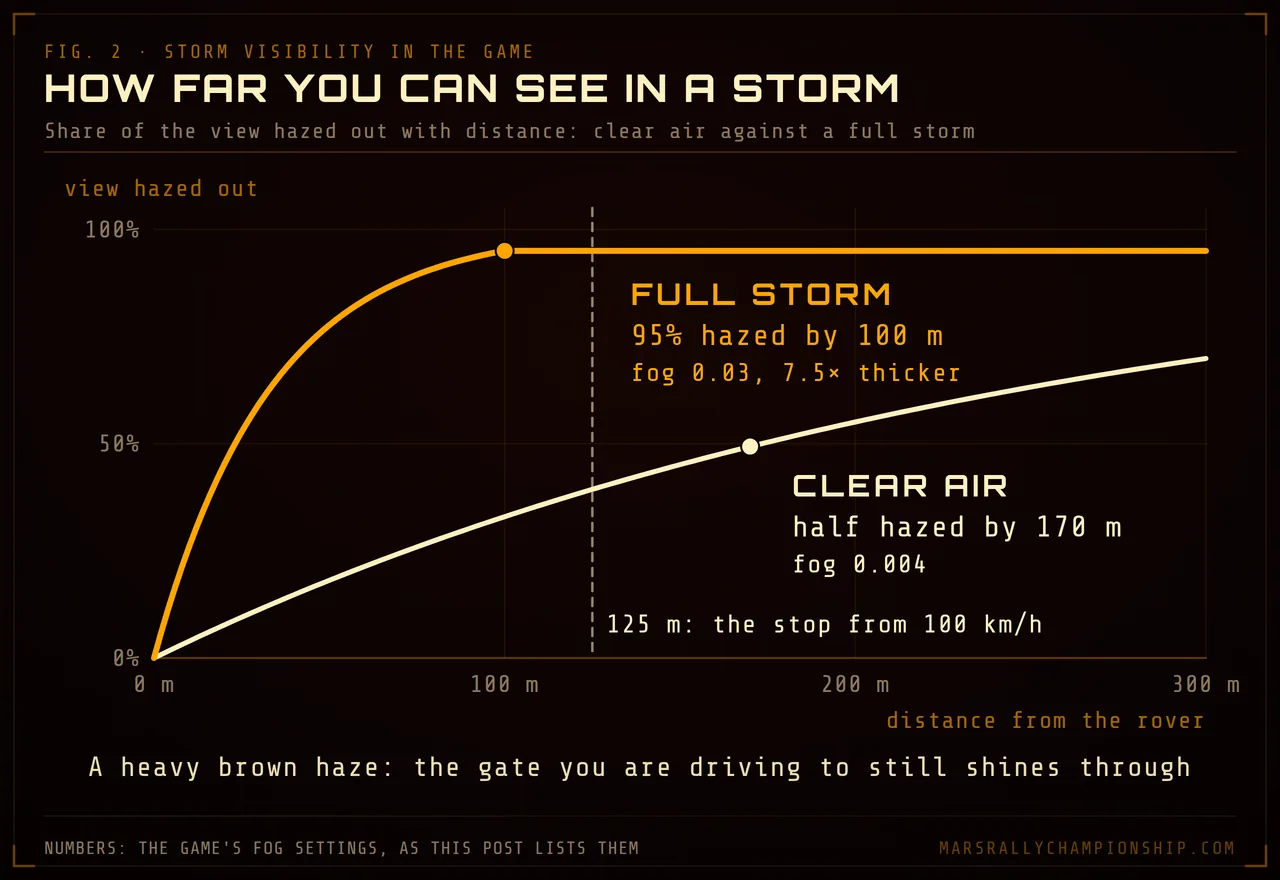
Diagram: in the game's full storm, 95% of the view is haze by 100 m, short of the 125 m a stop from 100 km/h needs.
Where to drive one
Any configured practice stage can be run as a storm variant, so the weather is something you choose rather than something you wait for.
- Start Stage 3 in a dust storm — a 1,164-metre timed line over 8 checkpoints, descending 65 metres, in full storm haze from start to finish.
- Stage 3's stage page has the clean-weather medal times to measure the difference against, and the full stage list shows what is configured and drivable today.
- Storm and reverse variants keep their own personal bests and their own boards, and they skip medals entirely — the public tables at the leaderboard rank standard forward runs, so a storm time never contaminates the ladder.
It runs in the browser with no download and no account, on a laptop, a school Chromebook, or a phone held in landscape.