A car race on Mars has never been held, and the first one would most likely be a rally: one car at a time against the clock, because a circuit would need infrastructure shipped from Earth and wheel-to-wheel contact could split a pressure hull. The cars would be electric: there is almost no oxygen to burn. Drivers would work with 38% of Earth's gravity and about 3.1 m/s² of grip on rally tyres, need roughly 125 metres to stop from 100 km/h, and have no marshals. Mars Rally Championship, a free browser rally game, runs that format today.
Looking for the MARS dirt late-model series? That is a US dirt-track tour, at marsracingseries.com; this page is about racing on the planet.
Has there ever been a car race on Mars?
No. Nothing with a driver aboard has ever moved on Mars. The six rovers that have driven there are robots, crawling at a few centimetres per second on commands planned on Earth.
The nearest thing to motorsport off Earth ran on the Moon. On Apollo 16 in April 1972, John Young put the Lunar Roving Vehicle through a planned "Grand Prix" of S-turns, hairpins and hard stops, a one-car handling test that Charlie Duke filmed on 16 mm. Apollo 17 set the off-world speed record that December, 18 km/h downhill with Gene Cernan driving, and it still stands.
How driving on Mars would feel, system by system, is covered in what it is like to drive on Mars, and whether any car has reached the planet in is there a car on Mars.
Why the first race on Mars would be a rally, not a Grand Prix
The first race on Mars would be a time trial, because a time trial needs nothing Mars lacks: no built track and no second car on the course at once. Circuit racing needs a prepared track, barriers, a pit lane, marshal posts and a medical car, and on Mars each would have to be landed first. Stage rally is a time trial: cars start alone, a minute or more apart, and race the clock from point to point, as what rally racing is explains.
Starting alone also removes contact. On Earth a crash brings marshals, medics and a recovery truck within minutes; on Mars a crumpled door could be a breached pressure hull, and the rescue service is whoever else is on the planet. NASA's concept for a 30-day crewed landing, covered in what a pressurized Mars rover would look like, puts two astronauts on the surface with two rovers, one pressurized and one open: enough for a time trial, not a grid. First, someone has to win the race to land people on Mars.
A clock also survives the radio delay. Signals take about 3 to 22 minutes each way, depending on the planets' positions, according to ESA's Mars Express team, so race control could not sit on Earth. A stage time, though, can be sent home and set against any other run, from any crew, in any year.
What racing on Mars would change for the driver
Grip changes most, and how Mars gravity changes rally driving works through why. Gravity is 3.72 m/s², 38% of Earth's, so tyres press into the ground with 38% of the force. On gravel-rally tyres, with soil cohesion on top, a car has about 3.1 m/s² of grip for braking, cornering and throttle combined, and needs about 125 metres and 9 seconds to stop from 100 km/h; the same tyres on Earth gravel need about 52 metres.
The air is about 1.6% as dense as Earth's, so no wing makes useful downforce at any speed a car could reach. Low gravity does the rest: a crest throws a car about 2.6 times as far and keeps it airborne 2.6 times as long. A drag race would be settled by grip rather than power: on those tyres, even a perfect launch needs about 9 seconds to reach 100 km/h.
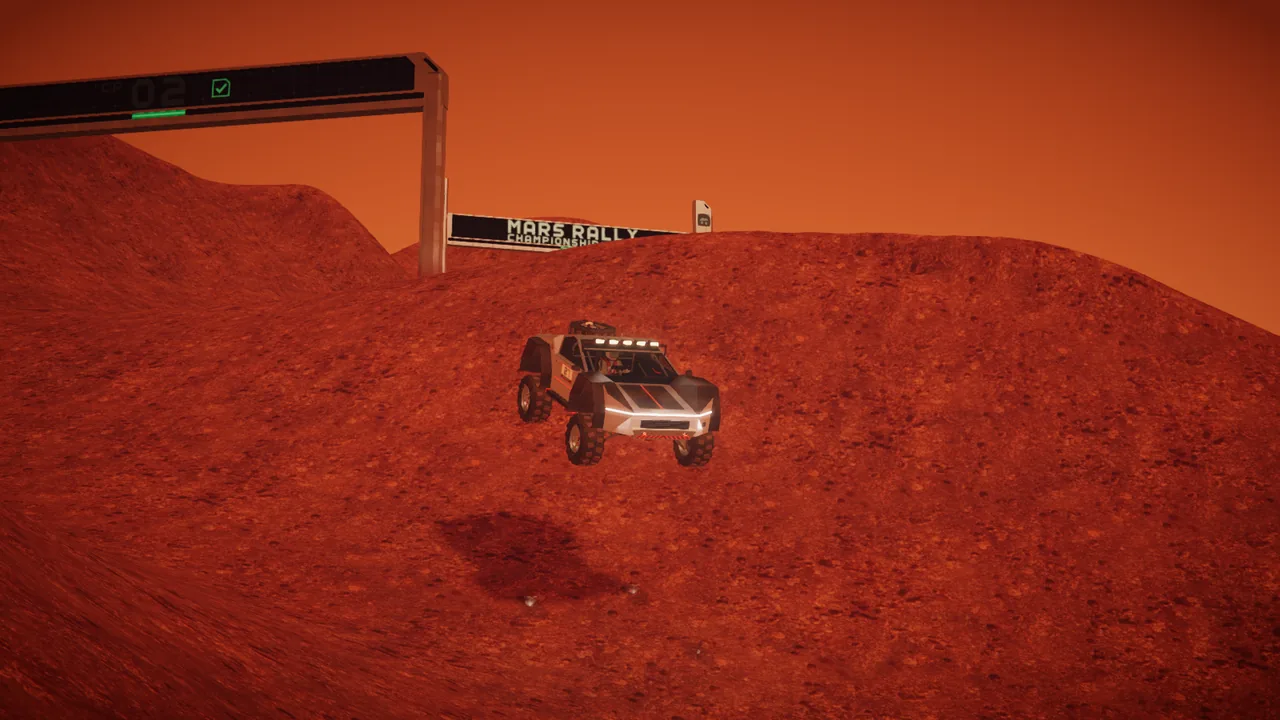
In-game screenshot: the rover airborne over a crest on Stage 1, The Opener, where every wheel off the ground is grip the driver cannot use.
The driver would race in a pressurized suit, harnessed into a cabin that doubles as life support. With 125 metres needed to stop, pace notes are no longer optional: Mars Rally Championship's co-driver calls each corner about 8 seconds ahead, because an Earth-tuned 4.5-second call arrived after the braking point.
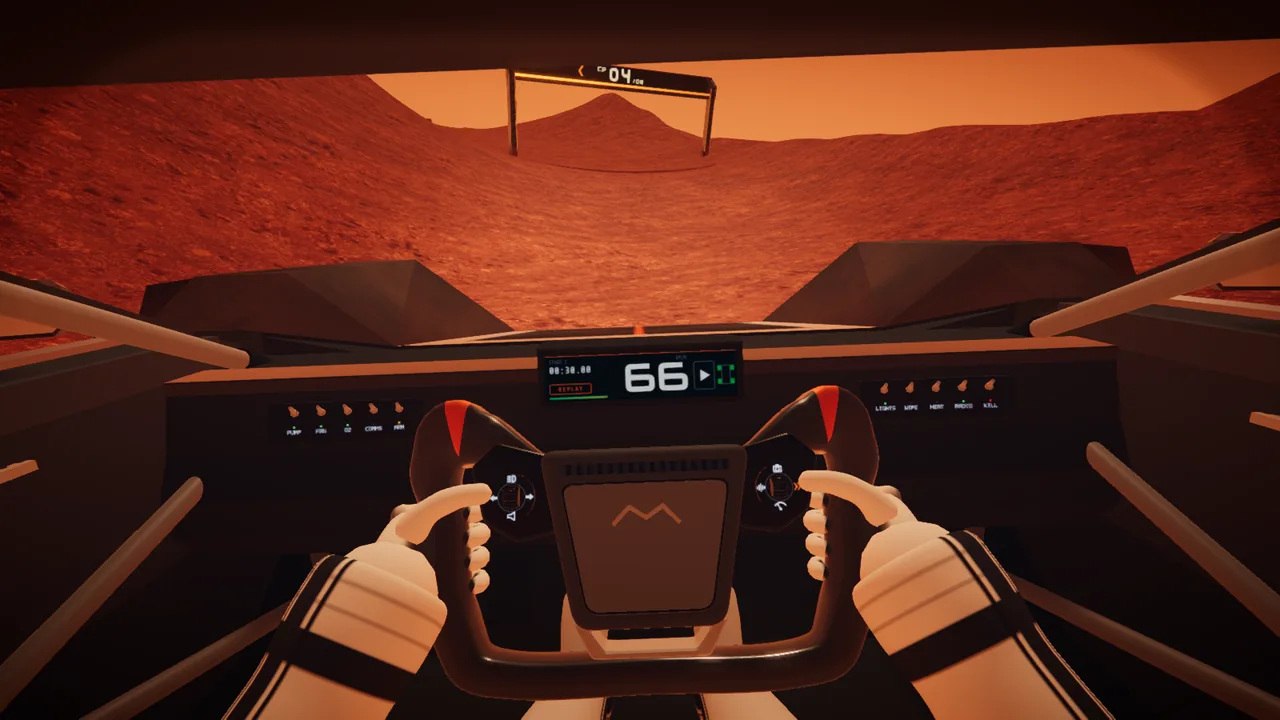
In-game screenshot: the HELMET view on Stage 1, gloved hands on the yoke and the next gate ahead, as a suited driver sees it.
What a Mars race car would need
A Mars race car would be an electric, sealed, long-travel off-roader that carries its own rescue kit. It would look nothing like a Formula car.
- Electric drive. Mars air is mostly carbon dioxide, so a combustion engine would have to carry its own oxygen, like a rocket.
- A pressure vessel around the driver. Surface pressure is under 1% of Earth's: a pressurized suit, a sealed cabin, or both.
- Cooling that barely works. Air at 1.6% of Earth's density carries off little heat, so motors would run derated.
- Wheels for the cold. Mars averages about −60 °C, cold enough to stiffen and crack ordinary rubber, which is why every wheel NASA has driven there is metal.
- Suspension travel, not wings. Useful downforce is impossible, and every crest means 2.6 times the airtime.
- Its own rescue. Spare wheels, tow points, bash plates and, ideally, a second vehicle.
Mars Rally Championship's rover is drawn to most of that brief: 3,000 kg and electric, with a 90 kWh battery, motors derated for the thin air, long-travel suspension, two stacked spare wheels and tow hooks. A pilot in a pressurized suit drives it from inside a roll cage. Its knobby tyres are rubber, a rally-game choice the real Martian cold would punish.
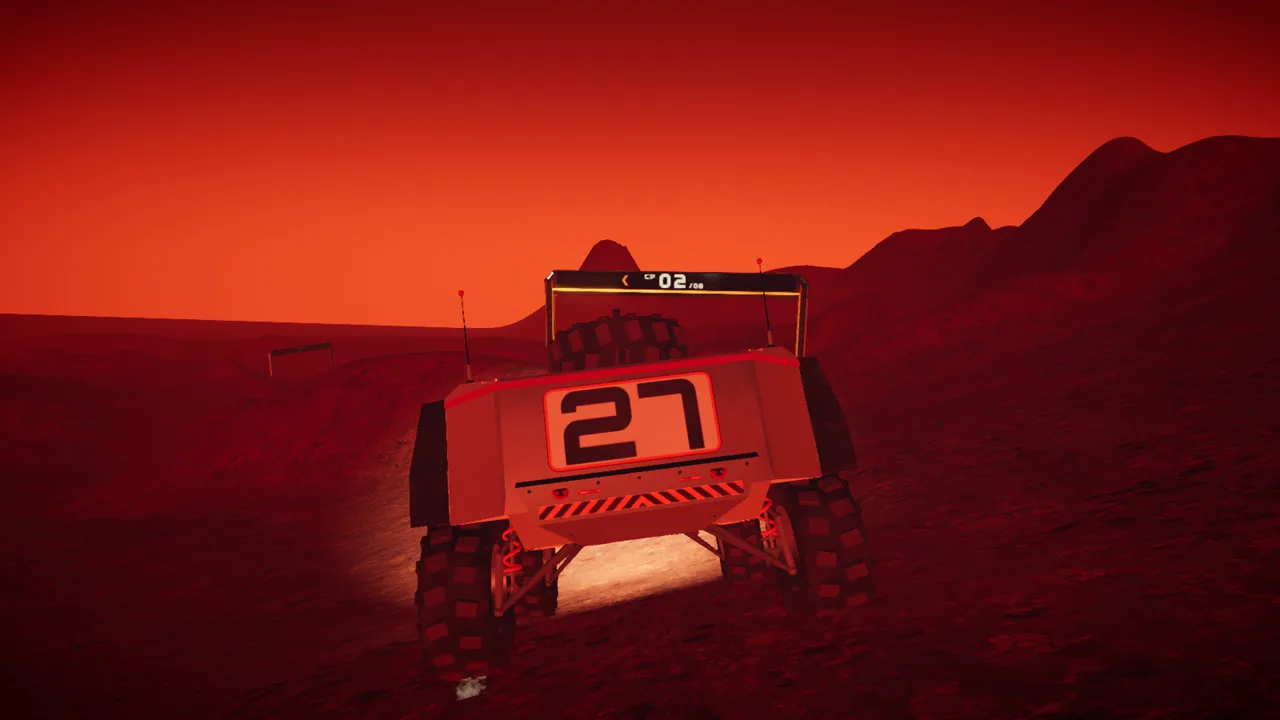
In-game screenshot: Mars Rally Championship's rover from a chase camera at sunset, race number 27 on its tail and two spare wheels stacked behind the cabin.
Rover races already happen, on Earth
Students race rovers every year. At NASA's Human Exploration Rover Challenge, called the Great Moonbuggy Race until 2014, teams drive rovers they built, pedalled by two riders or remote-controlled, over a half-mile obstacle course; its 2026 edition drew more than 500 students in 42 teams. The Mars Society's University Rover Challenge in Utah and the European Rover Challenge in Poland put robotic Mars rover prototypes through mission tasks instead.
| Competition | Where | What races | Format | In 2026 |
|---|---|---|---|---|
| NASA Human Exploration Rover Challenge (since 1994) | Huntsville, Alabama | Student-built rovers, pedalled or remote-controlled | Half-mile obstacle course of simulated lunar and Martian terrain, plus mission tasks | 32nd edition, 9–11 April: more than 500 students in 42 teams |
| University Rover Challenge (Mars Society, since 2007) | Mars Desert Research Station, near Hanksville, Utah | University-built robotic Mars rovers | Four field missions: science, delivery, equipment servicing, autonomous navigation | 27–30 May: teams from 11 countries; Missouri S&T won for the second year running |
| European Rover Challenge | Kraków, Poland | Student-built robotic rovers | Tasks modelled on NASA and ESA missions, on an artificial Mars yard | 12th edition, 4–6 September: 25 teams from more than 120 applications; EPFL Xplore won |
| Mars Rally Championship | A browser tab | One 3,000 kg pressurized rally rover | Timed point-to-point stages with a co-driver; up to 8 pilots live | Two stages open: 1,164 m and 2,306 m |
Where you can race on Mars today
Mars Rally Championship runs the format this page argues for, on Mars physics, in a browser tab with no download and no account. Its stages are timed point-to-point runs through checkpoints: Stage 1, The Opener, is 1,164 metres through 8 of them, and Stage 2, The Long Run, is 2,306 metres through 12.
You race the clock alone, or a ghost: the translucent rover of a leaderboard run, replaying its line beside you. Every board time is re-simulated from its recorded inputs before it is posted.
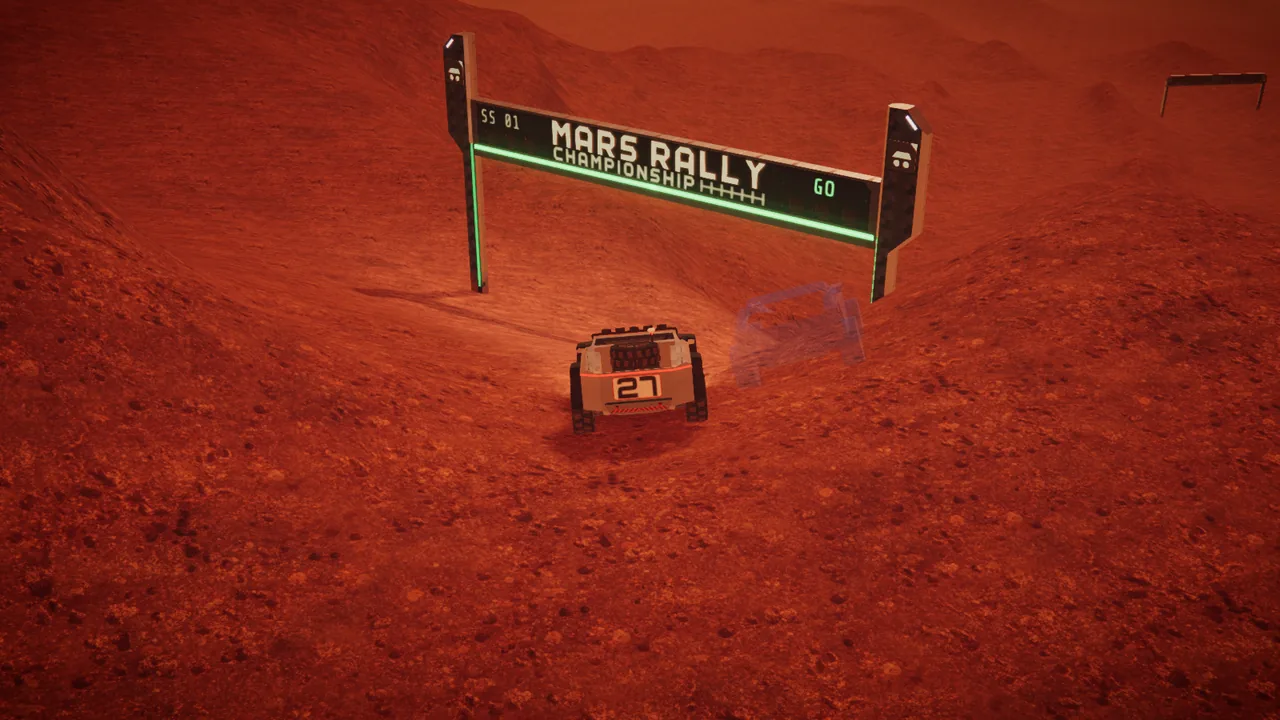
In-game screenshot: racing the translucent ghost of a leaderboard run, two rovers on one stage with no chance of contact.
Up to 8 pilots can also race one stage live, each timed from their own start, and the rovers pass through each other by design: the Mars-safe version of a grid.
What the game leaves out is survival. It does not simulate life support, cabin pressure, cold or radiation, so a crash costs chassis, suspension, motor, battery or tyre health, never air. A stuck pilot presses T and goes back to the last gate, upright, with the clock still running; no Mars crew would get that. The terrain is sculpted to Martian morphologies rather than surveyed from a real place, and there is one rover and two stages.
Mars racing photos from the game
No photograph of a car race on Mars exists, because none has happened. Every image on this page is an in-game screenshot from Mars Rally Championship; none was taken on Mars. Real pictures and video from the surface are collected in footage from Mars.
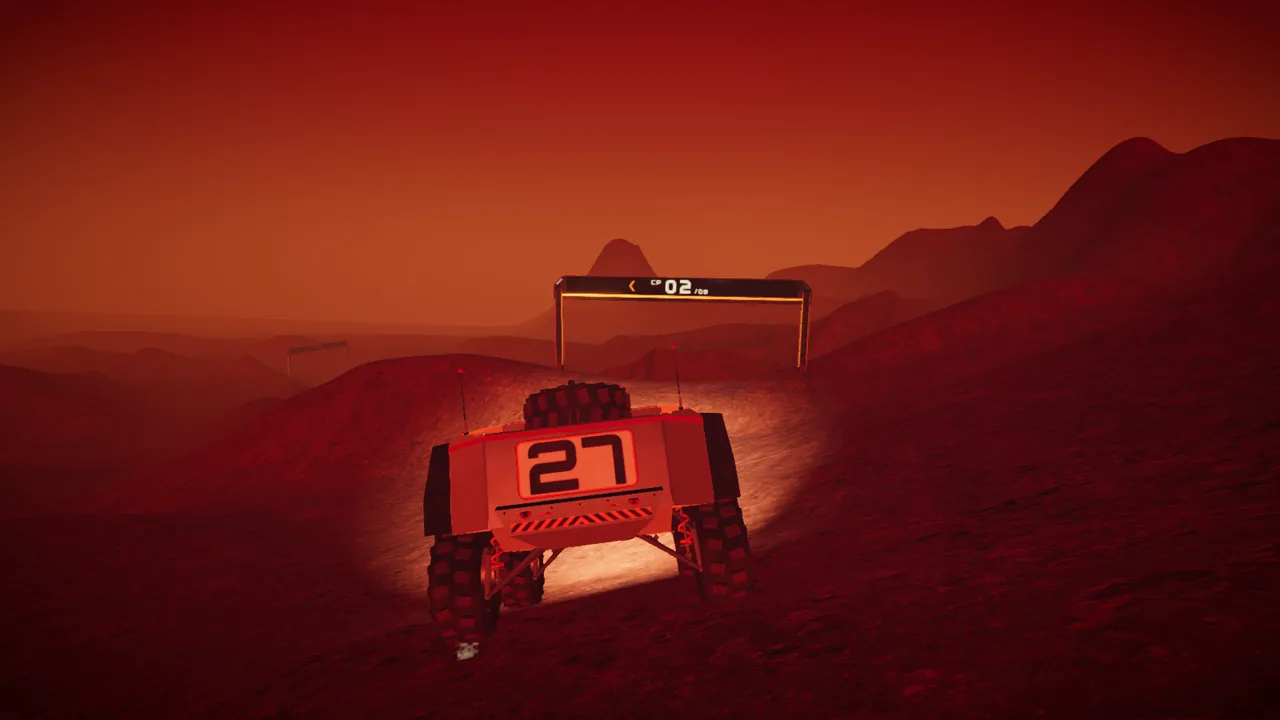
In-game screenshot: the storm variant's thick haze swallowing the ridges, with the next gate still glowing ahead, the view a dust storm leaves a driver.
A storm in the game thickens the haze 7.5-fold, until 95% of the view is gone by about 100 metres, and raises battery drain 50% as the panels dim. At night the sky fills with stars, the Milky Way and both of Mars's moons.
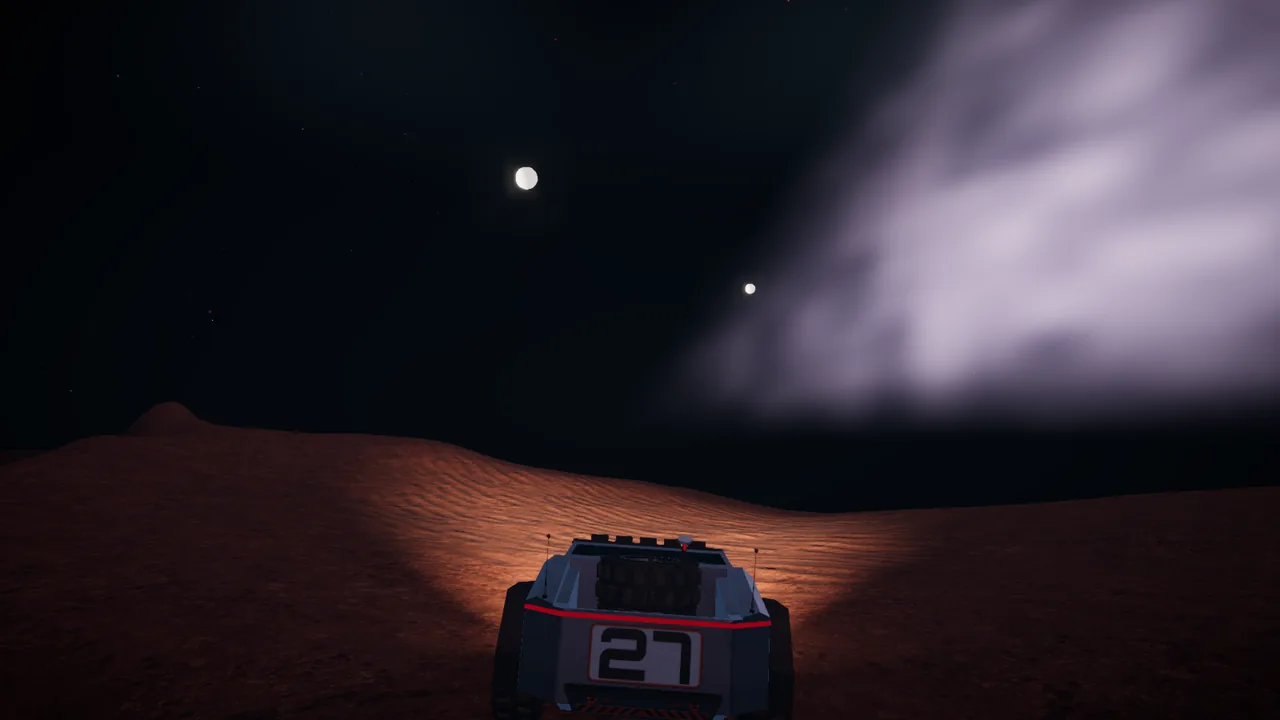
In-game screenshot: a night run under the stars, with Phobos and Deimos, the two moons of Mars, above the stage.
Other pictures of cars racing on Mars are renders too: the Nomads on Mars CGI concept, Cars on Mars (a sci-fi racer on Steam) and Altair's simulated drag race between a rover and a sports car. The best Mars games online sorts the ones you can play. To take your own shots, open any replay and press P for photo mode.
Where to try this
- Stage 2, The Long Run: 2,306 metres and 12 gates against the clock.
- Stage 1 in a storm: the brown-haze variant, with its own leaderboard.
- A live race: up to 8 pilots on one stage at once.
- Ghost racing: race any board run's ghost, with nothing to collide with.
- Braking distance on Mars vs Earth works through the 125-metre stop.
Mars Rally Championship is free, needs no download or account, and runs on a laptop, a school Chromebook or a phone in landscape.