Braking distance on Mars from 100 km/h is about 125 metres, and it takes about 9 seconds. On Earth gravel, the same tires on the same vehicle and soil stop in roughly 52 metres and under 4 seconds. The difference is almost all gravity: friction force is µ·m·g, so deceleration is µ·g, and Mars gravity is 3.72 m/s² against Earth's 9.81. Soil cohesion adds a little grip that gravity does not touch. Mars Rally Championship, a free browser rally game, models both, which is why braking — not cornering — is the hardest habit to unlearn.
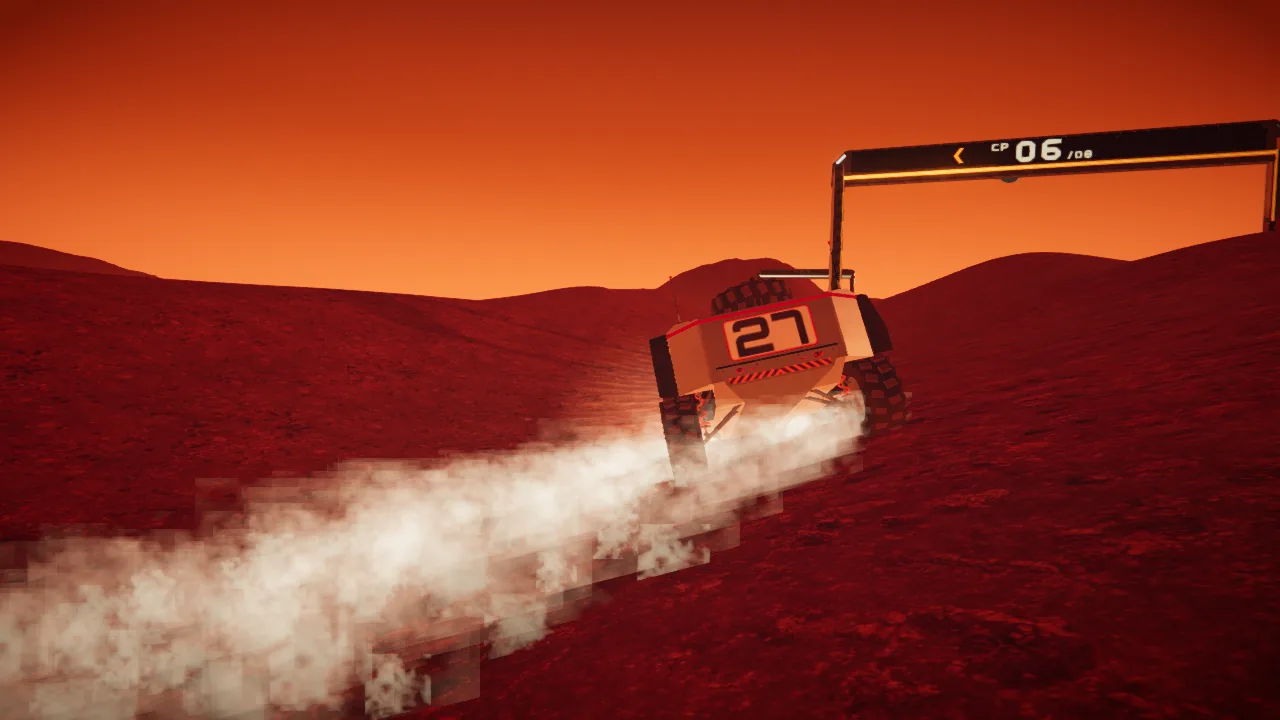
In-game screenshot: full braking in a straight line before a gate. On the game's Mars a stop from 100 km/h takes about 125 m.
Friction does not care how heavy the rover is
Start with one tire pressed onto the ground. The most friction it can produce before it slides is F = µ·N, where µ is the coefficient of friction and N is the normal force pushing the tire into the surface. On flat ground that normal force is just weight, N = m·g, so the maximum braking force the whole vehicle can generate is F = µ·m·g.
Now apply Newton's second law, a = F/m:
a = (µ · m · g) / m = µ · g
The mass cancels. This is the part almost everyone gets wrong. A loaded truck and an empty one, on the same tires and the same surface, share the same theoretical minimum stopping distance. Doubling the mass doubles the momentum you have to kill, but it also doubles the weight pressing the tires into the ground, and so doubles the friction available to kill it. The two effects are the same size and they cancel exactly.
For Mars Rally Championship the two inputs are µ = 0.70 — purpose-built rally rubber on dry basaltic regolith, in the range standard tables give for rubber on gravel and loose surfaces — and g = 3.72 m/s². NASA's Mars Fact Sheet puts Martian surface gravity at 3.71 m/s²; the game rounds to 3.72.
µ·g = 0.70 × 3.72 = 2.60 m/s²
Loose ground adds one term. Soil shear strength is τ = c + σ·tanφ: σ·tanφ is the friction above, and c is cohesion — about 2.6 kPa over a ≈0.14 m² patch, ≈0.12 m/s² per tire, ≈0.48 m/s² for all four. It does not scale with gravity, so next to friction it counts 2.6 times more on Mars than on Earth:
a = µ·g + cohesion = 2.60 + 0.48 = 3.08 m/s²
That single figure is the entire grip budget of the vehicle. Every metre of braking, every degree of cornering and every newton of throttle is drawn from the same 3.08 m/s². On Earth asphalt with µ near 1.0 the same budget is 9.81 m/s², more than three times larger.
So what does mass actually change?
Plenty — just not the friction-limited stopping distance. The rover masses 3,000 kg, so at 100 km/h it carries ½mv² = 1.16 megajoules of kinetic energy, and that energy has to go somewhere: into brake heat, into tire wear, or back into the 90 kWh battery through regen. Mass also decides how hard you hit things, which is why the damage model is energy-based rather than speed-based. And mass matters immediately wherever a force is not proportional to it — aerodynamic drag, downforce and motor thrust all lose effect as a vehicle gets heavier. (The rover's 11 seconds to 100 km/h is not one of those: that run is traction-limited, set by the tires rather than the motor.) Cohesion is one of those forces too: it comes from contact-patch area, not weight. Finally, real tires are mildly load-sensitive: µ falls slightly as vertical load rises, so a heavier vehicle does stop marginally longer in practice. That is a correction, not the main term.
Working it out: 50, 100 and 150 km/h
Two equations do all of the work. For a stop from speed v at constant deceleration a:
d = v² / (2a) and t = v / a
Convert to metres per second first, always. 100 km/h ÷ 3.6 = 27.78 m/s. On Mars, with a = 3.08 m/s²:
d = 27.78² / (2 × 3.08) = 771.6 / 6.16 = 125 m, and t = 27.78 / 3.08 = 9.0 s
Run the identical arithmetic for Earth gravel, keeping the same tires and soil so only g changes: a = 0.70 × 9.81 + 0.48 = 7.35 m/s², giving d = 771.6 / 14.70 = 52 m and t = 3.8 s. On Earth asphalt with µ = 1.00 and no soil to shear, a = 9.81 m/s², giving 39 m and 2.8 s.
| From a standing stop of | Mars regolith (µ 0.70, g 3.72, + cohesion) | Earth gravel (µ 0.70, g 9.81, + cohesion) | Earth asphalt (µ 1.00, g 9.81) |
|---|---|---|---|
| Deceleration a = µ·g + cohesion | 3.08 m/s² | 7.35 m/s² | 9.81 m/s² |
| 50 km/h (13.9 m/s) | 31 m / 4.5 s | 13 m / 1.9 s | 9.8 m / 1.4 s |
| 100 km/h (27.8 m/s) | 125 m / 9.0 s | 52 m / 3.8 s | 39 m / 2.8 s |
| 150 km/h (41.7 m/s) | 282 m / 13.5 s | 118 m / 5.7 s | 88 m / 4.2 s |
Two things fall out of that table. Distance scales with the square of speed, so 150 km/h is not 50% worse than 100 km/h, it is 125% worse — 282 metres against 125 on Mars. And the Mars-to-Earth-gravel ratio is the same at every single speed, 7.35 / 3.08 ≈ 2.4 — a little less than the gravity ratio, 9.81 / 3.72 = 2.64, because the 0.48 m/s² of cohesion does not scale with gravity and so carries more weight on Mars. Gravity is doing almost all of it. The braking distance calculator runs these same two equations for any speed, on Mars, Earth or the Moon, with an optional reaction time added.
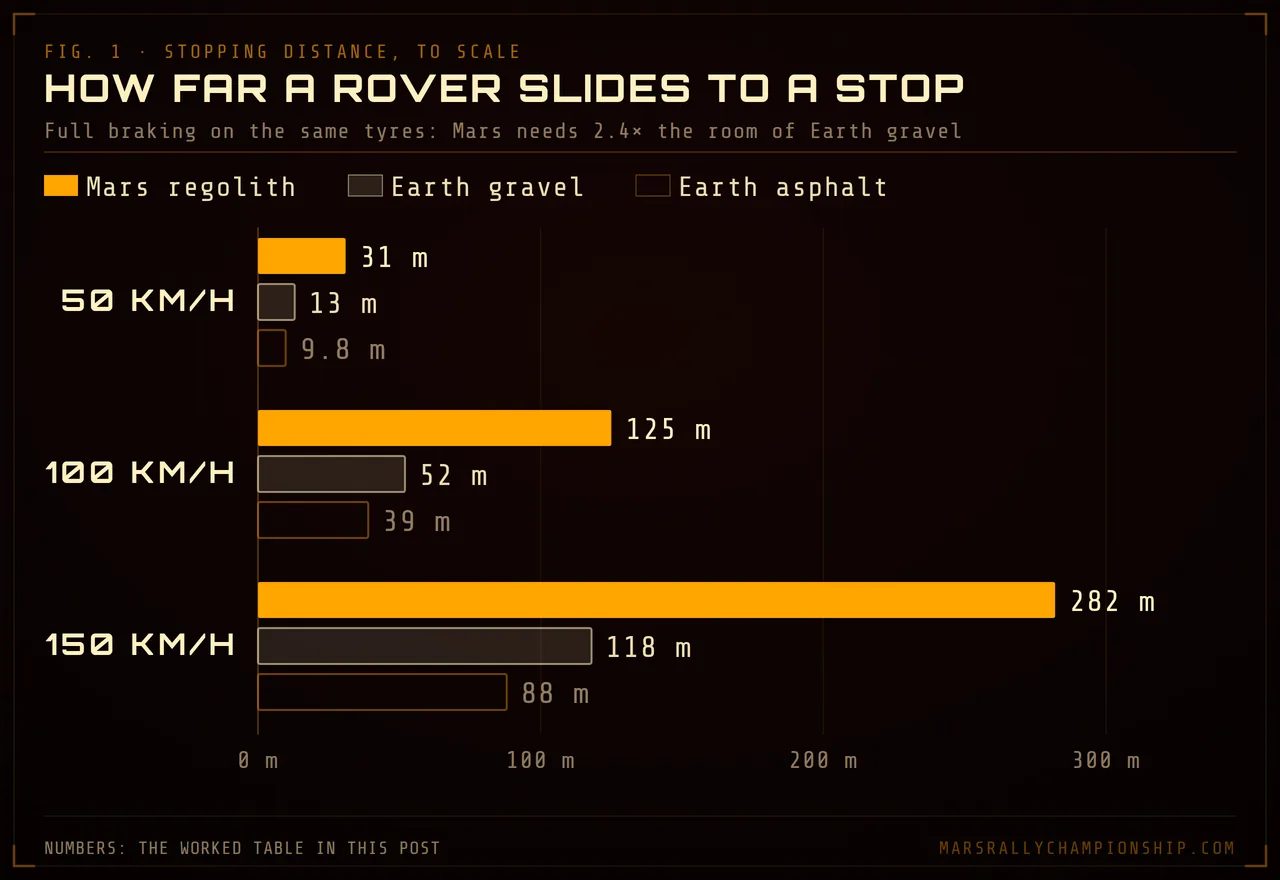
Diagram: from 100 km/h a rover needs 125 m on Mars against 52 m on Earth gravel; the ratio is 2.4 at every speed.
Why 125 metres is the number you actually get, and what it costs
125 metres is every tire poised exactly at the edge of grip, all of it spent going backwards — and Mars Rally Championship gives you exactly that. Its ABS holds each tire at the peak of its curve, so a straight-line stop uses the whole friction circle and the deceleration is the full 3.08 m/s² the table above is built on. The wheels never lock; only the handbrake does that. Rolling resistance quietly adds about 0.15 m/s², so a stopwatch in the game reads a few metres shorter still, nearer 118.
The shortest stop has a price, though. Grip is a circle, not two separate budgets: what you spend slowing down is not available for turning, and the two demands add as a vector sum. Steer with the pedal held and the ABS shares each tire's circle by demand, so the rover turns while it slows — from 60 km/h, full brake and full lock swing its path about 24° in 3 seconds — at the cost of some deceleration. A gamepad trigger can feather the pedal; a keyboard or touchscreen brake is all or nothing, so do the heavy braking in a straight line.
The same circle sets the cornering limit. Steady-state lateral acceleration also tops out at the grip budget, so the minimum radius you can hold at 100 km/h is r = v² / a = 771.6 / 3.08 ≈ 250 m. Set that beside the 125 m braking distance and you get a relation worth memorising: the tightest corner you can hold is exactly twice your shortest stop, because d = v²/2a and r = v²/a. Both come out of the same 3.08 m/s².
The handbrake exists to break that rule
The handbrake simply locks the rears. Locked rear wheels spend their whole friction circle longitudinally and keep nothing lateral, so the rear steps out and the vehicle pivots about the front axle. On a severity-1 hairpin — 149° or tighter on the co-driver's 1-to-6 scale — a 250 m minimum radius is simply not negotiable with steering. Rotating the vehicle is the only way through, and throwing away rear grip on purpose is how you rotate it.
Why your co-driver calls eight seconds ahead
Pace notes in Mars Rally Championship look 8.0 seconds ahead at current speed, clamped between 25 and 260 metres. That figure is arithmetic, not style. An Earth-tuned 4.5-second lookahead was tried first and failed for a reason you can now compute yourself: 4.5 s at 27.78 m/s is 125 metres of warning against a 125-metre stop — no margin at all, before anyone reacts. The call arrived after the braking point. Every time.
Eight seconds gives 222 metres at 100 km/h, leaving about 97 metres — three and a half seconds — of margin beyond the stop. Enough to hear the call and act on it.
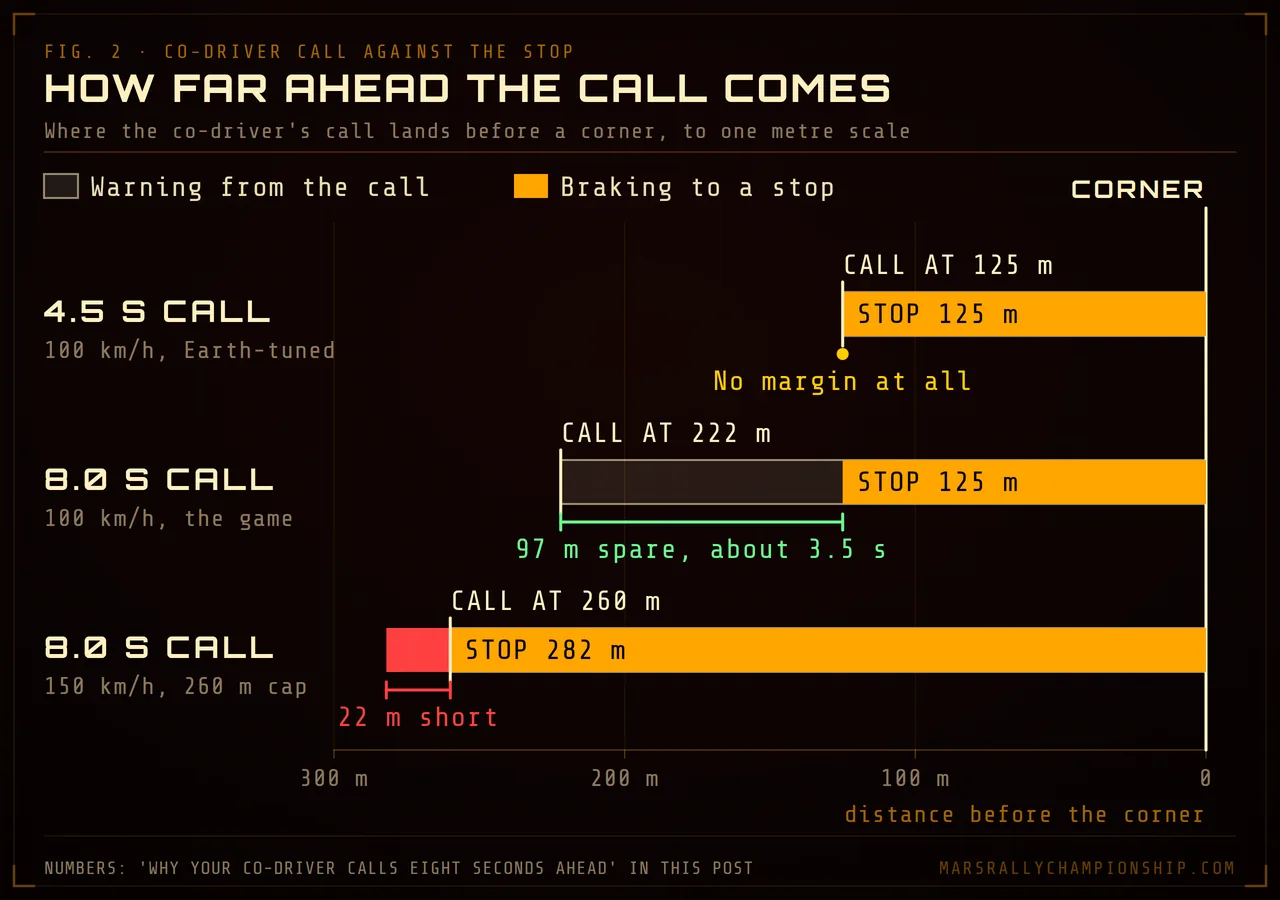
Diagram: at 100 km/h the 8 s call leaves 97 m spare and the old 4.5 s call none; at 150 km/h the capped call is 22 m short.
The clamp matters too. Above roughly 117 km/h (260 m ÷ 8 s = 32.5 m/s) the 260-metre ceiling starts to bind, so at 150 km/h you get 260 metres of warning against a stop that needs about 282 metres. That is the unglamorous reason running top speed into a blind crest is a mistake rather than commitment.
Nothing else on Mars slows you down
On Earth a meaningful share of speed loss on a long straight is free — the air does it for you. Mars surface air is 0.020 kg/m³, about 1.6% of Earth's 1.225 kg/m³, and the consequences are severe. Aerodynamic drag at the rover's 240 km/h top speed is about 0.02 m/s², under 1% of the grip budget, and it scales with v², so at 100 km/h it is a rounding error. Downforce is impossible for exactly the same reason: it scales with air density, so no wing, splitter or diffuser can add a single newton of grip on Mars at any speed.
Rolling resistance is the larger of the two passive terms, and still small: a = Crr·g = 0.040 × 3.72 = 0.15 m/s². Lift off at 100 km/h and touch nothing and the rover coasts roughly 2.5 kilometres over about three minutes before it stops.
Regenerative braking is the only deceleration you are not simply throwing away — up to 150 kW back into the 90 kWh battery instead of into heat. It still spends friction budget, because it acts through the same four contact patches, but it is the one form of braking that pays you back. Everything else comes out of those tires and that 3.08 m/s².
Where to feel this
- The Proving Ground — the nineteen-lesson tutorial has a braking lesson that makes you get under 15 km/h before a stop line, and 125 metres stops being an abstraction.
- Stage 3, "The Opener" — a 1,164 m timed line with 8 checkpoints at 30 m radius. One stop from 100 km/h consumes more than a tenth of the entire stage, and your braking distance is over four times the checkpoint radius.
- Ghost racing — the fastest way to find a braking point is to watch someone who already has one. Every board time is re-simulated from the pilot's inputs before it is posted, so a ghost's brake point is a real brake point.
- How Mars gravity changes rally driving covers the wider consequences of 3.72 m/s², and what it is like to drive on Mars covers how all of it feels from the seat.
- The Opener's fastest line guide applies these braking points call by call, and rally pace notes explained unpacks the severity scale the co-driver is reading from.
Mars Rally Championship is free, runs in any modern browser with no download and no account, and works on a school Chromebook or a phone in landscape.