The region of Mars Opportunity explored is Meridiani Planum, a flat plain near the equator in Terra Meridiani. NASA picked it because the Mars Global Surveyor orbiter had detected grey crystalline hematite, a mineral that on Earth mostly forms in water. Opportunity landed in Eagle crater on 25 January 2004 and drove 45.16 km in 14 years, past Endurance and Victoria craters to the rim of the 22 km Endeavour crater, where it fell silent in 2018. Mars Rally Championship, a free browser rally game, races a fictional rover on sculpted terrain, not on Meridiani.
What region of Mars did Opportunity explore?
Opportunity spent its whole working life in one region: Meridiani Planum, a plain within Terra Meridiani. It landed about two degrees south of the equator, at 1.95° south, 354.47° east, and JPL described the plain as a cratered flatland.
The name marks a line on the map. Around 1830 Wilhelm Beer and Johann Heinrich von Mädler ran the zero of longitude on their Mars maps through a dark patch just south of the equator, later labelled Sinus Meridiani, the Meridian Bay. In 1972, working from Mariner 9's images, mapmakers pinned that prime meridian to the centre of Airy-0, a crater about 500 metres across in the same region. Opportunity worked a little over five degrees of longitude west of it.
Its twin, Spirit, had landed three weeks earlier in Gusev crater, on the far side of the planet. How many rovers are on Mars lists all eight rovers that have reached the surface, with each one's landing site and fate; this page follows Opportunity across Meridiani, crater by crater.
Why NASA sent Opportunity to Meridiani Planum
Meridiani was chosen for its hematite. The Thermal Emission Spectrometer on NASA's Mars Global Surveyor orbiter had shown that parts of the plain carry up to 20% grey crystalline hematite at the surface, and on Earth that variety of iron oxide forms mostly in the presence of liquid water. The hematite deposits at Opportunity's landing site marked out possible ancient water, and sending a rover to them was a bet that the ground would confirm it.
A flat plain also suited the way the twins landed: each arrived wrapped in airbags that bounced across the ground before rolling to a stop.
The bet paid off quickly. The hematite turned out to sit in BB-sized spherules, which the team nicknamed blueberries, and Opportunity found evidence of liquid water in Mars's past at its very first stop.
Opportunity's route across Meridiani, stop by stop
Opportunity started in a crater 22 metres across and finished on the rim of one 22 kilometres across. The route followed a simple piece of geology: a bigger crater digs deeper, and deeper layers are older, so every larger crater read further back into Meridiani's history.
| Stop | On site | What Opportunity found there |
|---|---|---|
| Eagle crater, 22 m across | 25 Jan – 22 Mar 2004 | Hematite "blueberries" and sulfate-rich rock: evidence of liquid water in Mars's past |
| Endurance crater, about 130 m | May–Dec 2004 | A deeper stack of the same sulfate-rich layers, oldest at the bottom |
| Heat Shield Rock | Jan 2005 | An iron-nickel meteorite, the first identified on another planet |
| Victoria crater, about 750 m | Sep 2006 – Aug 2008 | Layers laid down as wind-blown dunes, later altered by groundwater |
| Cape York, Endeavour crater's rim | Aug 2011 – mid-2013 | The Homestake gypsum vein; Esperance, a clay altered by near-neutral water |
| Solander Point and Cape Tribulation | Aug 2013 – early 2015 | A boundary between ancient geological eras; Cape Tribulation's summit, 135 m above the plain |
| Marathon Valley | Jul 2015 – Sep 2016 | Clay minerals first spotted from orbit; marathon distance passed on the approach |
| Perseverance Valley | May 2017 – Jun 2018 | A shallow valley probably carved by a fluid; last contact on 10 Jun 2018 |
Eagle crater: Opportunity's landing site
Opportunity's first stop chose itself. The lander bounced across Meridiani Planum and rolled into Eagle crater, 22 metres across, a landing JPL called a hole in one. The golf-cart-sized rover inside was 1.6 m long and 185 kg, and the Mars rover size comparison sets it against every other rover. Eagle's rocks were sulfate-rich and studded with the hematite blueberries: Opportunity's first evidence of water. It drove out on 22 March 2004, its 57th sol, and headed east.
Endurance crater and Heat Shield Rock
Endurance, about 130 metres across, came next, and Opportunity worked there from May to December 2004. It drove down inside, where the walls exposed a deeper stack of the same sulfate-rich rock it had met at Eagle, with the older layers at the bottom.
In January 2005, after leaving Endurance, it came across the first meteorite identified on another planet entirely by chance: a pitted, basketball-sized lump of iron and nickel lying near the debris of its own discarded heat shield. The team named it Heat Shield Rock. In April 2005 a wind-blown ripple called Purgatory Dune held the rover for more than five weeks, an escape told in what Mars soil is like to drive on.
Victoria crater, 2006 to 2008
Victoria is about 750 metres across, nearly six times the width of Endurance. Opportunity reached it on 27 September 2006, after 9.28 km of driving from its landing site, and took a year to go in: it entered at Duck Bay in September 2007 and climbed back out the same way in August 2008. The layers in its walls preserve the cross-bedding of ancient wind-blown dunes, later altered by groundwater, and they change with depth the way Endurance's did.
The long drive to Endeavour crater
Endeavour is about 22 km across, more than 25 times as wide as Victoria, and NASA's Mars Reconnaissance Orbiter had detected clay minerals there that may have formed when Mars was warmer and wetter. The team expected much older rock than anything Opportunity had seen. It left Victoria in August 2008, drove about 21 km, and on 9 August 2011 arrived at Spirit Point on Endeavour's rim: just under three years for the crossing.
Endeavour's rim, from Cape York to Perseverance Valley
Opportunity spent almost seven years on Endeavour's western rim, and the older rock there told a gentler water story. At Cape York in November 2011 it examined Homestake, a vein about a thumb wide and 45 cm long, rich in calcium and sulfur and most likely gypsum. Steve Squyres of Cornell University, Opportunity's principal investigator, said it told a slam-dunk story that water flowed through underground fractures in the rock. In May 2013, near the end of almost two years at Cape York, a rock called Esperance proved to be clay intensely altered by relatively neutral water: the most favourable conditions for biology the rover had yet seen.
Then it worked south along the rim. At Solander Point, reached in August 2013, it crossed a boundary between ancient geological eras and wintered on a north-facing slope that tilted its solar panels toward the Sun. On 6 January 2015 it topped Cape Tribulation, about 135 metres above the surrounding plain, and on 24 March it passed marathon distance, 42.195 km, 11 years and two months after landing, as it neared Marathon Valley. It drove into the valley that July, six years after the Mars Reconnaissance Orbiter's spectrometer had spotted clay minerals there.
Its last stop was Perseverance Valley, reached in May 2017: a system of shallow troughs running about two football fields from the crest of the rim down to the crater floor, probably carved long ago by a fluid such as water, water-lubricated debris or wind.
What did Opportunity discover?
Opportunity's findings tell one story in two chapters. On the plains, hematite blueberries and sulfate-rich layered rock showed that liquid water once soaked Meridiani, as the view from orbit had suggested. On Endeavour's older rim, a gypsum vein recorded water moving through cracks, and Esperance's clay recorded near-neutral water, the most favourable conditions for biology the rover had yet seen. Along the way it found, by chance, the first meteorite identified on another planet.
How far Opportunity drove, and how the mission ended
Opportunity's final odometer reading was 45.16 km, or 28.06 miles, on a mission designed for 90 sols and 1,000 metres of driving, according to NASA's mission-end announcement. In July 2014 it passed the roughly 39 km the Soviet Lunokhod 2 had driven on the Moon, becoming the farthest-driven vehicle on another world, and in March 2015 it became the first to drive a marathon's distance off Earth. It still held the distance record at Perseverance's last published reading, 44.98 km on 24 August 2026, which left the newer rover 180 metres short; how fast Mars rovers go follows that race.
A planet-encircling dust storm darkened the sky over Perseverance Valley in June 2018, and the solar-powered rover last called home on 10 June. NASA sent its final commands on 12 February 2019 and declared the mission complete the next day; Mars dust storms explained takes that storm apart.
Can you drive Meridiani Planum in Mars Rally Championship?
No. Mars Rally Championship's terrain is sculpted to Martian morphologies, not copied from Meridiani or any other real site. The whole map is an 8.16 km square at one-metre resolution; each stage, like free roam, is a 2.5 km square cut from it.
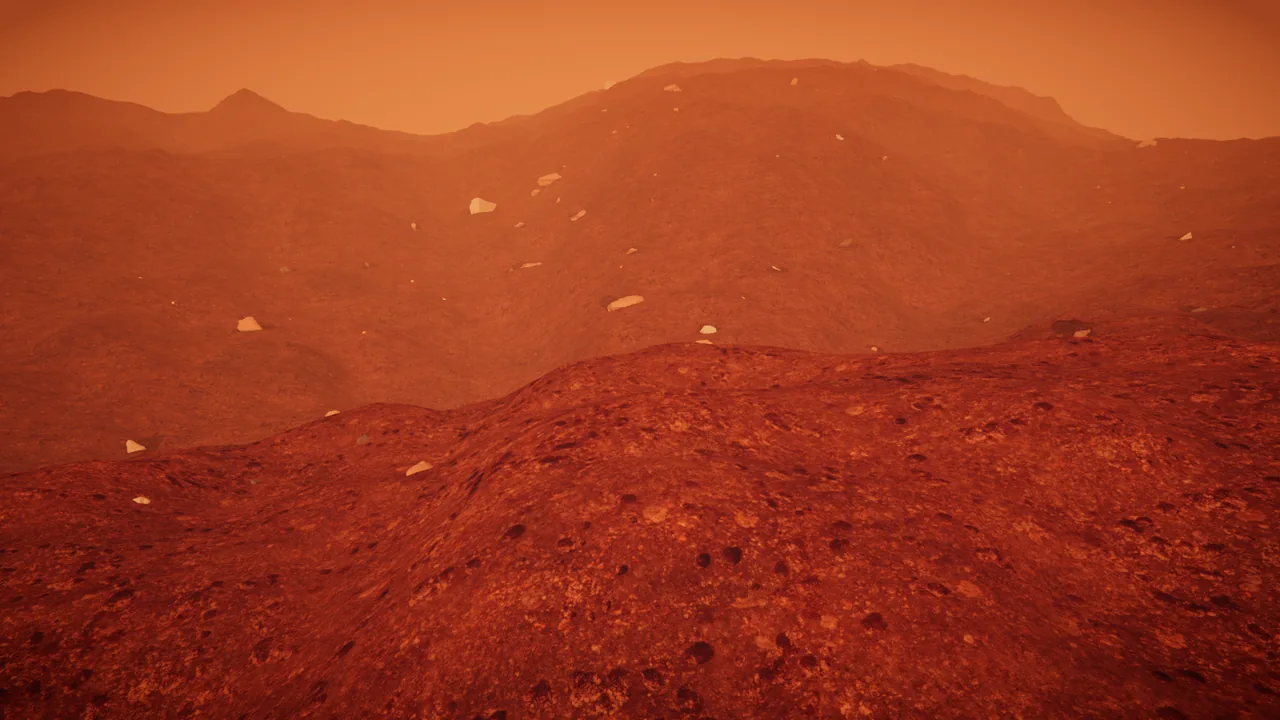
In-game screenshot: ridges, pitted ground and scattered rocks in Mars Rally Championship, sculpted to Martian landforms for the game and not copied from any real place.
Opportunity's stops make a useful ruler for that ground. Eagle crater, at 22 metres, is more than four lengths of the game's 5.0 m rover. Victoria, at about 750 metres, would fit three times across one 2.5 km square. Endeavour, at 22 kilometres, is nearly three times as wide as the game's entire map.
The flatter of the two playable stages is Stage 2, The Long Run: it drops 20 metres in its first 330 metres, then stays within a 9-metre band of height for the rest of its 2,306-metre timed line. That is the nearest the game comes to a Meridiani-style plain, and it is still not Meridiani.
What the game leaves out is Opportunity's whole job. It has no hematite, no blueberries and no layered rock to read. Its three driving surfaces, loose regolith, hardpack lakebed crust and cracked polygon ground, change grip and rolling drag, and a noise pattern, not geology, decides where each one lies. The rover is a fictional 3,000 kg rally machine, about 16 times Opportunity's mass, driven live by a pilot in a pressurized suit rather than planned one sol at a time.
What it keeps is the planet: gravity of 3.72 m/s², about 125 metres to stop from 100 km/h on loose regolith, and dust storms that raise battery drain by 50%, a nod to the dust that silenced Opportunity. Its longest distance achievement, WANDERER III, is set at 150 km, more than three Opportunity odometers, and only finished stage runs count toward it.
Where to try this
- Free roam has no timer and no checkpoints, just a 2.5 km square of sculpted ground to cross. Opportunity needed 32 months to cover its first 9.28 km.
- Stage 2 in a dust storm runs The Long Run's 2,306 metres through a heavy brown haze with the next gate still shining through: the weather that ended Opportunity, in miniature.
- The history of the Mars rover explains how Spirit and Opportunity grew out of a cancelled 2001 Mars lander mission.
- Mars Rally Championship is free in any modern browser, with no download and no account, on a laptop, a school Chromebook or a phone held in landscape.