A Mars rover size comparison runs from a microwave oven to a small SUV. Sojourner, the first rover to drive on Mars, was 65 cm long and 10.6 kg; Spirit and Opportunity were 1.6 m long and 185 kg. Curiosity and Perseverance are about 3 m long, 2.7 m wide and 2.2 m tall, at 899 kg and 1,025 kg, making Perseverance the heaviest rover ever sent to another world. Mars Rally Championship, a free browser rally game, lets you drive a fictional rover longer than all of them and nearly three times Perseverance's mass.
Mars rover size comparison, rover by rover
This Mars rover size comparison covers every rover design that has reached Mars, sorted by mass, plus Europe's Rosalind Franklin, due to land in 2030, and the game's fictional rover. How many rovers are on Mars lists where each one landed and how its mission ended; this table is only about size.
| Rover (agency, year) | Length | Width | Height | Mass | Wheels |
|---|---|---|---|---|---|
| PrOP-M (Soviet Union, 1971) | 21.5 cm | 16 cm | 6 cm | 4.5 kg | None: two skis |
| Sojourner (NASA, 1997) | 65 cm | 48 cm | 30 cm | 10.6 kg | 6 × 13 cm |
| Spirit and Opportunity (NASA, 2004) | 1.6 m | 2.3 m, solar wings spread | 1.5 m, to the mast top | 185 kg each | 6 × 25 cm |
| Zhurong (CNSA, 2021) | 2.6 m | 3.0 m, solar panels spread | 1.85 m | 240 kg | 6 × ≈32 cm |
| Rosalind Franklin (ESA, due 2030) | — | — | ≈2 m, to the mast top | 310 kg | 6 × 28.5 cm |
| Curiosity (NASA, 2012) | 3.0 m, arm not included | 2.7 m | 2.2 m, to the mast top | 899 kg | 6 × 50.8 cm |
| Perseverance (NASA, 2021) | 3.0 m, arm not included | 2.7 m | 2.2 m, to the mast top | 1,025 kg | 6 × 52.6 cm |
| Mars Rally Championship rover (fictional) | 5.0 m body, ≈5.2 m overall | 2.4 m body, ≈3.0 m over the tyres | ≈1.95 m roof, ≈2.1 m mast | 3,000 kg | 4 × 1.1 m, as drawn |
What each measurement includes
Mars rover dimensions depend on what the builder counts. NASA quotes Curiosity's and Perseverance's 3 m length without the 2.1 m robotic arm each carries, and their 2.2 m height to the top of the camera mast. Spirit's and Opportunity's 2.3 m is measured wingtip to wingtip across their solar panels, and Zhurong's 3.0 m is taken with its solar panels spread.
Three entries need a footnote. Sojourner's figures are JPL's; NASA's spacecraft catalogue lists it at 63 × 48 × 28 cm and 10.5 kg, too small a gap to change its place. Zhurong's height and mass are CNSA's, as Xinhua reported them; its footprint comes from secondary reference sources, and its wheel diameter is worked out from the one-metre circumference Xinhua gave. Rosalind Franklin's wheel size comes from engineering papers on its flexible metal wheels, not from an ESA fact sheet. A dash means no figure from the builder could be confirmed.
What is the biggest rover?
Perseverance is the biggest rover ever sent to another world. NASA gives it the same outer dimensions as Curiosity, on a slightly longer chassis, but it weighs 1,025 kg to Curiosity's 899 kg, 126 kg more. Its arm ends in a 45 kg tool turret with a coring drill, and a sample-handling system inside its body seals the cores in tubes, a job Curiosity was never built for.
Guinness World Records lists Perseverance as the largest planetary rover, at 1,026.4 kg against 900 kg for Curiosity. NASA's own figures are 1,025 kg and 899 kg; the two sources differ by about a kilogram on each rover, and this page uses NASA's.
The Moon does not change the answer. The Apollo Lunar Roving Vehicle was a little longer, at 3.1 m, but it was a 210 kg electric buggy built to carry another 490 kg of astronauts and equipment, and the Soviet Lunokhod 2 was about 840 kg. Perseverance outweighs every rover that has driven on another world, and what a space rover is covers the wider family.
Size follows the brief, not the calendar. China's Zhurong landed three months after Perseverance at 240 kg, under a quarter of its mass, and Europe's Rosalind Franklin is designed at 310 kg.
The next step up in size is a rover with a crew inside, and none has left Earth. NASA's Space Exploration Vehicle, a pressurized prototype it built and drove, is about the size of a pickup truck, and the pressurized rover Toyota and JAXA are developing for the Moon was drawn 6.0 m long in its 2019 concept; what a crewed, pressurized Mars rover would need covers both.
How big is a Mars rover compared to a car and a person?
NASA sizes its rovers against household things: Sojourner was the size of a microwave oven, Spirit and Opportunity of a golf cart, Curiosity of a small SUV, and Perseverance is car-sized. JPL's photo of three generations stands two engineers beside Sojourner's flight spare, Marie Curie, a working sibling of Spirit and Opportunity, and a Curiosity-sized test rover.
Against a 1.8 m adult:
- Sojourner's 30 cm reaches mid-shin.
- Spirit's and Opportunity's masts top out at 1.5 m, about shoulder height.
- Zhurong, at 1.85 m, stands 5 cm taller than the person.
- Curiosity's and Perseverance's mast heads, at 2.2 m, clear the person's head by 40 cm.
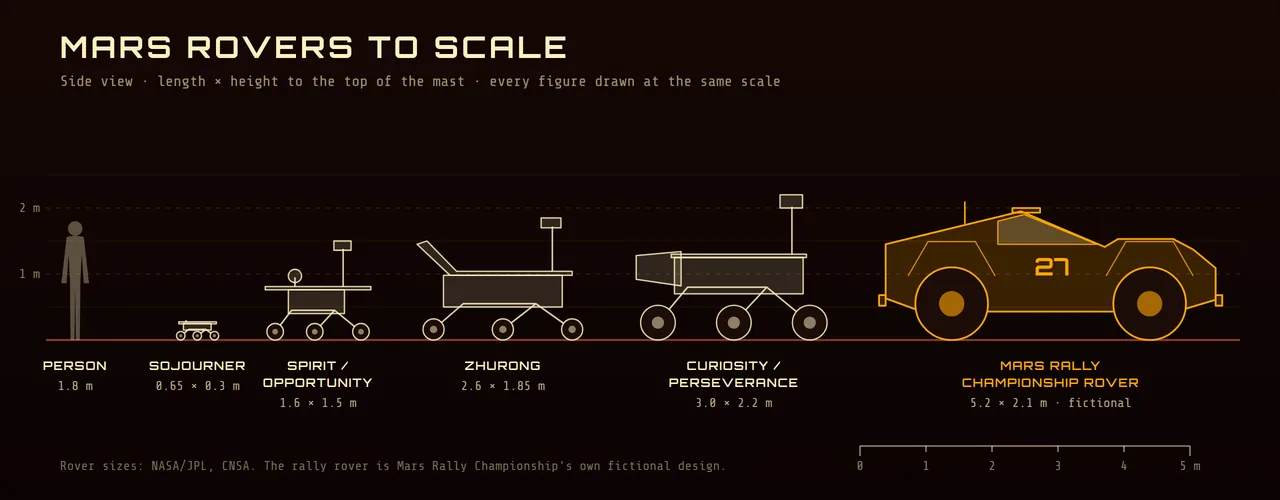
Diagram: NASA's rovers, Zhurong and the game's fictional rally rover drawn side-on to one scale, with a 1.8 m person for reference.
"Car-sized" is only half right. At 3 m long, Perseverance is shorter than most family cars; at 2.7 m wide and 2.2 m tall, it is wider and taller than nearly any of them. It is a box on six wheels, not a car shape.
Mass is not weight, either. Under Mars's 3.72 m/s² of gravity, Perseverance's 1,025 kg presses on the ground about as hard as 390 kg does on Earth.
Perseverance is as close as anything on Mars comes to a car, and whether there is a car on Mars gets a straight answer of its own.
Why Mars rovers got bigger with each generation
NASA's rovers grew because each was asked to do more than the last. JPL's announcement of Curiosity's launch put it plainly: its 10 science instruments have 15 times the mass of Spirit's and Opportunity's science payloads, and to haul and wield them the rover is twice as long and five times as heavy. The history of the Mars rover tells that story mission by mission; three constraints set the rest.
Power. Sojourner and the twins ran on solar panels. Curiosity and Perseverance each carry a radioisotope generator instead: 45 kg and 64 cm across its fins, turning the decay heat of plutonium-238 into about 110 watts at the start of a mission, by day or by night. That is a heavy thing to carry: the generator alone outweighs four Sojourners.
Landing. Pathfinder and the twins bounced to a stop inside airbags. Curiosity was too big and too heavy for that, so JPL built the sky crane: a rocket-powered descent stage that lowered the rover on nylon ropes, cut them and flew off to crash at a safe distance. Perseverance landed the same way.
Running gear. All five NASA rovers ride a springless, six-wheel rocker-bogie suspension, scaled up with each generation, and wheel diameter grew fourfold from Sojourner to Perseverance, 13 cm to 52.6 cm; how Mars rover wheels are built covers the metal.
Size bought capability, not speed. Spirit and Opportunity were rated at 5 cm/s and Perseverance at 4.2 cm/s, and how fast Mars rovers go explains why none of them hurries.
How big is the rover in Mars Rally Championship?
The rover in Mars Rally Championship is bigger than any real Mars rover because it does a different job: it is a fictional, pressurized rally rover with a pilot aboard. Its body is 5.0 m from nose to tail, about 5.2 m over the bash plates and tow hooks, and 2.4 m wide, about 3.0 m across the tyres. The roof apex stands about 1.95 m high and the comms mast about 2.1 m. It weighs 3,000 kg.
Set beside Perseverance, the game rover is about 1.7 times as long and nearly three times as heavy. Its 3.0 m wheelbase alone matches Perseverance's whole length, and eight Sojourners parked nose to tail would span its 5.2 m overall length. Perseverance still stands taller: its mast head is about 10 cm higher than the game rover's comms mast.
The extra size is cabin and kit, not science. A pilot in a white pressurized suit with a copper visor sits in a centre carbon bucket seat with a five-point harness, inside a roll cage. The open rear bay carries two stacked spare wheels, oxygen tanks and the comms mast. The knobby tyres on beadlock rims are drawn 1.1 m tall, twice the height of Perseverance's wheels, on long-travel suspension whose arms and coilovers follow each wheel; the physics rolls them on a 0.45 m radius.
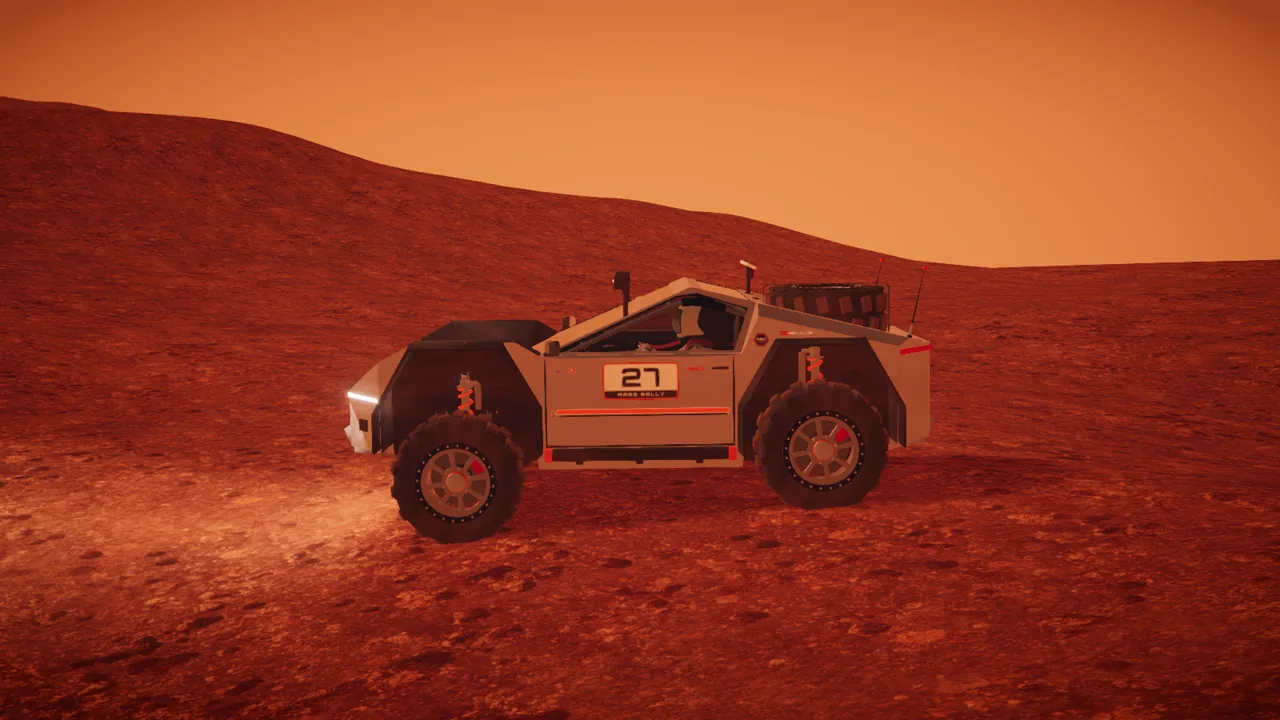
In-game screenshot: Mars Rally Championship's rover side-on, race number 27 on the door, a 5.0 m body over a 3.0 m wheelbase and 1.1 m tyres.
The game leaves out everything that makes a science rover big: no arm, no science instruments, no radioisotope generator. The rover runs on a 90 kWh battery, rolls on four sprung wheels instead of six on a rocker-bogie, and no sky crane ever had to lower it onto Mars. Its looks were rebuilt on 26 September 2026 and its handling was not, so every leaderboard time stands.
What it shares with Perseverance is the planet. Under 3.72 m/s² of gravity its 3,000 kg presses on the ground about as hard as 1,140 kg does on Earth, and loose regolith gives its tyres about 3.1 m/s² of grip, so a stop from 100 km/h takes about 125 m.
Where to try this
- Stage 1, "The Opener" is a 1,164 m timed line. Runs start in the HELMET camera by default, at the pilot's eyes; one press of C, or B on a gamepad, switches to CHASE and puts the whole rover in frame.
- Free roam has no timer and no checkpoints: cycle the 15 cameras with C, out to HELI, and watch a 5 m rover shrink against the terrain.
- The garage changes its paint, rims and brake calipers, but not its size: there is one vehicle and no performance upgrades.
- Mars Rally Championship is free in a browser tab, with no download and no account, on a laptop or a phone held in landscape.