"Mars game" is four different requests wearing one name. Some people want to learn how a real rover works, some want to command a mission, some want to build a colony, and some just want to drive fast on another planet. This guide sorts the field that way and says plainly which titles are free, which run in a browser with no download, and which are paid installs. Mars Rally Championship, a free browser rally game, leads the list below — it is ours, and this is its site.
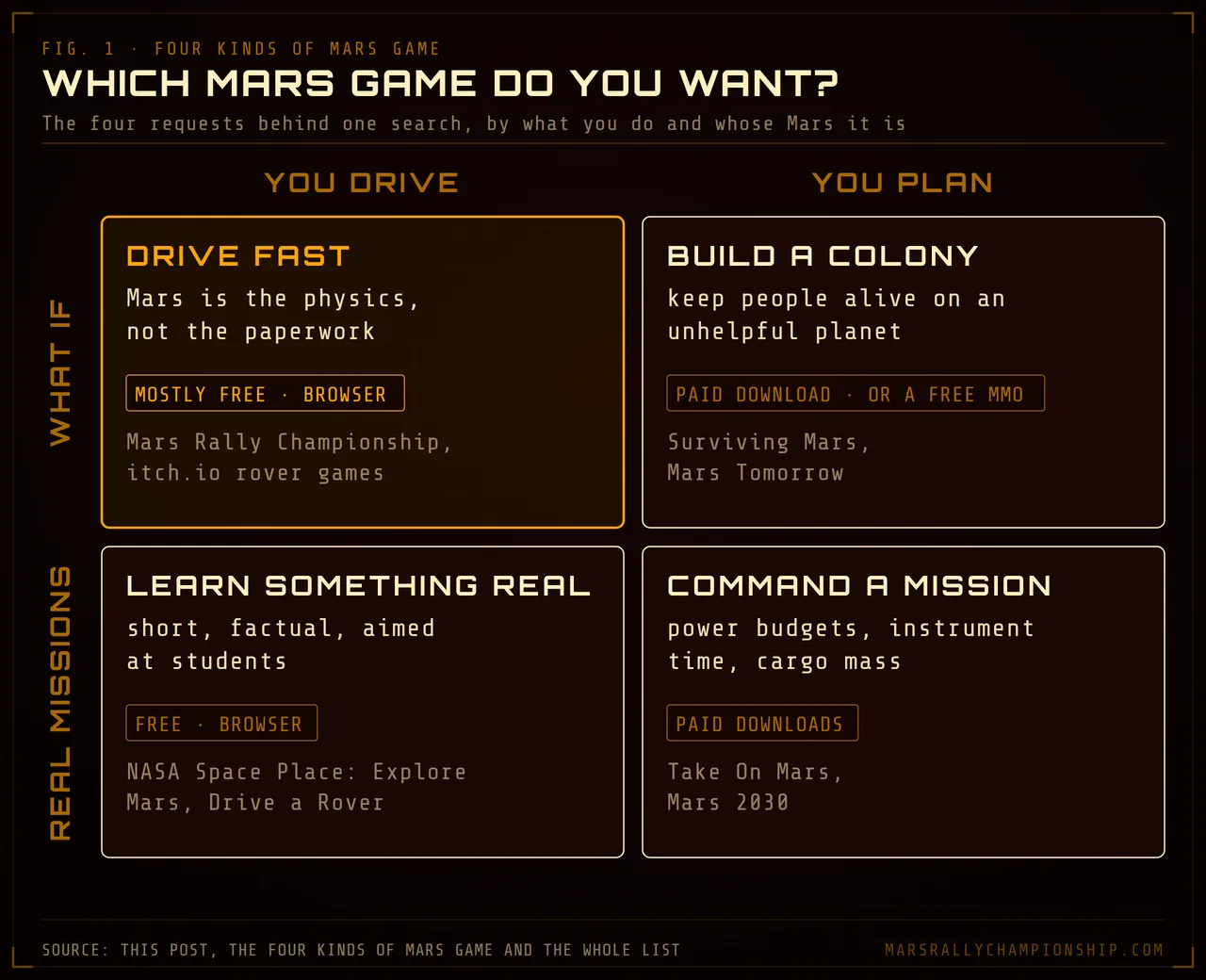
Diagram: the four requests behind one search for Mars games online, with where each kind usually runs and what it costs.
The four kinds of "Mars game", and which one you want
Most "best Mars games" lists mix these four together, which is why they rarely help. Sort by appetite first, then by whether the thing will actually run on the machine in front of you.
- Learn something real. Short, factual browser games and classroom activities, most of them published by NASA. Free, accurate, aimed at students, and deliberately shallow.
- Command a mission. Simulation-heavy titles where the difficulty is planning — power budgets, instrument time, cargo mass, and the consequences of a decision you made three sols ago. Mostly paid downloads.
- Build a colony. Strategy and management games about keeping people alive on a planet that is actively unhelpful. One major paid download, one free browser MMO.
- Drive fast. Driving games where Mars is the physics rather than the paperwork. The smallest category, and the one most likely to be free and browser-based. No real race has been run there yet, and how a car race on Mars would work covers what one would take.
The second filter is practical. A game that needs a 20 GB install and a graphics card is not an option on a school Chromebook or a work laptop, and "free" sometimes means free-to-play with an account, which is a different thing from a page that just loads and plays.
Our game first: Mars Rally Championship
Our game, listed first for that reason. This is Mars Rally Championship's own site; everything below it is sorted by what you actually want from a Mars game.
Mars Rally Championship is a free 3D rally game that runs in the browser with no download, no install, and no account. You drive a pressurised rover against medal times on timed stages, share a stage with up to eight pilots at once, and watch any run on the leaderboard rebuilt from its recorded inputs. It is built with Three.js and installs as a progressive web app if you want it on a phone home screen.
Its Mars is real in the physics and invented in the geography, and the distinction matters. Gravity is 3.72 m/s². Atmospheric density is 0.020 kg/m³, about 1.6% of Earth's, which makes aerodynamic downforce impossible at any speed. Tire friction is modelled on dry basaltic regolith at µ 0.70, plus the soil's own cohesion, so the whole grip budget is roughly 3.1 m/s² for braking, cornering, and throttle combined. Braking from 100 km/h takes about 125 metres, against roughly 52 m for the same tires on Earth gravel. The terrain itself, though, is a hand-sculpted heightmap shaped to Martian morphologies — mesas, crater rims, polygonal ground — not a scan of a real place. Games like Mars 2030 can claim the real landscape; this one claims the real forces.
Three stages are configured and drivable today, listed on the stage page, with more terrain being charted. Stage 3, "The Opener", is a 1,164 m line through 8 checkpoints that drops from 158 m to 93 m of elevation; the gold time is 1:12.8 and the author's is 1:04.0. For the reasoning behind those numbers, there are longer write-ups on what low gravity does to a rally car and what driving on Mars would actually feel like.
Play free — no downloadMars games that teach you something real
NASA publishes the best free factual Mars games, and nearly all of them run in a browser with nothing to install. If you searched for a Mars rover game and expected NASA, you were right to.
NASA Space Place: Explore Mars
NASA Space Place hosts Explore Mars: A Mars Rover Game, a short browser coding game built for younger players. You pick a rock, program a sequence of commands that sends the rover to it, include a command to analyze it, and score points for each new rock you study. You plan the drive rather than steer it live, which is closer to how real rover driving works than any racing game will be. It is free, needs no account, and finishes in a few minutes. Space Place is NASA's site for elementary-age learners, so the reading level and the session length are both pitched low on purpose.
NASA and JPL have also published browser interactives that are not quite games but scratch the same itch — the best known lets you move Curiosity around Gale Crater in terrain reconstructed from orbital surveys. That is a genuine distinction worth knowing about when a game claims realism: some Mars landscapes come off a spacecraft, and most do not. Our guide to Mars rover simulator games takes those NASA tools one at a time, Experience Curiosity and Explore with Perseverance among them, and sorts the paid rover games by what each one actually simulates.
JPL's coding and engineering activities
JPL Education hosts the classroom end of the category: block-coding projects, lesson plans tied to live missions, and build-and-test engineering exercises. These are free, aligned to curriculum standards, and written for teachers rather than for players. Treat them as teaching material with a game-shaped surface rather than as something a twelve-year-old picks on a Saturday.
Mars games where you command a mission
Mission games are the opposite trade: far more depth, far more friction. Every one of the notable ones is a download, and they are paid releases rather than free browser titles.
Take On Mars
Take On Mars, from Bohemia Interactive, begins with you as a remote operator — landers and rovers, instrument choices, power to budget, and science returned as the score. Later content moves toward crewed exploration and survival. It is a PC download and a commercial release, and it is the closest thing on this list to running an unmanned programme rather than starring in one.
Mars 2030
Mars 2030 is an exploration experience developed with input from NASA, set in Valles Marineris, with a landscape derived from orbital survey measurements rather than sculpted by hand. You explore on foot and by rover. It is a download, it leans toward presence and sightseeing rather than challenge, and availability of releases this old changes — check the storefront before planning an evening around it.
Mars games where you build a colony
Colony games are the most crowded Mars category, because the subject matter — closed life support, thin air, supply lines measured in months — is naturally a management problem.
Surviving Mars
Surviving Mars is a colony-management city builder. You land drones before people, raise domes, and balance oxygen, water, power, food, and the mental health of colonists who did not fully read the brochure. It is a paid download available on PC and consoles, and it is the safest recommendation in this guide for anyone who already likes city builders. The 2018 original is no longer sold: since November 2025 the version on sale is Surviving Mars: Relaunched, one of the paid picks in our list of games set on Mars, sorted by genre.
Mars Tomorrow
Mars Tomorrow is a free browser MMO about terraforming, and it is the one genuinely large free Mars game that needs no install. Players share a single persistent Mars, run vehicles and facilities, trade with each other, and move planet-wide numbers like temperature and atmospheric pressure over weeks of real time. It runs in a browser, but it expects an account and a long-term habit — it is a strategy MMO, not something you finish in a lunch break.
Mars games where you just drive fast on Mars
Mars Rally Championship, covered first above, is the main entry on this shelf; the itch.io entries below are the rest of it.
This is the thinnest shelf. Mars is a popular setting for management and exploration and a rare one for driving, which is odd, because 3.72 m/s² of gravity changes a car more than it changes a spreadsheet.
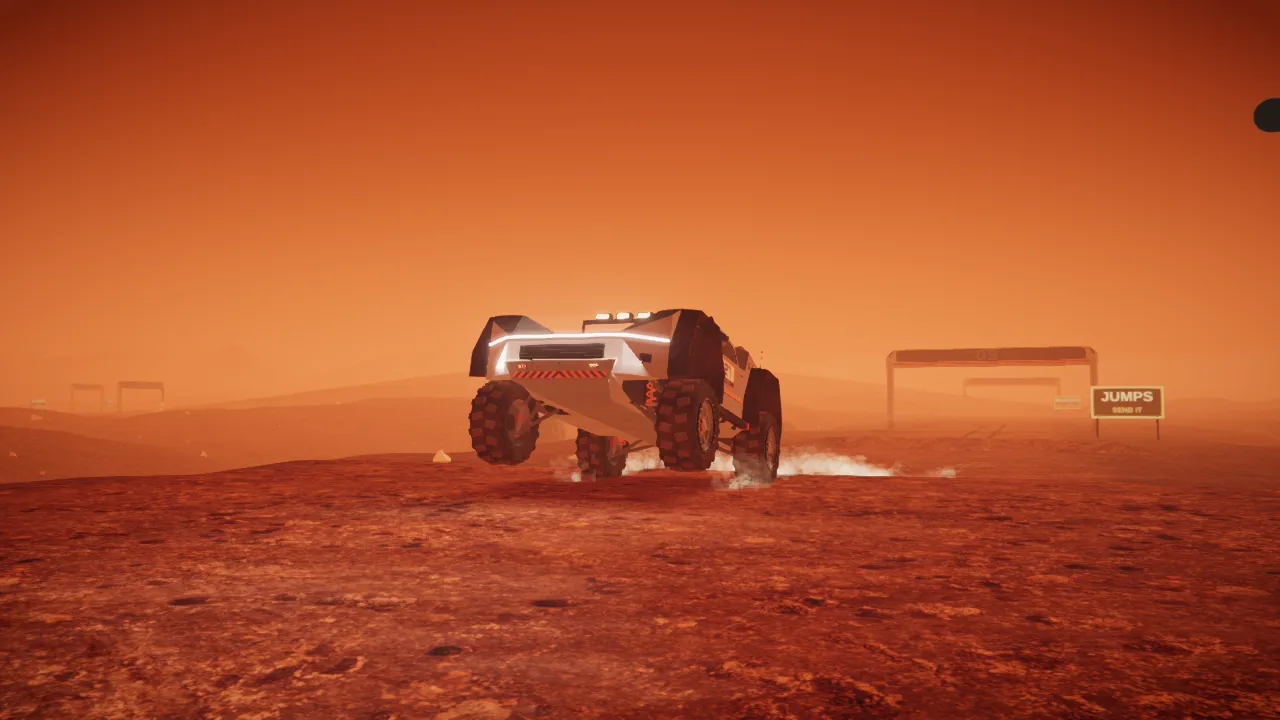
In-game screenshot: at 0.38 g the rover hangs over the Proving Ground tabletop far longer than a car would on Earth.
Rover-driving entries on itch.io
itch.io is where the rest of the Mars driving games live: jam entries, student projects, and one-developer experiments, many of them free and playable in the browser via WebGL. Quality is unpredictable and pages go stale, but the hit rate on "small rover, big hill, thirty minutes of fun" is better than the storefronts suggest. Search the platform for rover and Mars tags and expect to close a few tabs. For driving with no clock on any map, our free-roam driving games guide compares open cities, endless roads and off-road maps you can play in a browser.
Free or paid, browser or download: the whole list
Prices and store availability change, so the cost column says what kind of thing a title is rather than what it charges today.
| Game | What you want | Cost | Where it runs | Who it is for |
|---|---|---|---|---|
| Mars Rally Championship Play | Drive fast | Free, no account | Browser (PWA) | Racing and rally players |
| NASA Space Place: Explore Mars | Learn something real | Free | Browser | Younger kids, classrooms |
| JPL education activities | Learn something real | Free | Browser and offline | Teachers, students |
| Take On Mars | Command a mission | Store purchase | Download (PC) | Simulation players |
| Mars 2030 | Command a mission | Store purchase | Download (PC, VR) | Explorers, space nerds |
| Surviving Mars | Build a colony | Store purchase | Download (PC, console) | City-builder players |
| Mars Tomorrow | Build a colony | Free to play, account needed | Browser | Long-game strategy players |
| itch.io rover games | Drive fast | Mostly free | Browser or small download | Experimenters |
Four of the eight entries need no payment and no install: NASA's two, Mars Tomorrow, and Mars Rally Championship. That is the practical answer to "Mars games no download". Of those four, only NASA's titles and Mars Rally Championship also skip the account, which is the difference between reading a sign-up form and driving within about ten seconds of a page load.
What "realistic Mars" actually means in a game
"Realistic" gets used for at least three different claims, and they are worth separating before you trust one.
Real geography means the landscape was built from orbital survey measurements of an actual place — Gale Crater, Valles Marineris, Jezero. NASA's own interactives do this, and Mars 2030 does it. It is the rarest form of realism and the easiest to verify.
Real physics means the simulation uses Martian constants rather than Earth ones: gravity at 3.72 m/s² instead of 9.81, atmospheric density near 0.020 kg/m³, and surface friction chosen for regolith instead of asphalt. This is what Mars Rally Championship does, and it is what changes how a vehicle behaves — long braking distances, wide minimum corner radii, no downforce, and airtime that lasts long enough to be a tactical decision.
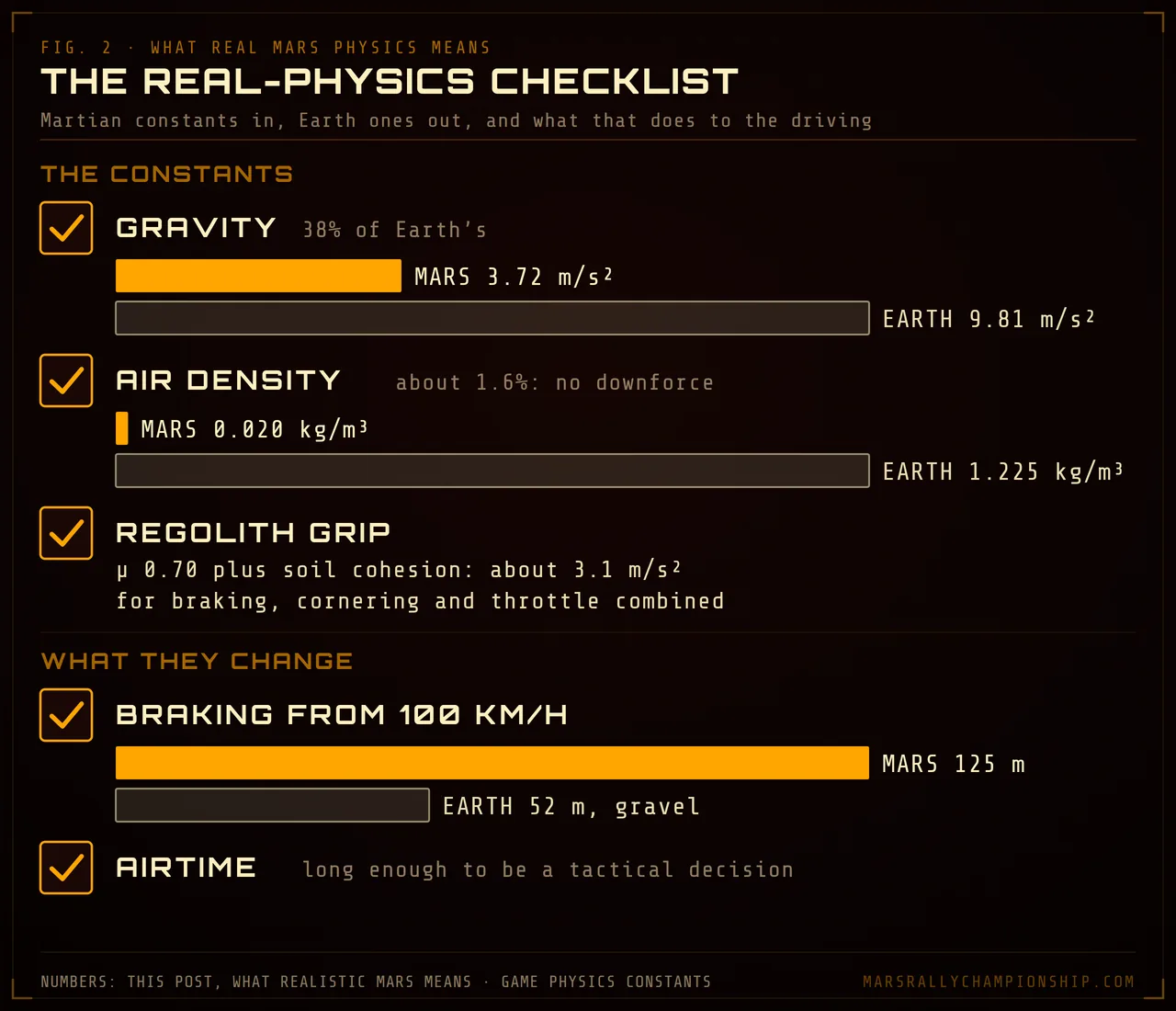
Diagram: the constants a game has to change before it can claim Martian physics, and what they do to the driving: long stops, no downforce, long airtime.
Real weather and sky is the third, and it is mostly set dressing that occasionally becomes a mechanic. Mars Rally Championship's storm variant holds a full dust storm from the start to the finish, thickening fog 7.5-fold into a heavy brown haze and raising battery drain by 50% as the panels are obscured, which is a fair sketch of what real Martian dust storms do to solar power. At night the sky renders stars and both Martian moons, drawn larger and quicker than life so they read on screen; the real pair is stranger than most people expect — there is a separate piece on what Phobos and Deimos look like from the surface.
A game can have any one of these without the others, and most have exactly one. Knowing which one a title is selling saves a lot of disappointment.
Where to start
Pick by the appetite you came in with. If you want the science and you have a few minutes, start with NASA's browser games. If you want a week-long project, Surviving Mars or Mars Tomorrow. If you want to drive, that part is free and instant.
- Start driving — Mars Rally Championship, no download, no install, no account.
- Run the tutorial first — the Proving Ground, nineteen lessons, and it teaches the 125 m braking distance before a stage does.
- Browse the stages — what is open, what is being built.
- About the project — what this is, and who built it.