From the surface of Mars, Phobos looks like a small grey disc roughly a third the width of the full Moon seen from Earth, and Deimos looks like a very bright star. Phobos is only about 22 kilometres across, but it orbits about 6,000 kilometres above the ground, close enough to show a visible disc, to cast a faint shadow, and to cross the sky in a few hours — rising in the west. Deimos is smaller and more than three times farther away, so it stays a point of light. Mars Rally Championship, a free browser rally game, renders both of them in its night sky.
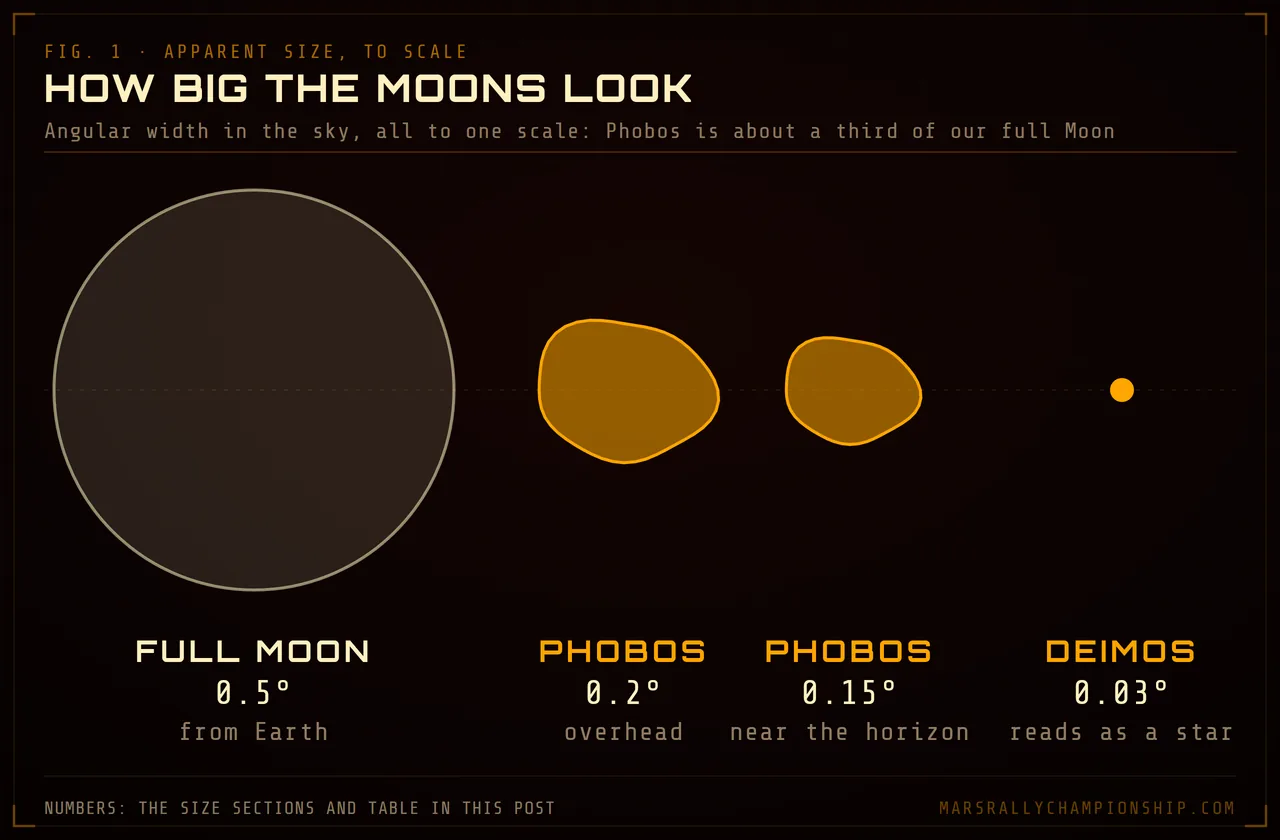
Diagram: overhead, Phobos spans about 0.2°, a third of our full Moon; Deimos, at 0.03°, reads as a bright star.
Phobos is tiny, but it is very close
Apparent size is a ratio, not a size. Phobos wins on the denominator.
The mean diameter of Phobos is about 22 kilometres — a body you could drive the long way across in an afternoon if the gravity let you. What makes it a moon rather than a rumour is that it orbits at roughly 9,400 kilometres from the centre of Mars, which puts it only about 6,000 kilometres above your head. Divide one by the other and Phobos spans about 0.2 degrees when it is directly overhead, shrinking to roughly 0.15 degrees down near the horizon where it is farther away.
Our own full Moon covers about 0.5 degrees, so Phobos is roughly a third of the width of the Moon you already know — a golf ball held at twelve metres. That is far past the one arcminute of detail the eye can resolve, so there is no ambiguity: it is a disc, and a visibly lumpy one. Phobos measures about 27 × 22 × 18 kilometres, and that irregular profile shows against the stars.
It is also dark. Phobos reflects about 7% of the light that reaches it, and that sunlight is already down to roughly 43% of what Earth gets. Small disc times dark surface times weak sun leaves a full Phobos delivering a few percent of the light a full Moon gives Earth — still comfortably the brightest object in the Martian night, and enough to throw a faint shadow of your rover onto the regolith. NASA's Phobos overview has the physical numbers.
Deimos reads as a very bright star
Deimos is the moon most people forget, and from the ground it earns that. Its mean diameter is about 12.4 kilometres and it orbits some 23,500 kilometres from the centre of Mars — roughly 20,000 kilometres up, more than three times as far out as Phobos.
That works out to an apparent width of about 2 arcminutes, near enough a fifteenth of the full Moon's, which sits right at the edge of what the eye can resolve. So Deimos does not read as a moon at all. It reads as a star that is much too bright to be a star: roughly comparable to Venus at its best from Earth, a hard white-grey point that does not twinkle. NASA's Deimos overview has the orbital elements.
Phobos rises in the west, and does it twice a day
Here is the part that would actually unsettle a visitor. Not the size of the moons — the direction they travel.
Mars turns on its axis once every 24 hours 37 minutes. Phobos completes an orbit in 7 hours 39 minutes, more than three times faster. It is orbiting below the areostationary altitude — the roughly 17,000-kilometre radius where an orbit would take exactly one Martian day — so instead of the ground overtaking the moon, the moon overtakes the ground. Relative to a rock you are standing on, Phobos runs backwards: it rises in the west, crosses the sky in a little over four hours, and sets in the east. Then it comes round again. A given spot on Mars sees Phobos rise about twice per Martian day. That Martian day, sunrise to sunrise, runs 24 hours 39 minutes 35 seconds, a little longer than the 24 hours 37 minutes of one turn against the stars; how long a day on Mars is explains the gap.
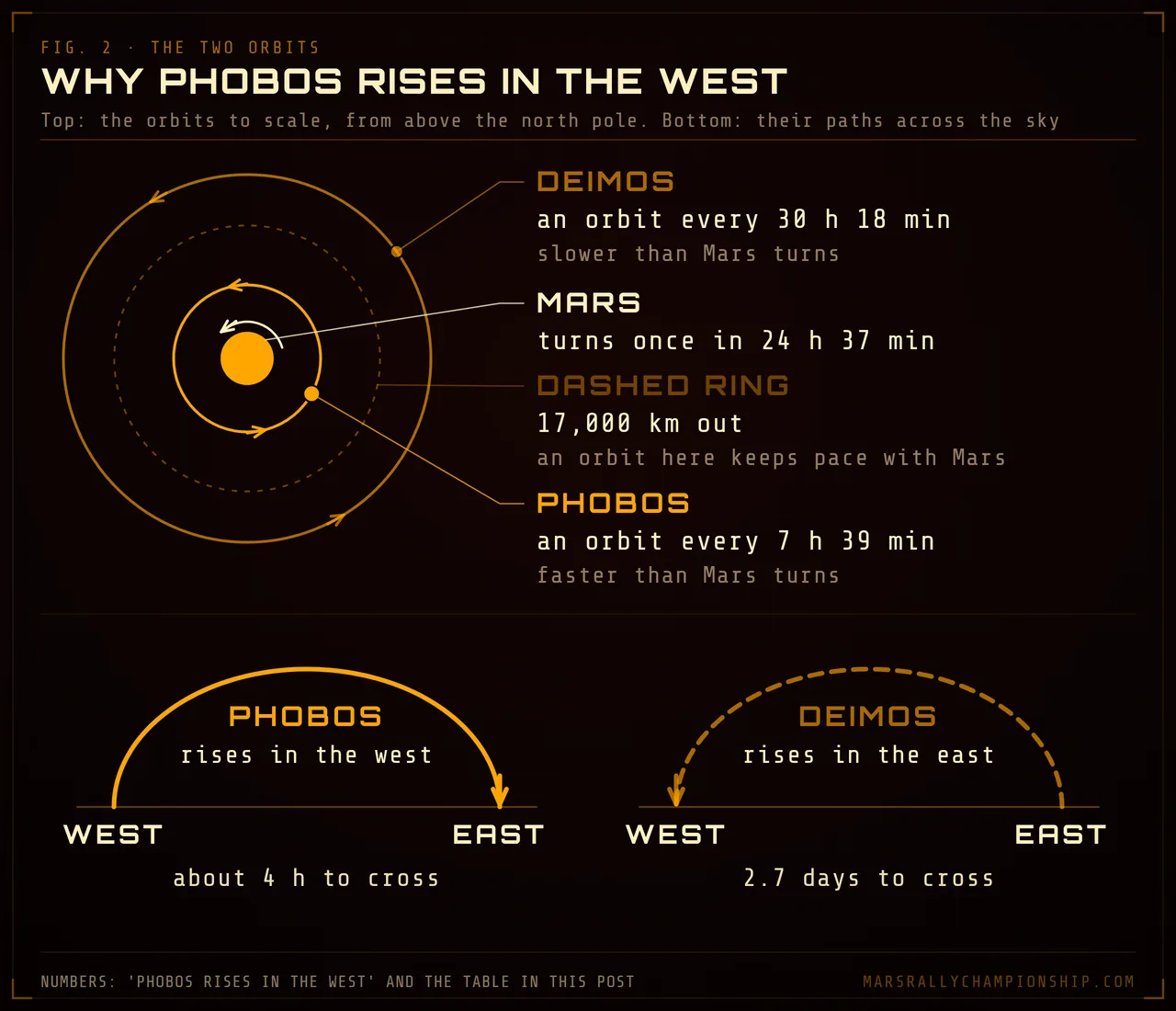
Diagram: Phobos orbits in 7 h 39 min, faster than Mars turns, so it rises in the west; Deimos, at 30 h 18 min, rises in the east.
Because the sun-moon-observer geometry changes so fast, Phobos also runs through most of its cycle of phases during a single pass: a crescent at moonrise can be gibbous by the time it is overhead. Our Moon takes a month to do what Phobos does between the start of a shift and lunch.
Deimos does the opposite, slowly. Its 30-hour-18-minute orbit is slightly longer than a Martian day, so it loses a small race against the rotating planet each turn. It rises in the east and sets in the west, the ordinary way, but so gradually that one crossing takes roughly 2.7 days. Deimos is less an event than a fixture: a bright point that drifts a little and is still there tomorrow night.
One more consequence of both moons orbiting almost exactly in the Martian equatorial plane: from high enough latitude, they never come up at all. Phobos stays permanently below the horizon above about 70 degrees north or south, Deimos above about 82 degrees. A polar base on Mars has no moons.
Phobos vs Deimos, side by side
| Phobos | Deimos | Earth's Moon | |
|---|---|---|---|
| Mean diameter | ~22 km (27 × 22 × 18) | ~12.4 km | 3,475 km |
| Height above the surface | ~6,000 km | ~20,000 km | ~378,000 km |
| Orbital period | 7 h 39 min | 30 h 18 min | 27.3 days |
| Apparent width from the ground | ~0.2° (about a third of our Moon) | ~0.03° (starlike point) | ~0.5° |
| Rises in the | west | east | east |
| Rise to set | ~4 hours, about twice a day | ~2.7 days | ~12 hours |
Every figure above is approximate, and the apparent sizes are position-dependent: a moon overhead is closer than a moon near the horizon, and Phobos is close enough for that to matter by about a third.
There are no total eclipses on Mars, only transits
Mars has two moons and never gets a proper solar eclipse out of either. The Sun seen from Mars is about 21 arcminutes across — roughly two-thirds of its apparent width from Earth, because Mars sits about 1.5 times farther out. Phobos, at 12 arcminutes at its best, is simply not big enough to cover it.
What you get instead is a transit: a dark, potato-shaped silhouette sliding across the solar disc for about 30 seconds, taking a real bite out of the light without ever blacking it out. The sky dims the way it does when thin cloud crosses the sun on Earth, and then it is over. Deimos transits are less dramatic still — a small dot crossing an already-small sun.
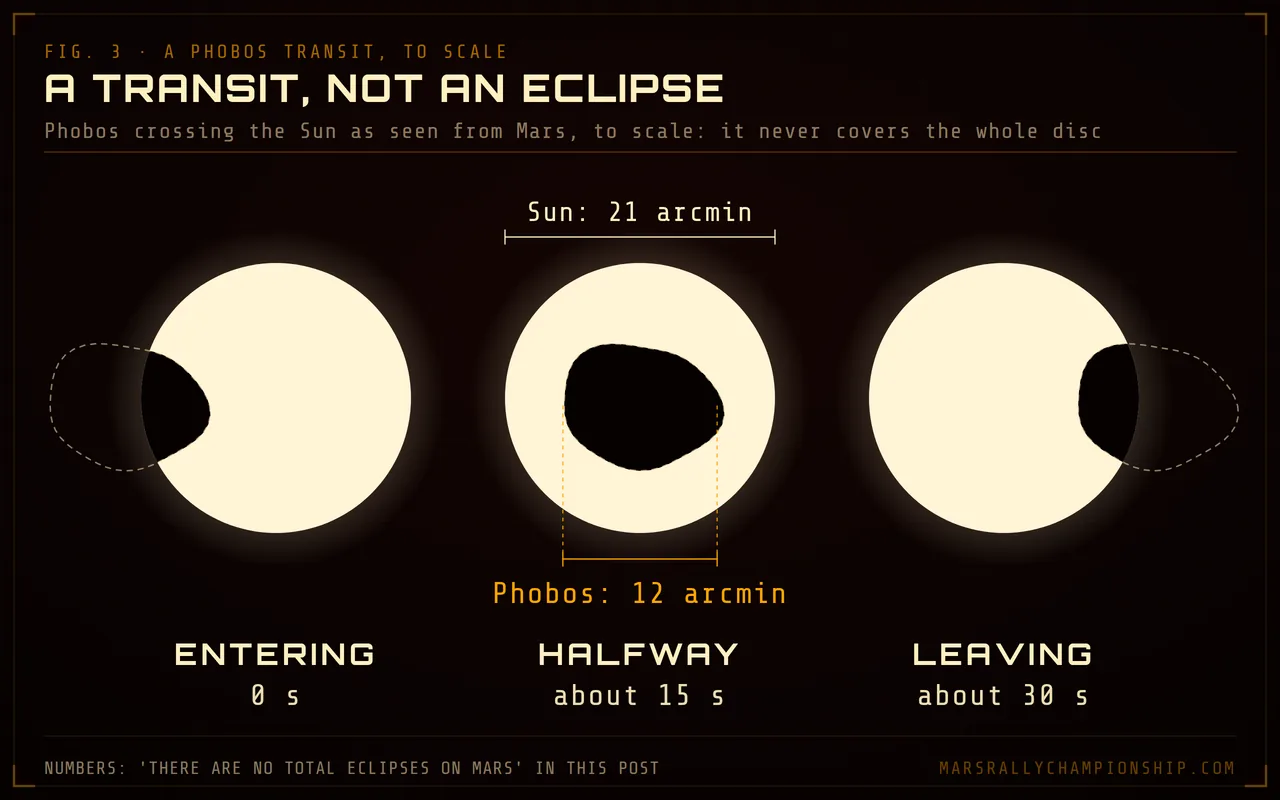
Diagram: Phobos, at most 12 arcminutes wide against a 21 arcminute Sun, can only take a bite out of the light; a crossing lasts about 30 seconds.
Rovers have photographed all of this from the ground. Spirit, Opportunity and Curiosity each caught Phobos transits, and in April 2022 Perseverance filmed one with Mastcam-Z. These are not postcards: timing exactly when a transit starts and ends measures where Phobos really is, which is one of the ways its orbit is tracked over decades. Mars also gets true eclipses in the other direction, when the moons pass through the planet's shadow. Perseverance's clip is genuine footage from the Martian surface; footage from Mars lists the other real videos and sounds, from its landing to Ingenuity's flights, with dates and where to watch them.
Phobos is on its way down
The tracking matters because Phobos is not in a stable orbit. It circles below the areostationary radius, so the tides it raises on Mars pull it backwards rather than pushing it forward, and it is spiralling inward at roughly 1.8 centimetres a year — about two metres per century.
That is slow enough to be irrelevant to anyone reading this and fast enough to be terminal. Within the next tens of millions of years Phobos is expected to cross the Roche limit, where Martian tides exceed whatever strength holds it together. Whether it becomes a debris ring or an impact depends on how strong the moon actually is, and the evidence is not encouraging: radio tracking during ESA Mars Express flybys measured a bulk density near 1.86 g/cm³, implying an interior roughly a quarter to a third empty space. Rubble piles do not land intact.
Deimos, orbiting outside the synchronous radius, is drifting slowly away instead — the same thing our Moon is doing to us.
What the night sky looks like in Mars Rally Championship
Mars Rally Championship runs four sun presets — sunrise, day, sunset and night — and the night one is the reason this post exists. At night the sky renders stars, the Milky Way, and both moons on a virtual dome, each on a tilted circular path: Phobos on roughly a 6-hour period in game time with a 26-degree tilt, Deimos on roughly 24 hours at 22 degrees. Real Mars runs 7 h 39 min and 30 h 18 min, so the game is close rather than exact. The sunset preset is looser still: a hand-graded palette with a painted steel-blue halo, held up against the real thing in why sunsets on Mars are blue.
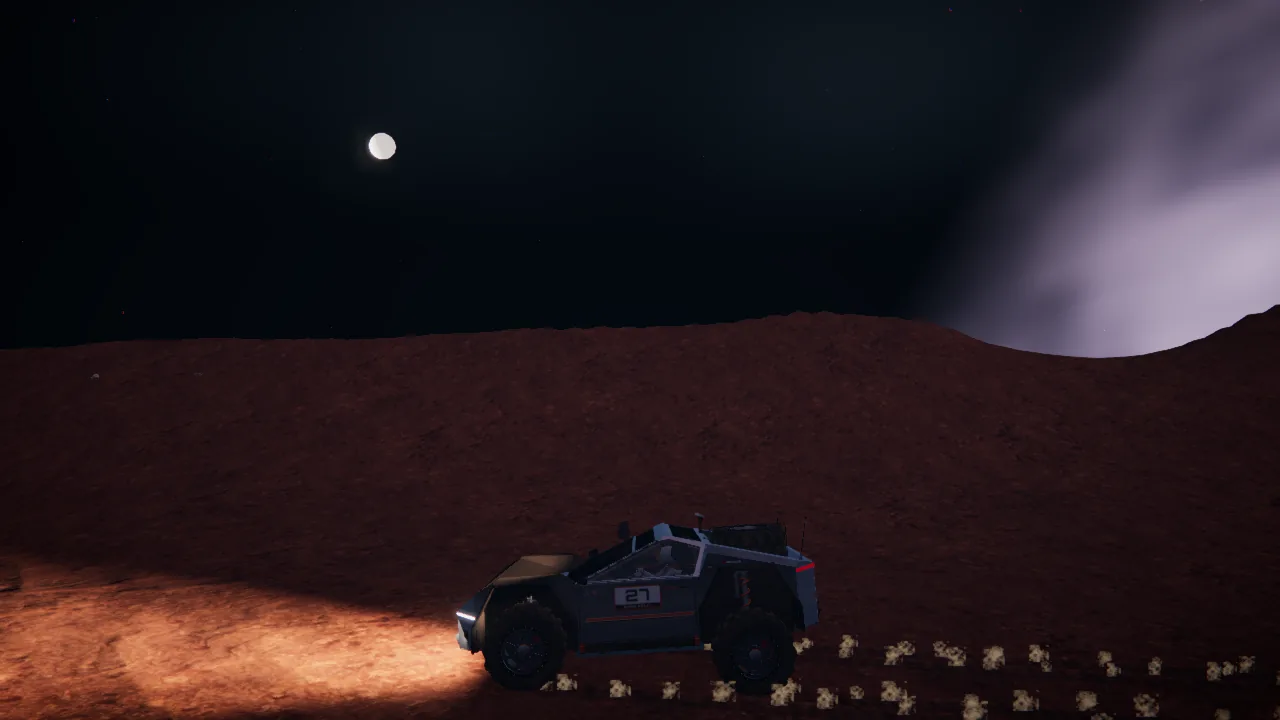
In-game screenshot: Phobos over Stage 2 at night. The game draws it about four times its true angular size so it reads on screen.
Both moons share a small custom rim shader that reads the same sun-direction value the sky itself uses, so the lit and dark hemispheres always agree with the stage's sun: drive a sunset stage and the crescent points where it should. Two honest caveats. The in-game Phobos is drawn about 0.86 degrees across, roughly four times its true angular size, because a correctly sized disc is a speck on a screen at arm's length. And at night the drift is multiplied by about twelve, so a full Phobos circuit takes around half an hour of play — still rising, crossing and setting continuously, never teleporting.
You do not choose the sky. The daily challenge seeds a stage and a sun preset from the date, identically for every player, and night comes up on about 26% of days (against 32% sunrise, 30% day, 12% sunset). Roughly one day in four, everyone racing that seed is racing under Phobos. The exception is Stage 1, The Eight, a 2,676 m loop driven at night, with the stars, the Milky Way and both moons in the sky. There is a hidden achievement, NIGHT OWL, for winning a night daily — one of five hidden entries covered in the achievements guide.
Night is not day with the lights off. It stacks with the same fog and dust systems described in Mars dust storms explained, and the driving underneath is unchanged: 3.72 m/s² of gravity, about 125 metres to stop from 100 km/h, and the rest of the constants in what it is like to drive on Mars. The sky is real astronomy, approximated where it had to be. The terrain is a hand-sculpted heightmap shaped to Martian morphologies, not a survey of a real place. The two moons were a game setting long before this one: the original Doom set its first two episodes on Phobos and Deimos, as our guide to games set on Mars notes.
Where to see it
- Today's daily challenge — one seeded stage and sky for everyone; check the daily challenge page to see what came up.
- Your pilot dossier tracks hidden achievements, NIGHT OWL included, against your local profile.
- The best Mars games online, if the planet rather than the racing is the draw.
- Mars Rally Championship is free, runs in a browser tab with no download and no account, and works on a laptop, a phone or a school Chromebook.