Mars atmosphere density at the surface is about 0.020 kg/m³, against 1.225 kg/m³ at sea level on Earth — roughly 1.6%. Every aerodynamic force scales directly with that number, so downforce on Mars is impossible at any speed: a rear wing worth 12,250 N of load on Earth is worth about 200 N on Mars. Drag nearly disappears with it. In Mars Rally Championship, a free browser rally game, that means mechanical grip from the tires is all you will ever have, and lifting off the throttle barely slows you down.
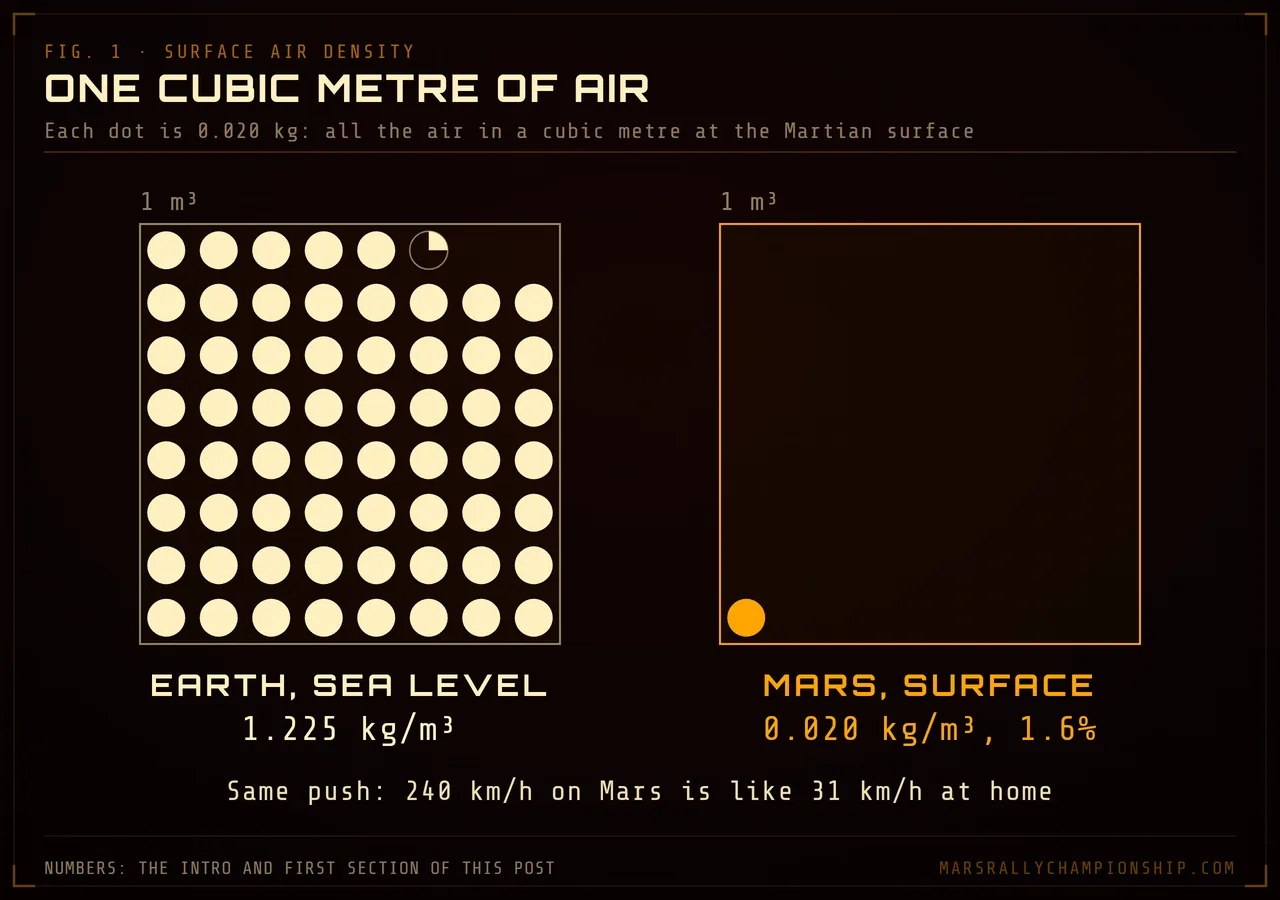
Diagram: a cubic metre of Martian surface air holds 0.020 kg, about 1.6% of the 1.225 kg in the same box at Earth's sea level.
Every aerodynamic force scales with the same number
Aerodynamic forces all come from dynamic pressure, q = ½ρv², where ρ is air density and v is speed. Downforce is q × Cl × A; drag is q × Cd × A. Between planets the wing does not change and the car does not change — only ρ and v do. As NASA's Beginner's Guide to Aeronautics puts it: halve the density and you halve every aerodynamic force at the same speed.
Mars gives you about 1.6% of the density. NASA's Mars Fact Sheet puts mean surface density near 0.020 kg/m³ and mean surface pressure near 6 millibars — about 0.6% of Earth's — in an atmosphere roughly 95% carbon dioxide.
The two percentages differ because density depends on temperature and molecular weight, not pressure alone. Martian air is very cold and mostly carbon dioxide, heavier per mole than Earth's nitrogen and oxygen, and both effects raise density for a given pressure.
The cleanest way to feel the number: reaching Earth's dynamic pressure on Mars takes √(1.225 / 0.020) ≈ 7.8 times the speed. Run it backwards and the game's 240 km/h clamp — 66.67 m/s — is aerodynamically equivalent to about 31 km/h at home. Flat out on Mars, the air pushes about as hard as it does on a slow bicycle here.
What a wing would actually do on Mars
Assume a serious Earth-style rear wing with Cl × A = 4.5 m² — a large, well-loaded element, not a decorative spoiler. Bolt it to the rover in Mars Rally Championship, mass 3,000 kg, and compare both planets at 240 km/h, using the game's own drag figure of about 0.02 m/s² and scaling the Earth column by the density ratio.
| At 240 km/h (66.67 m/s) | Earth | Mars | Mars ÷ Earth |
|---|---|---|---|
| Air density ρ | 1.225 kg/m³ | 0.020 kg/m³ | 1.6% |
| Dynamic pressure q = ½ρv² | ≈2,722 Pa | ≈44 Pa | 1.6% |
| Downforce, identical wing (Cl·A = 4.5 m²) | ≈12,250 N | ≈200 N | 1.6% |
| That downforce as a share of the car's weight | ≈42% | ≈1.8% | — |
| Aero drag deceleration, same body | ≈1.2 m/s² | ≈0.02 m/s² | 1.6% |
| Rolling resistance (Crr 0.040) | ≈0.39 m/s² | ≈0.15 m/s² | 38% |
Read the downforce row twice. On Earth that wing adds 12,250 N to a car weighing 29,430 N — 42% more load pressing the tires down, for free. On Mars it adds 200 N to a rover weighing 11,160 N under 3.72 m/s² of gravity. Multiply by the tire friction coefficient of 0.70 and you gain roughly 0.05 m/s² of grip against a 3.1 m/s² budget: under 2%, inside the noise of whichever surface you are on.
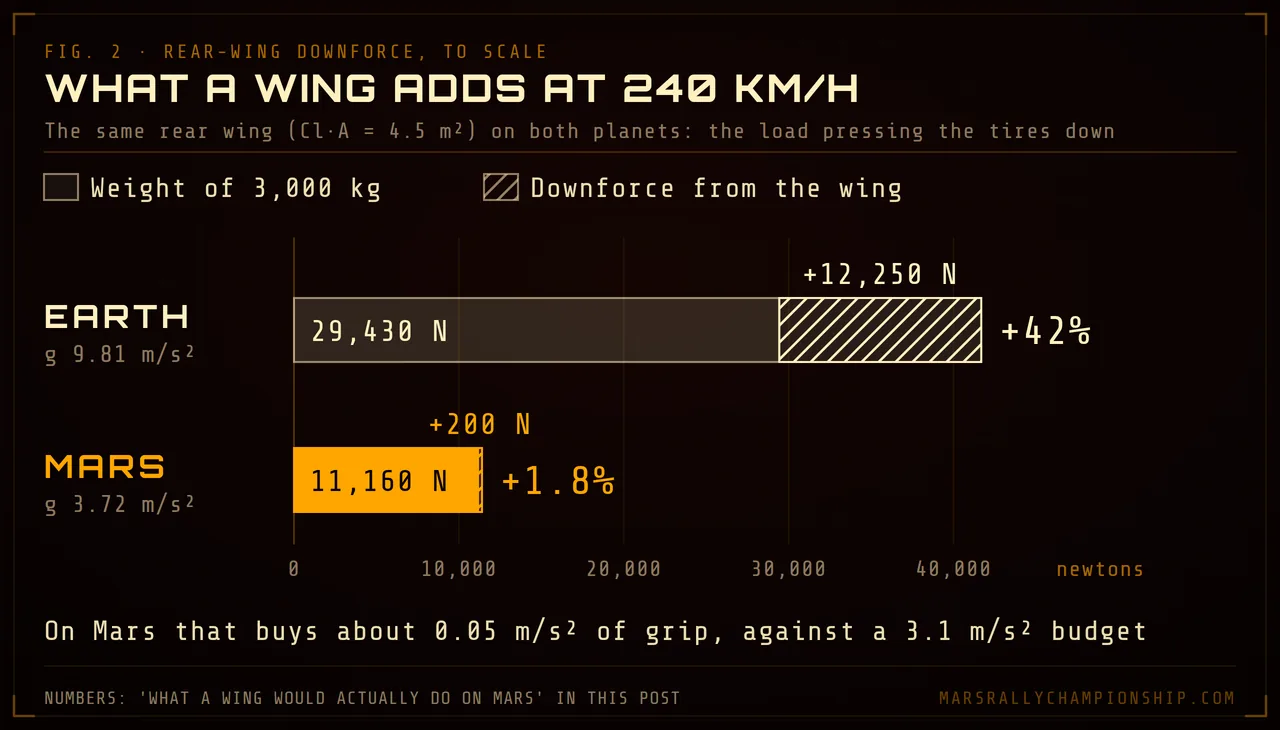
Diagram: at 240 km/h the same wing adds 42% to the load on the tires on Earth and 1.8% on Mars, about 0.05 m/s² of grip.
Note the last row too. Rolling resistance scales with gravity rather than density, so it only falls to 38% of its Earth value — about seven times larger than aerodynamic drag at top speed. The force that usually matters least is the one left standing.
No downforce means the fast line is long and low
All you have on Mars is mechanical grip: friction coefficient 0.70 times gravity 3.72 m/s², plus about 0.48 m/s² of soil cohesion, a budget of about 3.1 m/s² shared between braking, cornering and acceleration. The structural point is that this budget is flat. An aero car on Earth gets grippier the faster it goes, because downforce climbs with v². The rover in Mars Rally Championship has exactly the same 3.1 m/s² at 40 km/h as at 240 km/h.
That reshapes the racing line. Braking from 100 km/h takes about 125 m and roughly 9 seconds, against about 52 m for the same tires on Earth gravel, so a late-braking lunge is not a move — it is a missed checkpoint. Minimum corner radius at 100 km/h is about 250 m, and no wing is coming to rescue a corner you entered too fast. That compounds what Mars gravity does to rally driving, and it is why braking distance is the first thing new pilots get wrong.
So the fast line is long, low arcs: enter early, hold one steady radius, spend no grip you did not have to. Stage 3, "The Opener" — a 1,164 m timed line with 8 checkpoints, descending from 158 m to 93 m — pays far better for a smooth arc than for any single heroic brake.
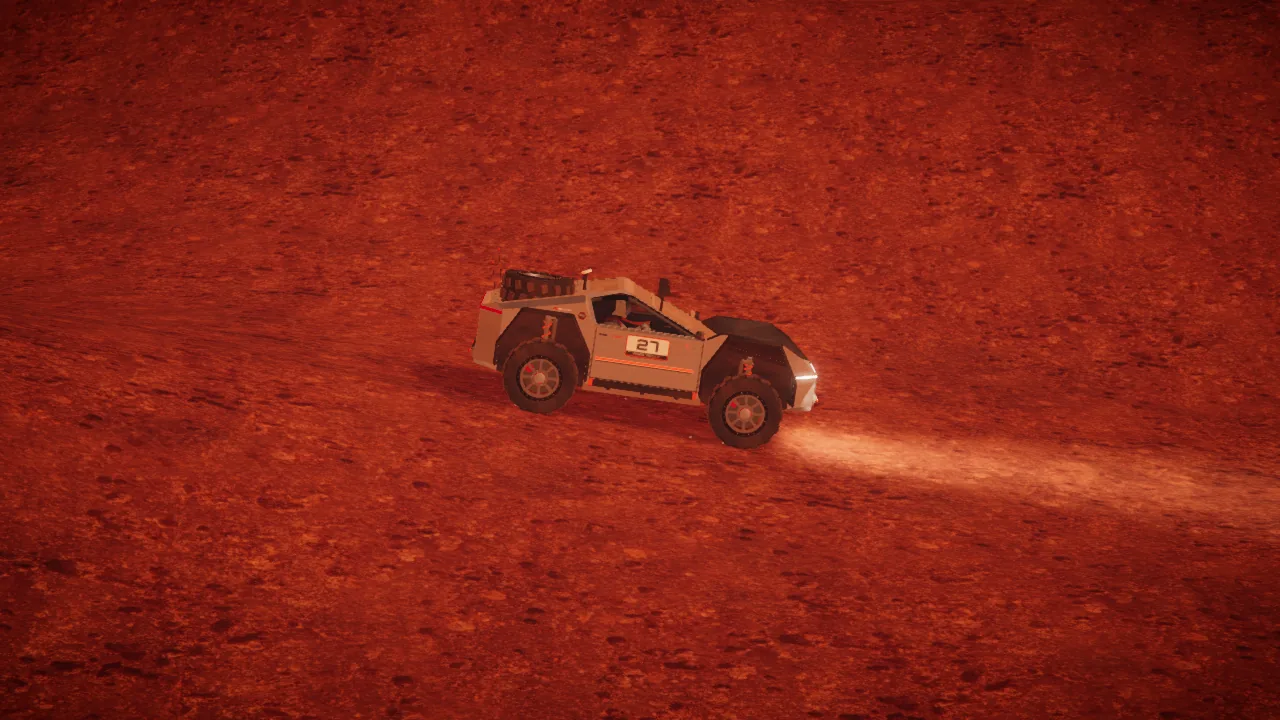
In-game screenshot: a long lens on Stage 3, The Opener, shows the rover holding one steady arc with every wheel on the ground.
Drag nearly vanishes, which changes what lifting off means
Aerodynamic drag on Mars at 240 km/h is about 0.02 m/s². Rolling resistance, a coefficient of 0.040 against 3.72 m/s² of gravity, is about 0.15 m/s². Lift off at top speed and those two together give you roughly 0.17 m/s² of passive deceleration.
Work it through. Shedding 10 km/h — 2.8 m/s — on coast alone takes about 16 seconds and a bit over a kilometre of ground. The same car on Earth, with drag at 1.2 m/s² and rolling resistance at 0.39 m/s², sheds that 10 km/h in under two seconds and a little over 100 m. Lifting off is a real input on Earth. On Mars it is closer to a suggestion. You can time it in free roam: get up to speed on loose, level ground, lift off, and see whether the speed readout takes roughly a quarter of a minute to shed 10 km/h, as the sums above predict, rather than two seconds.
Regenerative braking is therefore the only meaningful free deceleration you have. The rover's regen peaks at 150 kW; if the motor takes all of it at 66.67 m/s, P/v gives about 2,250 N, which on 3,000 kg is roughly 0.75 m/s² — about 37 times what the atmosphere contributes at the same speed.
Thin air also makes top speed a gearing and traction problem rather than a drag problem: the rover's acceleration is set by grip rather than power all the way to 100 km/h, and its 240 km/h clamp exists because the atmosphere was never going to impose one.
The same physics is why flying on Mars is so hard
A rotor is a wing that goes in circles, so it obeys the same q = ½ρv². Making lift in 1.6%-density air demands enormous blade area, extreme tip speed, or both — and NASA's Ingenuity Mars Helicopter is the finished worked example of what that costs.
Ingenuity weighed about 1.8 kg — roughly 6.7 N of weight to overcome on Mars. Lifting it took two counter-rotating rotors spanning about 1.2 m, turning near 2,400 rpm, around five times the rotor speed of a comparable Earth helicopter. It worked: 72 flights over nearly three years, until rotor damage ended the mission in January 2024. The ratio is the lesson. A machine the size of a tissue box needed rotors that big, that fast, to lift itself off the ground. Air that can barely hold two kilograms up will not press three tonnes down.
If the air is that thin, how are there dust storms?
Mars has global dust storms anyway, and the reason is not force per particle — it is speed, particle size and time. Winds in a major storm reach roughly 100 km/h, but at 0.020 kg/m³ that is only about 8 Pa of dynamic pressure, the same push as a 13 km/h breeze on Earth. NASA's explainer on the fact and fiction of Martian dust storms notes that such a storm would feel like a light breeze and could not tip a rocket over.
What thin air is good at is keeping small things aloft. Martian dust grains are a few micrometres across, and under 3.72 m/s² of gravity a particle that light settles extraordinarily slowly once a dust devil or a saltating sand grain lifts it. Weak forces on very light particles, sustained for weeks across a planet, make a storm that goes global while still unable to push a car sideways — a mechanism with its own post.
Mars Rally Championship models storms the honest way. Its storm variant runs at full strength for the whole stage, driving fog density from 0.004 to 0.03, 7.5 times thicker: a heavy brown haze that hides 95% of the view by about 100 metres, though the gate you are driving to still shines through. Ambient dust rises 2.2× and battery drain 50% as the panels are obscured. It never shoves the rover, because a few pascals against 3,000 kg would be a lie. A storm costs you sight and energy, not grip.
Where to try this
The quickest way to feel a planet with no aerodynamics is to drive one. Mars Rally Championship runs in the browser, with no download and no account, on a laptop, a school Chromebook or a phone held in landscape.
- Play now — the game starts driving straight away.
- Stage 3, "The Opener" — 1,164 m and 8 checkpoints, the stage that teaches the long arc.
- Ghost racing — race your best run's ghost, or watch a replay rebuilt bit-exact from your inputs, and see where the coasting phases diverge.
- What it is like to drive on Mars — the whole sensation, not just the aerodynamic half.