A rocker-bogie is the passive six-wheel linkage every Mars rover has used since Sojourner in 1997. It has no springs and no dampers. Each side of the vehicle carries a rocker arm; one end holds a rear wheel, the other pivots on a smaller bogie carrying two more. The two rockers are joined through a differential, so the chassis pitches at roughly the average of the two sides and all six wheels stay loaded on badly broken ground. Mars Rally Championship, a free browser rally game, borrows exactly one idea from it.
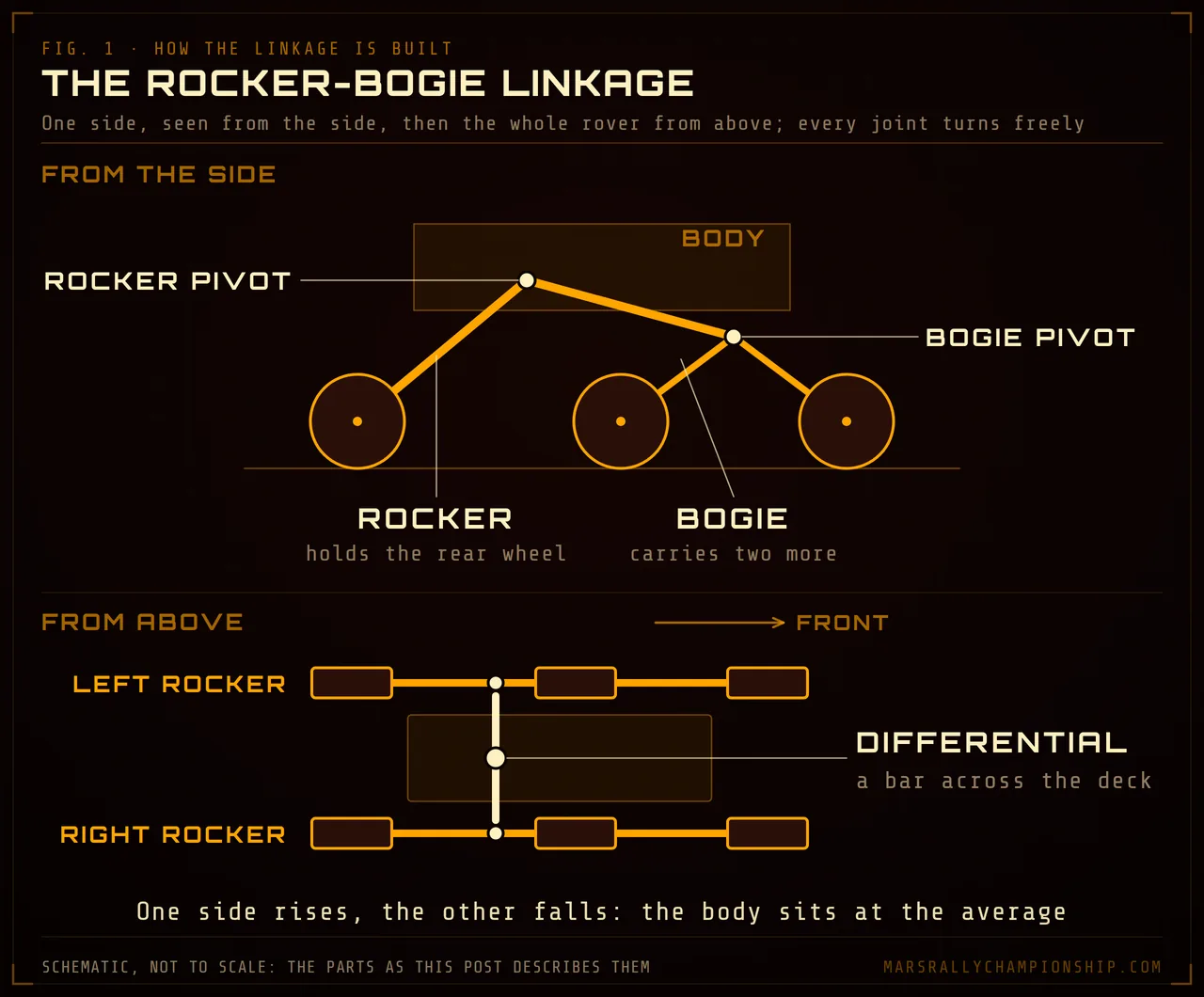
Diagram: each rocker holds a rear wheel and a bogie with two more; the differential bar across the deck makes the body sit at the average of both sides.
What a rocker-bogie suspension actually is
A rocker-bogie is a linkage, not a spring system. Each side of the rover carries a rocker: a beam pivoted on the chassis. The rear end of that beam holds one wheel. The front end holds a second pivot — the bogie — a shorter beam with a wheel at each end. Three wheels per side, six in total, and every joint is free to rotate.
Nothing holds those joints at a preferred angle. Drive the front wheel onto a rock and the bogie rotates about its pivot: that wheel rises, the middle wheel stays planted, the rocker absorbs the rest. Travel comes out of geometry instead of deflection, which is why a rocker-bogie is drawn as arms and pivots rather than coils and shocks.
Donald Bickler worked the linkage out at NASA's Jet Propulsion Laboratory and patented it in 1989; the history of the Mars rover follows it from his scale model to Perseverance.
The differential is the part people miss
Two independent rockers would let the body follow whichever side was having the worse time. They are not independent: left and right are tied together through a differential — visible as a bar across the top deck on Curiosity and Perseverance — which holds the body at roughly the average of the two rocker angles.
That averaging buys two things. The chassis pitches about half as much as either side, so the mast, antenna and science instruments stay closer to level while the wheels do the work. And because no joint can lock, load keeps redistributing across six contact patches instead of piling onto two.
Keeping every wheel loaded matters more than ride quality
Traction at one wheel is µ·N: the friction coefficient times the force pressing that wheel into the ground. A wheel carrying no load produces no drive force at all, however good the tire or the motor behind it. Every rover wheel has its own motor, so an unloaded wheel is a motor contributing nothing while the others cover its share.
A rigid four-wheel chassis does exactly that: put one corner on a boulder and the diagonally opposite wheel goes light. Rally drivers live with it because speed and momentum bail them out. A rover has neither.
The margin is thin to begin with. Mars surface gravity is 3.72 m/s², about 38% of Earth's, so every wheel presses into the regolith with 38% of the force it would at home. Losing a contact patch costs a quarter of an already small number, in a place where getting stuck ends the mission: Spirit finished its working life embedded in soft soil it could not drive out of.
Why springs would be the wrong answer at four centimetres per second
Springs and dampers exist to manage energy that arrives fast: a car hitting a kerb at 100 km/h dumps a large impulse into one corner in milliseconds, and the spring, damper and tire sidewall share the work of spreading that spike out. A rover moving at four centimetres per second takes 25 seconds to cross a metre. Nothing arrives fast. There is no impact to absorb, no wheel hop to damp, no unsprung-mass resonance to chase and nobody aboard to keep comfortable.
What a spring would add instead is stiffness, which is actively unhelpful here. A sprung wheel pushes back harder the further it deflects, and that reaction lifts load off the other wheels — precisely the failure the linkage exists to avoid. A rocker-bogie redistributes load geometrically rather than elastically, keeping all six wheels near-even by construction rather than by tuning.
Then there is the part that decides missions. A passive linkage is a short parts list: pivots, bearings, bogies. No fluid to leak, no valve to clog with dust, no elastomer to embrittle through Martian nights, no spring to fatigue, and nothing to service, because nobody is coming to service it. Opportunity landed in 2004 with a 90-day primary mission, drove more than 45 kilometres, and sent its last transmission in 2018. Its suspension was not what stopped it; a planet-scale dust storm was.
The design rule: an obstacle about twice a wheel diameter
The classic figure engineers quote for a rocker-bogie is that it can climb an obstacle roughly twice its wheel diameter. Curiosity's wheels are half a metre across, putting the geometric limit near a metre. NASA's published operational figure is more conservative — about 65 cm — because the design limit assumes ideal traction and no risk appetite, and a real drive plan has both.
The climb happens as a sequence rather than a single event. Because no spring forces the front wheel into the face of the rock, the bogie rotates and lifts it while the middle and rear wheels stay down and push. The middle wheel climbs next while front and rear provide traction, and the rear wheel climbs last while the two ahead of it pull. At no point does the rover depend on a single contact patch, or pitch through the full angle of the obstacle.
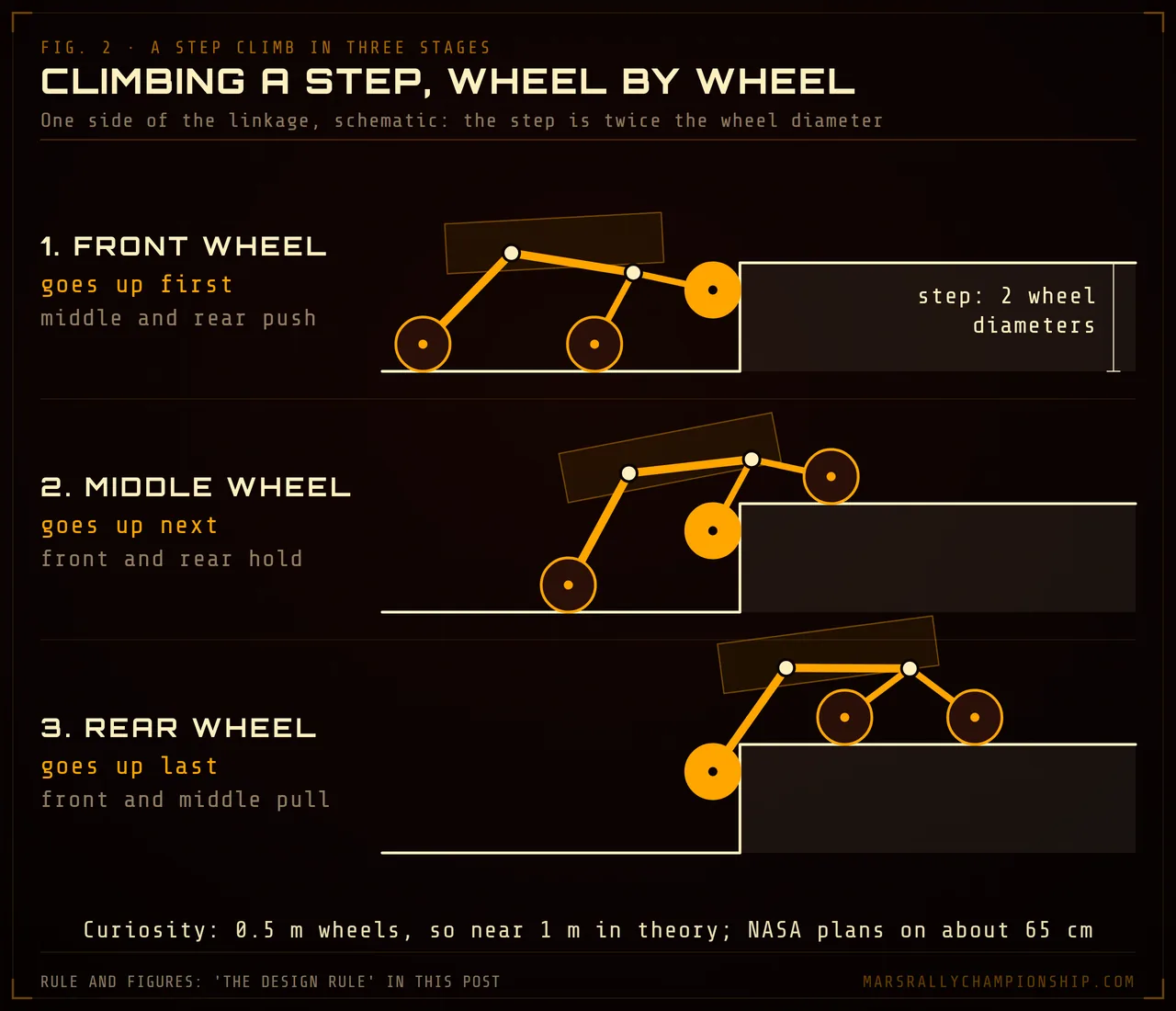
Diagram: the front wheel climbs first, then the middle, then the rear, so two wheels always hold the ground; the step is twice the wheel diameter.
Four rovers, one architecture
The architecture has scaled by two orders of magnitude in mass without changing in principle. Sojourner was a microwave-sized technology demonstration; Perseverance is a one-tonne mobile laboratory. Both run the same linkage. Five NASA rovers have used it, and two are still driving; how many rovers are on Mars lists all eight that have reached the surface, from the Soviet PrOP-Ms of 1971 to China's Zhurong.
| Rover (mission) | Wheels | Suspension | Mass | Top speed |
|---|---|---|---|---|
| Sojourner (Mars Pathfinder, 1997) | 6 | Rocker-bogie, passive | ≈11 kg | ≈1 cm/s |
| Spirit and Opportunity (MER, 2004) | 6 | Rocker-bogie, passive | 185 kg | ≈5 cm/s |
| Curiosity (MSL, 2012) | 6 | Rocker-bogie, passive | 899 kg | ≈4 cm/s |
| Perseverance (Mars 2020, 2021) | 6 | Rocker-bogie, passive, redesigned wheels | 1,025 kg | ≈4.2 cm/s |
| Mars Rally Championship rover | 4 | Sprung, per-wheel spring and damper | 3,000 kg | 66.7 m/s (240 km/h) |
The real rovers' top speeds are ratings for flat, hard ground, and their actual drives run slower; how fast Mars rovers go has every rover's record single-day drive and lifetime distance.
What changed between missions was mostly the wheels. Curiosity's aluminium wheels began showing holes and torn skin in 2013, punctured by sharp embedded rocks on wind-scoured bedrock nobody had driven before. JPL answered with route planning that avoids the sharpest terrain, a traction-control algorithm that modulates wheel speeds so wheels stop dragging each other across rock, and a redesign: Perseverance's wheels are narrower and slightly larger in diameter, with thicker skin and twice as many gently curved treads in place of Curiosity's chevron grousers. The wheels themselves, from the Morse-code holes to the broken grousers and the redesign in numbers, are covered in how Mars rover wheels are built, and why Curiosity's have holes.
Note what did not change: no springs were added. The fix for wheel damage was better wheels and better driving, not a softer suspension.
What a Mars rally rover borrows from a rocker-bogie
Very little, architecturally, and it is worth being blunt. The vehicle in Mars Rally Championship is a four-wheeled, sprung, 3,000 kg rally rover with a 0.45 m wheel radius and a 240 km/h speed clamp. It is not a rocker-bogie, and no differential is averaging anything between rocker arms. It is a race car that happens to be on Mars. The physical problem, though, turns up anyway, and it turns up because of the same 3.72 m/s² that makes the real rovers' job hard.
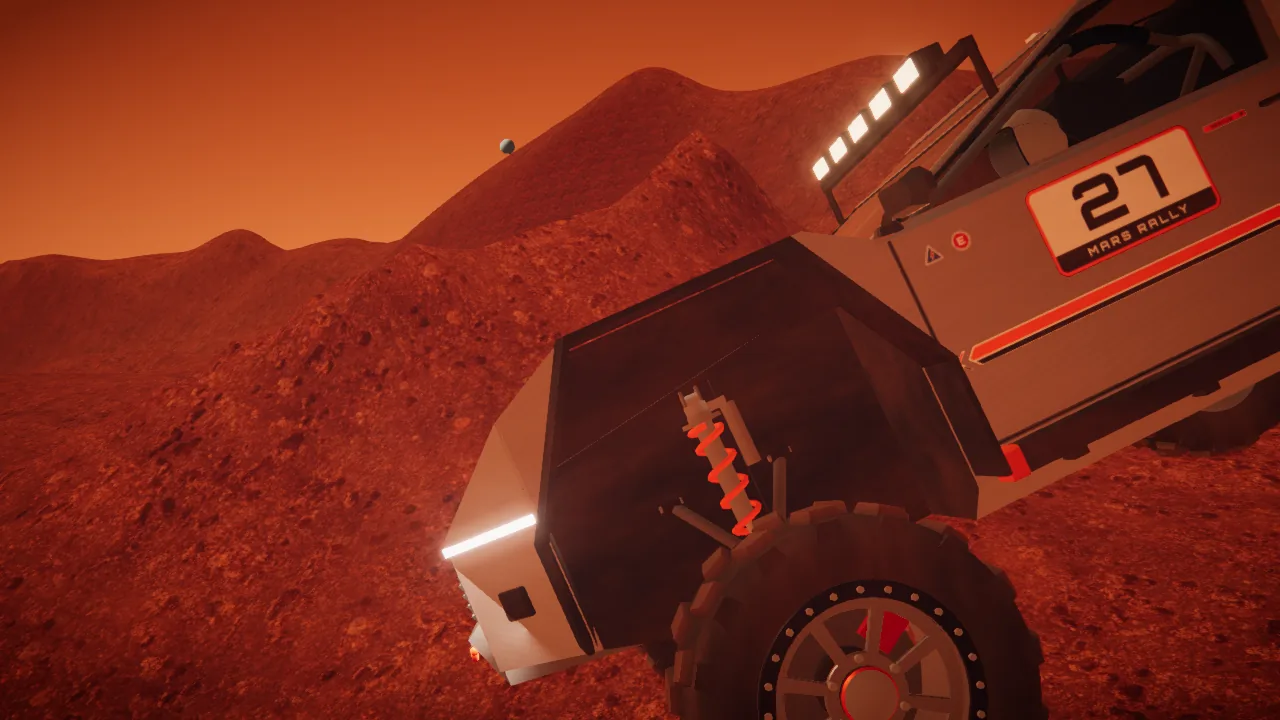
In-game screenshot: the game's rover rides on sprung double wishbones and a coilover at each corner, here at full travel. It is not a rocker-bogie.
Drive a sprung chassis over a crest at speed on Mars and the ground falls away faster than gravity can pull the body after it. On Earth, 9.81 m/s² keeps the chassis on a descending slope far longer. At 38% of that, the wheels hang over every crest, and everything that depends on contact — drive torque, braking, steering — switches off at the moment you wanted it. The car floats, lands, floats again.
The fix is a soft attractive contact spring. Wheels hovering within a short band above the terrain still get a weak downward pull toward the ground — stiffness SOFT_CONTACT_K 30 — which closes the gap and keeps tire forces live across the crest. The comment beside it in the physics config says what it is modelled on in as many words: active rocker-bogie reach, real rover wheels extending downward to track falling terrain. One paragraph of spacecraft engineering informing one constant in a game loop.
The three things that keep the hack honest
It is bounded. The soft spring acts only in a narrow band beyond normal suspension travel. Inside that travel the ordinary contact spring owns the dynamics, so body pitch and squat still play out naturally instead of being flattened by an invisible magnet.
It switches off for jumps. If the chassis is climbing away from the terrain faster than a velocity threshold, the spring is disabled entirely. A crest produces a small relative velocity and the spring fires; a deliberate ramp launch produces a large one and the arc stays purely ballistic. Losing low-gravity flight would be a poor trade — how high you can jump on Mars covers what that arc looks like. The Proving Ground has a jump lesson where you can watch that arc for yourself.
It does not manufacture grip. A wheel in the soft band contributes no spring force to the tire model. Forces still come from the per-wheel Pacejka-style tire model running at 480 Hz, against the same ≈3.1 m/s² grip budget as every other wheel. The soft spring changes where the chassis is, not how much traction it has.
What the game does not simulate is everything else on this page: passive load equalisation across six wheels, a differential averaging two rocker angles, obstacle climbing at twice a wheel diameter, or a suspension with no springs in it. Damage is modelled per corner, and a destroyed suspension multiplies grip by 0.40 — a spring system failing, not a linkage.
Where to try this
- Free roam — no timer, no checkpoints. Drive at the crests deliberately and watch the rover track a falling slope instead of skipping down it, then find a ramp and confirm the jump still goes ballistic.
- Stage 3, "The Opener" — a 1,164 m timed line descending from 158 m to 93 m elevation: 65 metres of falling ground, and most of the behaviour described above.
- What it is like to drive on Mars covers the surfaces real rovers cross; how Mars gravity changes rally driving works through the 3.72 m/s² consequences in full.
- Mars Rally Championship is free and runs at /play in any modern browser — no download, no account, and it works on a school Chromebook or a phone in landscape.