There is no car on Mars in the everyday sense, and nobody has ever been there to drive one. Six robotic rovers have driven on Mars, and two of them, NASA's car-sized Curiosity and Perseverance, are still working as of September 2026. Elon Musk's Tesla Roadster, launched in 2018, never reached Mars: it orbits the Sun, and its first close pass, in October 2020, was about 7.4 million km from the planet. Mars Rally Championship, a free browser rally game, lets you drive a fictional pressurized rover on a simulated Mars instead.
Is there a car on Mars, or only rovers?
Only rovers. People who look up a car on Mars, or a car in Mars, usually want one of three things: the rovers, the only vehicles that have driven there; Elon Musk's Tesla, which is not there; or whether an ordinary car could cope. The rovers are robots, with no seat, no steering wheel and nobody aboard: engineers on Earth plan each day's drive, and the rover carries it out on its own.
Could an ordinary car work on Mars?
No. A petrol or diesel engine needs oxygen, and the air there is about 95% carbon dioxide at under 1% of Earth's surface pressure, according to NASA's Mars fact sheet. An electric car solves only that: its cooling still needs air to shed heat into, its tyres and battery would suffer at an average of about −60 °C, and its passengers would need pressure suits or a sealed cabin. The gravity, 3.72 m/s² or 38% of Earth's, is not what stops it; it only means less grip. What it would be like to drive a car on Mars works through the rest, system by system.
How many cars are on Mars?
There are no cars on Mars, if a car is something a person drives. Count rovers instead and there are three correct answers as of September 2026: eight have reached the surface, six have driven on it, and two still work. The eight include two Soviet PrOP-Ms of 1971 that never moved, and four that drove and went silent: NASA's Sojourner, Spirit and Opportunity, and China's Zhurong. How many rovers are on Mars lists all eight, with their landing sites and status.
NASA calls both working rovers, Curiosity and Perseverance, car-sized: Perseverance is about 3 metres long without its robotic arm, 2.7 metres wide and 2.2 metres tall, and weighs 1,025 kg.
There the resemblance ends: both roll on six aluminium wheels under a springless rocker-bogie suspension and top out at about 4 centimetres per second on flat, hard ground. NASA puts Perseverance's driving power at under 200 watts, against nearly 150,000 watts for a 200-horsepower car engine. How every Mars rover measures up against a car and a person puts them side by side.
Is the Tesla Roadster on Mars?
No. The Tesla Roadster SpaceX launched on 6 February 2018 has never been to Mars, and was never on course to land there or orbit it. The car flew as the dummy payload on the first Falcon Heavy, with a spacesuited mannequin nicknamed Starman in the driver's seat, and the rocket's upper stage sent it into orbit around the Sun.
The Roadster's orbit is an ellipse: once every 557 days or so, the car swings from 0.99 astronomical units from the Sun, just inside Earth's orbit, out to 1.66 AU, beyond Mars's average distance of 1.52 AU. An AU, Earth's average distance from the Sun, is about 150 million km. The path crosses the orbit of Mars, but crossing an orbit is not meeting a planet.
The Roadster's first close approach to Mars came on 7 October 2020, at about 7.4 million km, or 4.6 million miles, by the astronomer Jonathan McDowell's calculation: roughly 19 times the distance from Earth to the Moon.
Where is Starman now?
Starman is still orbiting the Sun as of September 2026, more than five and a half laps into the same loop. The Roadster was first at its farthest from the Sun on 9 November 2018; counting 557-day laps from that date, it was last that far out around June 2026 and is now falling back toward its closest point, due around March 2027. NASA's Jet Propulsion Laboratory keeps its orbit in the Horizons system as target -143205, where anyone can look up its position.
A 2018 study led by University of Toronto researchers put the chance of the Roadster hitting Earth within the next million years at about 6%, and Venus at about 2.5%, and found its likeliest end, millions of years from now, is a collision with one of the two.
The only cars anyone has driven on another world are on the Moon
NASA's three Lunar Roving Vehicles are the only cars anyone has sat in and driven on another world, and all three are still parked on the Moon. They were electric two-seaters of 210 kg with a motor in each wheel, and they carried the crews of Apollo 15, 16 and 17 in 1971 and 1972. Apollo 17's rover covered 35.9 km in 4 hours 26 minutes of driving.
Every other rover that has moved on another world has been a robot; what a space rover is counts 19 in all, on the Moon, Mars and an asteroid. No crewed Mars landing has a date yet.
Which vehicles are actually on Mars?
Of every machine that comes up in a search for a car on Mars, only the rovers are there. Status as of September 2026:
| Vehicle | What it is | On Mars? | Where it is, September 2026 | Who drives it |
|---|---|---|---|---|
| Curiosity (NASA, 2012) | Car-sized robotic rover, 899 kg | Yes | Gale Crater, still driving | Engineers on Earth |
| Perseverance (NASA, 2021) | Car-sized robotic rover, 1,025 kg | Yes | Beyond Jezero Crater's western rim, still driving | Engineers on Earth, plus its own path-finding |
| Sojourner, Spirit, Opportunity, Zhurong (1997–2021) | Robotic rovers, 10.6 to 240 kg | Yes | Silent where they stopped, 1997 to 2022 | Nobody, any more |
| Two PrOP-Ms (Soviet Union, 1971) | 4.5 kg units on skis | Yes | One wrecked, one never deployed | Never moved |
| Tesla Roadster (SpaceX, 2018) | Electric sports car, flown as a test payload | No | Orbiting the Sun; passed Mars at 7.4 million km, Oct 2020 | Nobody; a mannequin, Starman, sits at the wheel |
| Three Lunar Roving Vehicles (NASA, 1971–72) | Electric two-seaters, 210 kg | No | On the Moon, at the Apollo 15, 16 and 17 sites | Apollo astronauts |
| Mars rover concept vehicle (Parker Brothers Concepts, 2017) | Solar-electric show vehicle, about 28 ft long | No | On Earth | A driver, on Earth |
| Space Exploration Vehicle (NASA, 2008–2015) | Pressurized 12-wheeled prototype | No | On Earth | A crew of two, inside |
| Mars Rally Championship rover | Fictional pressurized rally rover, 3,000 kg | Simulated | In a browser tab | You, as a pilot in a pressurized suit |
No vehicle on Mars has ever carried a person; the only crewed machines in this table drove on the Moon or never left Earth.
Mars cars that never left Earth
Every car built for people to drive on Mars is still on Earth, and some were never meant to leave. The Mars rover concept vehicle that helped the Kennedy Space Center Visitor Complex open its Summer of Mars in June 2017 is a show vehicle, built for inspiration and education. Parker Brothers Concepts of Port Canaveral, Florida, made it with input from NASA subject-matter experts. It is about 28 feet (8.5 m) long, and an electric motor drives it from solar panels and a 700-volt battery.
NASA's own Space Exploration Vehicle, a 12-wheeled pressurized prototype about the size of a pickup truck, was built to house two astronauts for up to 14 days and to drive at about 10 km/h. In one NASA concept for a 30-day crewed landing on Mars, a pressurized rover is where the crew lives for the whole stay. What a crewed, pressurized Mars rover would need covers both.
Where you can drive a car on Mars today
Until a crew lands, driving a car on Mars means driving a simulated one, and Mars Rally Championship is ours. It is a free browser rally game, built for a job no real Mars machine has had: racing. The rover is fictional, a pickup-truck-sized, 3,000 kg pressurized rally rover with a 5.0 m body, long-travel suspension, knobby tyres on beadlock rims, two spare wheels in its open rear bay and race number 27 on its doors and tail.
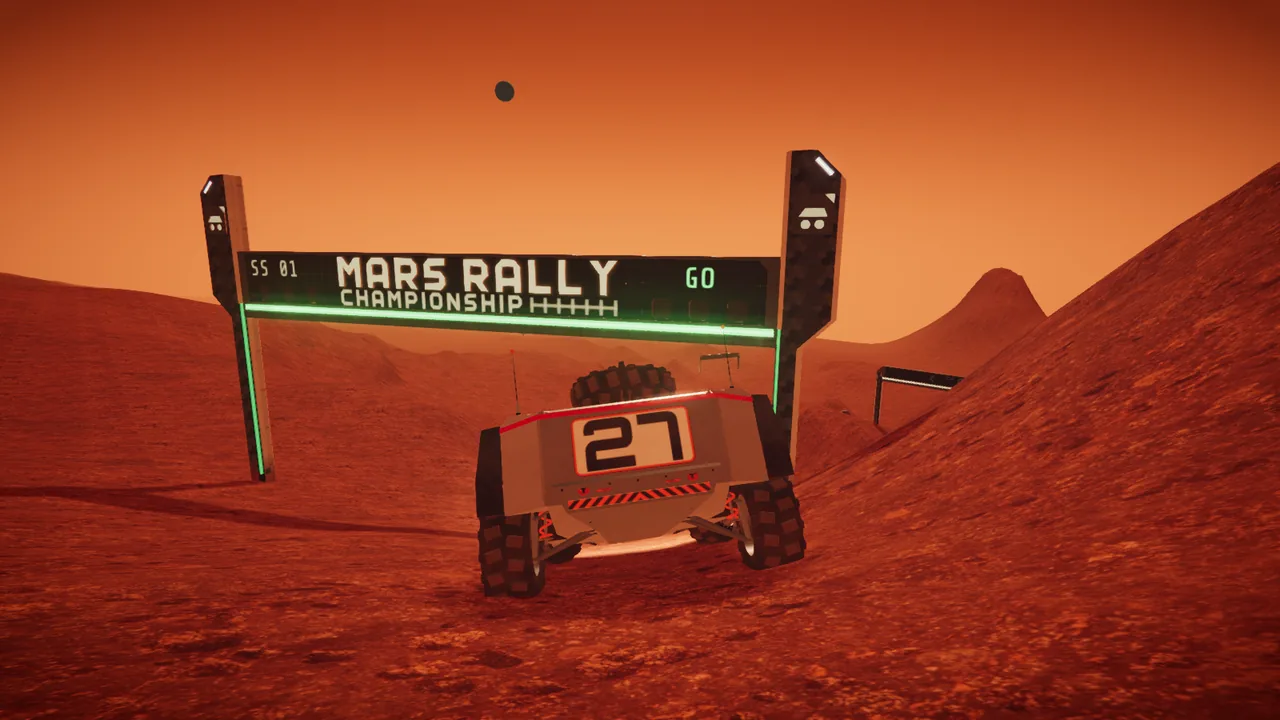
In-game screenshot: the rally rover, race number 27, rolling under the Stage 1 start arch, on terrain sculpted to Martian morphologies, not copied from a real place.
A pilot in a pressurized suit drives it from a carbon bucket seat inside a roll cage, and runs start in the HELMET camera by default, at the pilot's eyes, with the gloves on a squared-off carbon yoke that turns as you steer. One press of C, or B on a gamepad, switches to the CHASE view.
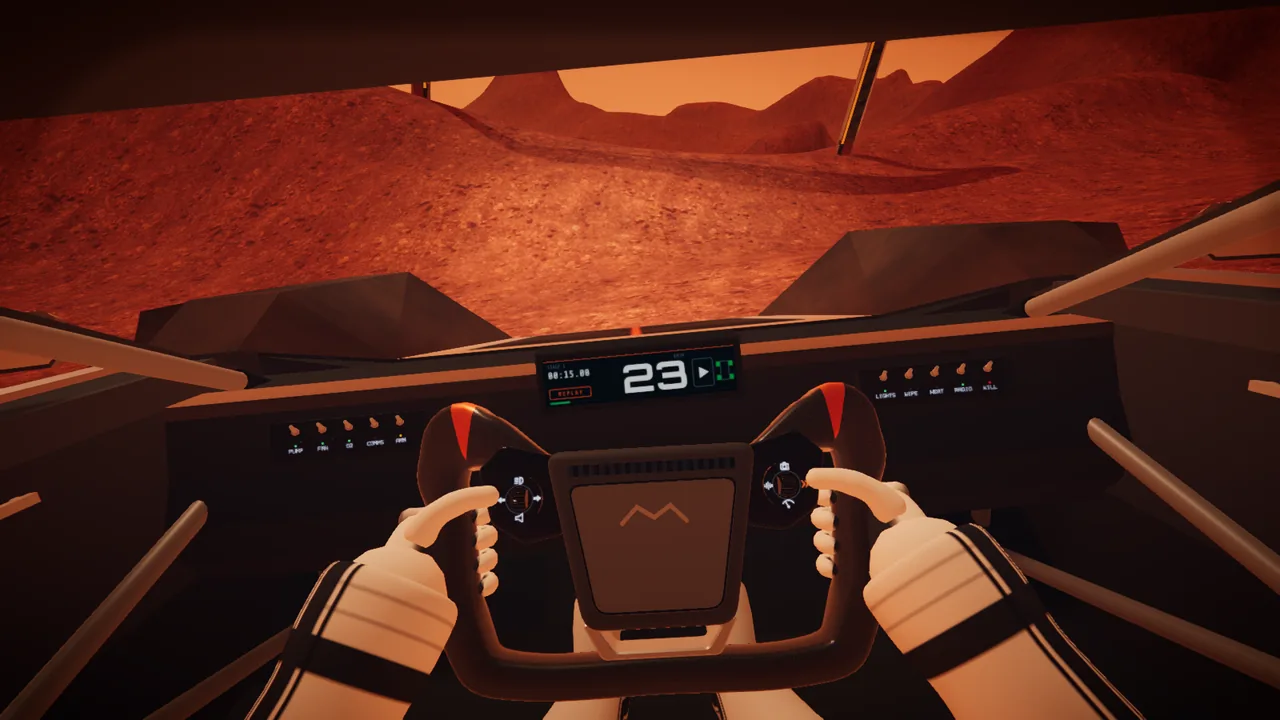
In-game screenshot: the default HELMET view out of the pressurized cabin, past the pilot's gloved hands on the yoke, from a driver's seat no real Mars rover has had.
The planet around it runs on real constants, 3.72 m/s² of gravity and air at 0.020 kg/m³, and the tyres get about 3.1 m/s² of grip on loose regolith, so a stop from 100 km/h takes about 125 metres and 9 seconds. The drive is electric, from a 90 kWh battery, with the motors derated because radiators barely work in air that thin, and a dust storm raises battery drain by 50%.
The game does not model a body to keep alive: no oxygen supply, no cabin leak, no cold, no radiation dose. Damage lands on the chassis, suspension, motor, battery and tyres. The terrain is sculpted to Martian morphologies rather than surveyed from a landing site, and two stages are open: Stage 1, The Opener, a 1,164-metre timed line, and Stage 2, The Long Run, at 2,306 metres.
Where to try this
- Free roam has no timer and no checkpoints: just the rover, the terrain and 15 cameras, cycled with C.
- Why the first car race on Mars would be a rally, and what its cars would need.
- Mars Rally Championship is free in a browser tab, with no download and no account, on a laptop, a school Chromebook or a phone held in landscape.